Thiamine Mitigates Nicotine Withdrawal Effects in Adolescent Male Rats: Modulation of Serotonin Metabolism, BDNF, Oxidative Stress, and Neuroinflammation
- PMID: 40780966
- PMCID: PMC12370353
- DOI: 10.1523/ENEURO.0140-25.2025
Thiamine Mitigates Nicotine Withdrawal Effects in Adolescent Male Rats: Modulation of Serotonin Metabolism, BDNF, Oxidative Stress, and Neuroinflammation
Abstract
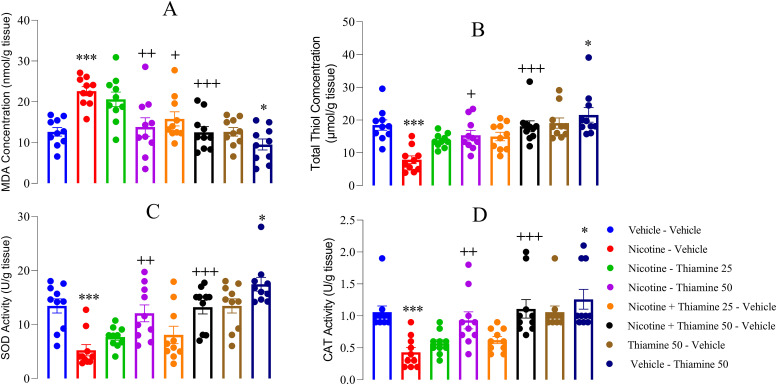
Adolescent nicotine use is particularly concerning due to increased susceptibility to long-term effects and dependence during this critical developmental period. This study investigates the therapeutic effects of thiamine on nicotine withdrawal-induced anxiety, anhedonia, and depression in rats. Adolescent rats received nicotine (2 mg/kg, s.c.) for 21 d, followed by 21 d of withdrawal. Thiamine (25 or 50 mg/kg, i.p.) was administered during exposure and withdrawal. Behavioral assessments were used to evaluate anxiety- and depressive-like symptoms, and biochemical analyses measured oxidative stress markers, serotonin levels, MAO activity, BDNF, and GFAP as indicators of neuroinflammation in the prefrontal cortex. Nicotine withdrawal significantly elevated anxiety-, depression-, and anhedonia-like behaviors, increased oxidative stress, and upregulated MAO-A activity and GFAP expression, indicating neuroinflammatory effects. Notably, thiamine administration during both nicotine exposure and withdrawal effectively alleviated these behavioral impairments, restored serotonin levels, reduced oxidative stress markers, and mitigated the increase in GFAP expression. Additionally, thiamine alone has been shown to alleviate anxiety- and depressive-like behaviors. This study highlights thiamine's potential as a promising intervention for managing psychological distress associated with nicotine withdrawal. Given the high prevalence of adolescent nicotine use and its associated mental health challenges, further research on thiamine's mechanisms and therapeutic potential is warranted to improve treatment strategies during this critical developmental stage.
Keywords: adolescence; anxiety; depression; neuroinflammation; nicotine withdrawal; oxidative stress.
Copyright © 2025 Haidary et al.
Conflict of interest statement
The authors declare no competing financial interests.
Figures



References
-
- Ahmadi-Soleimani SM, Amiry GY, Khordad E, Masoudi M, Beheshti F (2023) Omega-3 fatty acids prevent nicotine withdrawal-induced impairment of learning and memory via affecting oxidative status, inflammatory response, cholinergic activity, BDNF and amyloid-B in rat hippocampal tissues. Life Sci 332:122100. 10.1016/j.lfs.2023.122100 - DOI - PubMed
MeSH terms
Substances
LinkOut - more resources
Full Text Sources
Miscellaneous