


Investigating phubbing behaviors among university students: a latent profile analysis study
- PMID: 40781693
- PMCID: PMC12335047
- DOI: 10.1186/s40359-025-03212-y
Investigating phubbing behaviors among university students: a latent profile analysis study
Abstract
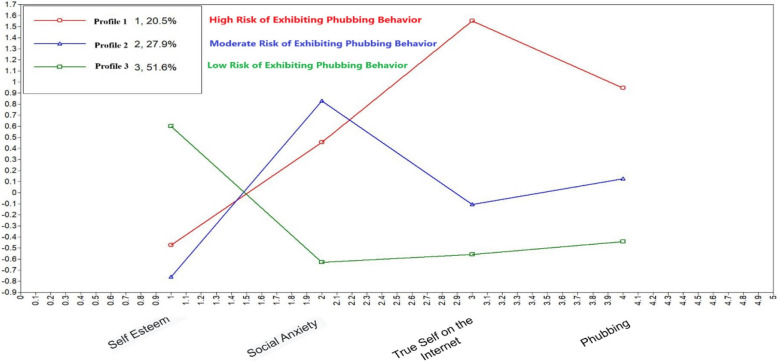
This study aims to identify the latent profiles of university students regarding phubbing behavior based on the relationships between self-esteem, social anxiety, perceived true self on the internet, and phubbing behaviors. University students require healthy identity development and fulfilling social relationships. Those who fail to meet these needs may resort to excessive and maladaptive smartphone use. A total of 550 students (67.6% female, 32.4% male), aged between 18 and 27 (Mean = 21.33, SD = 2.97), participated in the study. Data were collected using the General Phubbing Scale, the Interaction Anxiety Scale, the True Me on the Net Scale, and the Rosenberg Self-Esteem Scale. Latent profile analysis, one-way ANOVA, and logistic regression were employed in the analyses. The results revealed three distinct profiles based on phubbing risk: high, moderate, and low risk. According to the logistic regression analysis, self-esteem, social anxiety, perceived true self on the internet, and daily smartphone use were significant variables in determining phubbing risk groups. Individuals in the high-risk group were found to engage more frequently in digital interactions, whereas those in the low-risk group exhibited higher self-esteem and lower social anxiety. In summary, the findings of this study contribute to a better understanding of the psychosocial factors influencing phubbing behavior and offer valuable insights for future research on phubbing.
Keywords: Latent profile analysis; Phubbing behaviors; Self-esteem; Social anxiety; True self on the internet.
© 2025. The Author(s).
Conflict of interest statement
Declarations. Ethics approval and consent to participate: All procedures in this study involving human participants were conducted in accordance with the ethical standards of the 1975 Helsinki Declaration. Prior to data collection, ethical approval was obtained from the relevant Tokat Gaziosmanpaşa University Social and Human Ethics Committee (Date: 14/01/2025—Decision No: 01.25). Informed consent for participation was obtained before completion of the survey. Consent for publication: During data collection, no information was collected or processed to reveal the confidentiality of the participants. Competing interests: The authors declare no competing interests.
Figures
References
-
- Al-Saggaf Y, Hogg R. The effect of children’s phubbing on parents’ psychological wellbeing: a moderated mediation analysis. Hum Behav Emerg Technol. 2024;2024(1): 9719351.
-
- Amichai-Hamburger Y, Wainapel G, Fox S. On the Internet no one knows I’m an introvert": Extroversion, neuroticism, and Internet interaction. Cyberpsychol Behav. 2002;5(2):125–8. - PubMed
-
- Bargh JA, McKenna KY. The internet and social life. Annu Rev Psychol. 2004;55(1):573–90. - PubMed
-
- Bargh JA, McKenna KY, Fitzsimons GM. Can you see the true me? Activation and expression of the “true self” on the Internet. J Soc Issues. 2002;58(1):33–48.
MeSH terms
LinkOut - more resources
Full Text Sources
Medical
