


The association between urinary nitrate and prostate specific antigen without prostatic disease: a cohort study
- PMID: 40783521
- PMCID: PMC12335116
- DOI: 10.1186/s12894-025-01878-5
The association between urinary nitrate and prostate specific antigen without prostatic disease: a cohort study
Abstract
Purpose: The carcinogenic effects of nitrate reduction to nitrite are well established, and nitrate has been closely linked to various diseases. However, research on its effects on the urinary system remains limited, and its association with PSA remains unclear. This study aims to investigate the relationship between urinary nitrate and PSA.
Methods: We employed weighted generalized linear models, weighted univariate analysis, forest plots, weighted multivariable analysis, and generalized additive models (GAM) to investigate the relationship between urinary nitrate and PSA. Subgroup analyses were conducted to further validate the stability of this association across different groups. GAM was utilized to provide a more intuitive representation of the specific relationships between PSA and urinary nitrate.
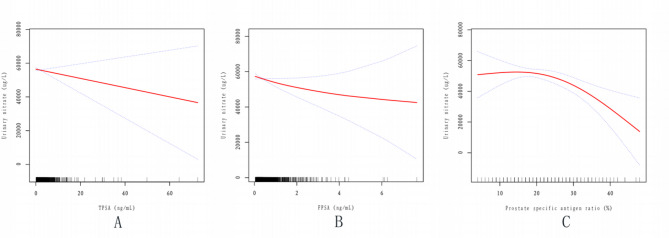
Results: TPSA, FPSA, and the prostate specific antigen ratio (%, 4 ng/mL ≤ TPSA ≤ 10 ng/mL) showed negative correlations with urinary nitrate. After adjusting for confounders, only the prostate-specific antigen ratio maintained a significant negative association (β = -632.7; 95% CI: -1094.9, -170.6; P = 0.011), while correlations with TPSA and FPSA were not statistically significant. A nonlinear relationship was observed, where urinary nitrate initially remained stable or changed minimally before gradually declining.
Conclusion: This study identifies a negative correlation between urinary nitrate and the prostate-specific antigen ratio in individuals with gray-zone TPSA. These findings enhance our understanding of urinary nitrate's impact and may help reduce overtreatment in this population.
Keywords: NHANES; PCa; PSA; Urinary nitrate.
© 2025. The Author(s).
Conflict of interest statement
Declarations. Ethics approval and consent to participate: The study was conducted by following the Declaration of Helsinki, and the National Center for Health Statistics institutional review board approved the overall NHANES. This study was approved by the Institutional Review Board and documented consent was obtained from participants. Clinical trial number: not applicable. Competing interests: The authors declare no competing interests. Informed consent: The survey protocol was approved by the Research Ethics Review Board of the National Center for Health Statistics ( https://www.cdc.gov/nchs/nhanes/ ), and NHANES has obtained written informed consent from all participants.
Figures
References
-
- Siegel RL, Miller KD, Fuchs HE, Jemal A. Cancer statistics, 2021. CA Cancer J Clin. 2021;71(1):7–33. - PubMed
-
- Force USPST, Grossman DC, Curry SJ, Owens DK, Bibbins-Domingo K, Caughey AB, Davidson KW, Doubeni CA, Ebell M, Epling JW, editors. Jr.: Screening for Prostate Cancer: US Preventive Services Task Force Recommendation Statement. JAMA 2018, 319(18):1901–1913. - PubMed
-
- Kristal AR, Chi C, Tangen CM, Goodman PJ, Etzioni R, Thompson IM. Associations of demographic and lifestyle characteristics with prostate-specific antigen (PSA) concentration and rate of PSA increase. Cancer. 2006;106(2):320–8. - PubMed
-
- Liu Z, Chen C, Yu F, Yuan D, Wang W, Jiao K, Yang S, Zhang Y, Wang Y, Liu L et al. Association of Total Dietary Intake of Sugars with Prostate-Specific Antigen (PSA) Concentrations: Evidence from the National Health and Nutrition Examination Survey (NHANES), 2003–2010. Biomed Res Int 2021, 2021:4140767. - PMC - PubMed
-
- Mouzannar A, Kuchakulla M, Blachman-Braun R, Nackeeran S, Becerra M, Nahar B, Punnen S, Ritch C, Parekh DJ, Gonzalgo ML. Impact of Plant-Based diet on PSA level: data from the National health and nutrition examination survey. Urology. 2021;156:205–10. - PubMed
MeSH terms
Substances
Grants and funding
LinkOut - more resources
Full Text Sources
Medical
Research Materials
Miscellaneous
