


Effect of Educational Intervention Based on Theory of Planned Behavior on Reducing Smoking and Hookah Use Among High School Male Students
- PMID: 40785589
- PMCID: PMC12336669
- DOI: 10.1111/crj.70119
Effect of Educational Intervention Based on Theory of Planned Behavior on Reducing Smoking and Hookah Use Among High School Male Students
Abstract
Background: Using smoking and hookah has increased among high school students in recent years. Therefore, the present study aimed to determine the effect of educational intervention based on the theory of planned behaviour (TPB) on reducing smoking and hookah use among high school students.
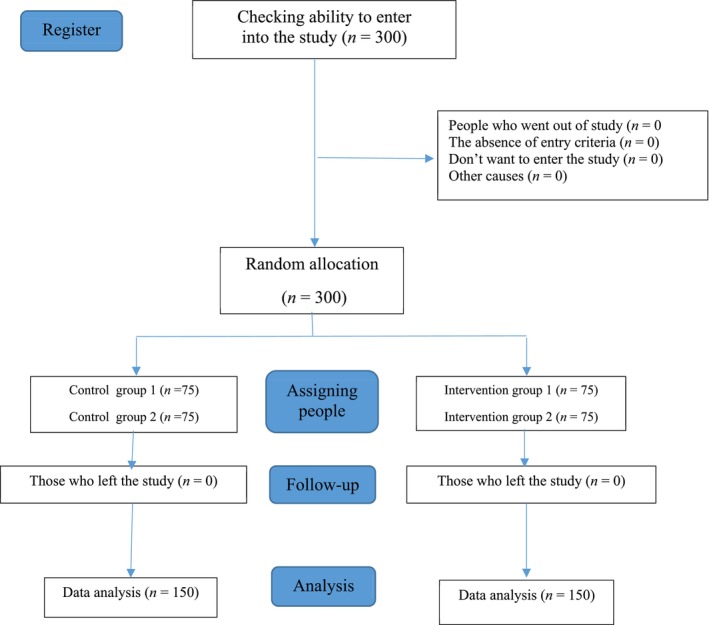
Methods: This experimental study was conducted on 300 high school male students in Fasa City, Fars Province, Iran, in 2021-2022. Subjects were selected using a simple sampling method and were randomly divided into intervention (n = 150) and control (n = 150) groups. The educational intervention for the experimental group included 7 sessions of 45-55 min using small group discussion, question and answer, practical demonstrations, video clips, PowerPoint, and booklets. Before the intervention and 3 months after the educational intervention, both experimental and control groups completed the questionnaire. Data were analyzed using SPSS 22 software through Chi-square, independent t-test, paired t-test, and McNemar test.
Results: The mean age of the experimental and control groups was 17.89 + 1.46 and 17.1 + 1.58 years. The results showed that before the educational intervention, there was no significant difference between the experimental and control groups in terms of awareness, attitude, subjective norms, perceived behavioral control, and behavioral intention; however, 4 months after the educational intervention, there was a significant increase in the experimental group. Also, before the educational intervention, there was no significant difference between the two groups in terms of current smoking and hookah use; however, 4 months after the intervention, there was a significant difference between the two groups.
Conclusion: Implementing the TPB-directed instructional sessions resulted in reducing smoking and hookah use among high school students.
Keywords: hookah; smoking; students; theory of planned behavior (TPB).
© 2025 The Author(s). The Clinical Respiratory Journal published by John Wiley & Sons Ltd.
Conflict of interest statement
The authors declare no conflicts of interest.
References
-
- Bracken‐Clarke D., Kapoor D., Baird A. M., et al., “Vaping and Lung Cancer–A Review of Current Data and Recommendations,” Lung Cancer 153 (2021): 11–20. - PubMed
-
- Hojjati H., Aloustani S., Akhondzadeh G., Heidari B., and Sharifnia H., “Study of Mental Health and Its Relation With Quality of Life in Addicts,” (2010).
-
- Barfi M., Miri M. R., Ramazani A. A., and Norozi E., “The Effect of Education Based on the Theory of Planned Behavior in Smoking,” Journal of Birjand University of Medical Sciences 25, no. 1 (2018): 42–51.
-
- Bashirian S., Hidarnia A., Allahverdipour H., and Hajizadeh E., “Application of the Theory of Planned Behavior to Predict Drug Abuse Related Behaviors Among Adolescents,” (2012). - PubMed
Publication types
MeSH terms
LinkOut - more resources
Full Text Sources
Medical
