


The effect of sandblasting distances on the shear bond strength of a self-etch and total-etch adhesive system to cervical dentin in the gingival wall of Class II restorations
- PMID: 40786500
- PMCID: PMC12334089
- DOI: 10.4103/drj.drj_398_24
The effect of sandblasting distances on the shear bond strength of a self-etch and total-etch adhesive system to cervical dentin in the gingival wall of Class II restorations
Abstract
Background: This study aimed to examine the effect of sandblasting on the shear bond strength (SBS) of two adhesive systems on cervical dentin in the gingival wall of Class II restorations at two different distances.
Materials and methods: In this in vitro study, 88 intact premolars were used. After creating a natural smear layer, samples were divided into self-etch (CLEARFIL LINER BOND F) and total-etch (Adper Single Bond 2) groups (n = 44). Each group was subdivided into subgroups (n = 22) for sandblasting at 5 mm or 10 mm, with the contralateral half as control. Following sandblasting (50-μm particles, 2 bar, 2 s), the resin composite was bonded to the dentin surface, with the SBS of the samples measured using a universal testing machine. The samples were examined using a scanning electron microscope (SEM) and analyzed by an energy dispersive X-Ray (EDX). The results were analyzed using three-way repeated measures analysis of variance and Chi-square tests (α = 0.05).
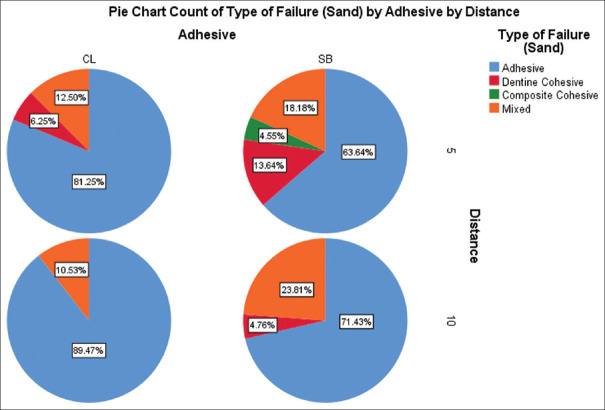
Results: Sandblasting significantly reduced the SBS in both adhesive groups (P < 0.001). However, the adhesive system and distance did not significantly affect the bond strength (P > 0.05). The SEM images displayed the formation of irregularities in the smear layer, and EDX analysis revealed the presence of residual alumina particles on the blasted dentin samples.
Conclusion: Cervical dentine sandblasting reduced the adhesive SBS regardless of the 5- or 10-mm distance or the adhesive system used. Thus, sandblasting is not recommended as a method of dentin preparation before restoring cervical lesions.
Keywords: Air abrasion; dental; dental bonding; dental cavity preparation; dental restoration; permanent.
Copyright: © 2025 Dental Research Journal.
Conflict of interest statement
The authors of this manuscript declare that they have no conflicts of interest, real or perceived, financial or nonfinancial in this article.
Figures




References
-
- Kirmali O, Barutcugil C, Harorli O, Kapdan A, Er K. Resin cement to indirect composite resin bonding:Effect of various surface treatments. Scanning. 2015;37:89–94. - PubMed
-
- Leinfelder KF, Terry DA. Indirect composite resin systems:A clinical material review. Inside Dent Texas. 2006;2:1–8.
-
- Van Meerbeek B, De Munck J, Yoshida Y, Inoue S, Vargas M, Vijay P, et al. Adhesion to enamel and dentin:Current status and future challenges. Oper Dent Univ Washington. 2003;28:215–35. - PubMed
LinkOut - more resources
Full Text Sources