


Establishment of a TaqMan qPCR method with MGB probe for the specific detection of BVDV field strains circulating in China
- PMID: 40786977
- PMCID: PMC12332510
- DOI: 10.3389/fvets.2025.1634429
Establishment of a TaqMan qPCR method with MGB probe for the specific detection of BVDV field strains circulating in China
Abstract
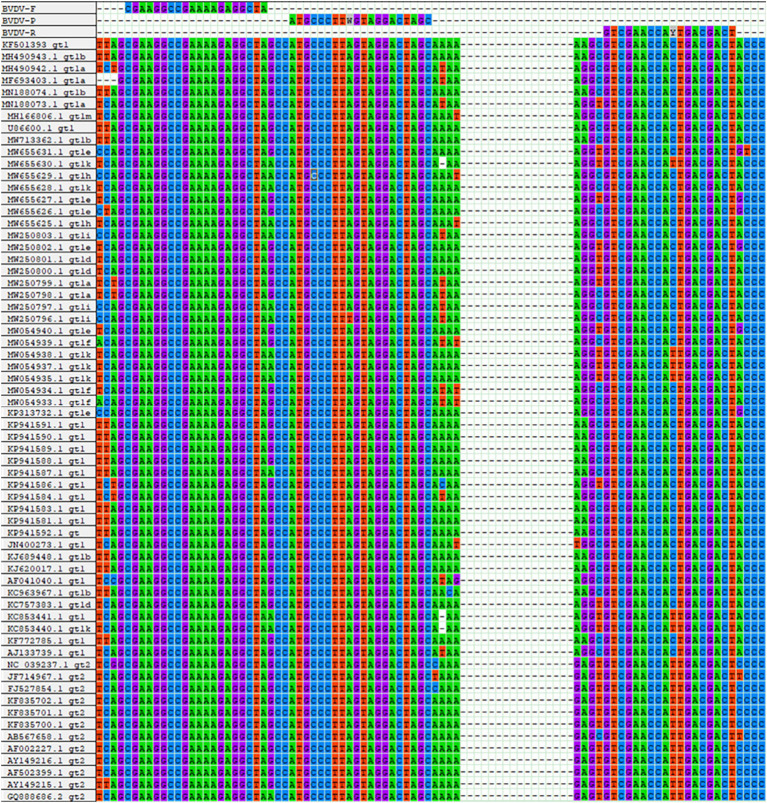
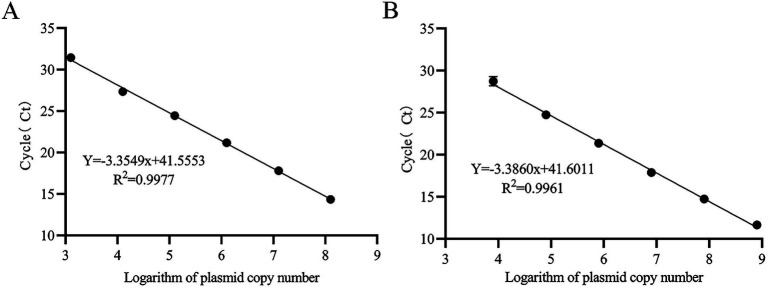
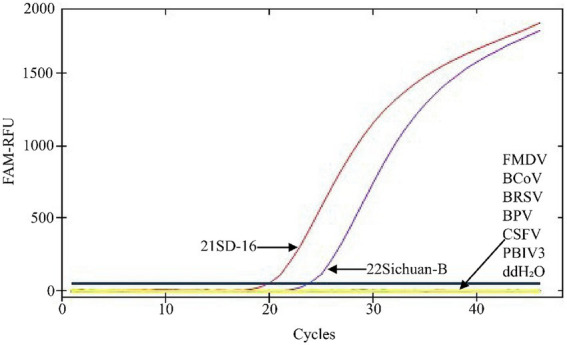
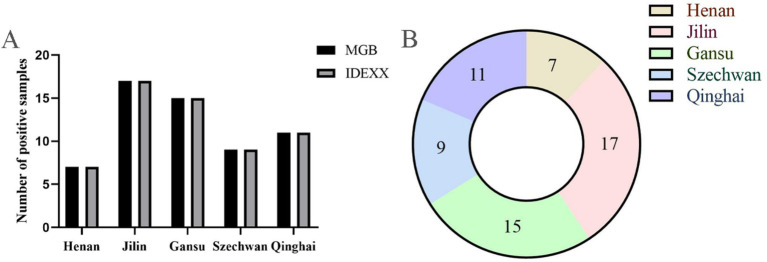
Bovine viral diarrhea virus (BVDV), a highly mutable pathogen, poses a significant threat to the cattle industry in China. Therefore, the development of a rapid, sensitive, and specific diagnostic assay is essential for effective surveillance and control. In this study, a TaqMan real-time quantitative PCR (qPCR) assay utilizing a minor groove binder (MGB) probe was developed for the detection of BVDV, with a focus on strains currently circulating in China. Universal primers and an MGB probe targeting the conserved 5' untranslated region (5'UTR) of both BVDV-1 and BVDV-2 were designed based on complete genome sequences available in GenBank. Following optimization of the reaction conditions, the assay demonstrated a detection limit of 1.265 copies/μL using a plasmid standard. The method exhibited high specificity for BVDV-1 and BVDV-2, with no cross reactivity observed with other common bovine pathogens. Intra- and inter-assay coefficients of variation were below 1.5%, indicating excellent repeatability and reproducibility. When applied to field serum samples collected from free-range cattle in various regions of China, the assay achieved a 100% concordance rate with a commercial reference kit (IDEXX RealPCR™ BVDV RNA Test). These results suggest that the established TaqMan MGB qPCR assay is a reliable and efficient tool for the detection and epidemiological investigation of BVDV-1 and BVDV-2 infections in cattle herds across China.
Keywords: BVDV-1; BVDV-2; TaqMan MGB qPCR; clinical diagnosis; epidemiological investigation.
Copyright © 2025 An, Ren, Zhang, Zhang and Zhao.
Conflict of interest statement
The authors declare that the research was conducted in the absence of any commercial or financial relationships that could be construed as potential conflicts of interest.
Figures
References
-
- Riaz R, Zahid S, Khan MS. Designing an epitope-based vaccine against bovine viral diarrhea using immuno-informatics. Pak Vet J. (2024) 44:465–75. doi: 10.29261/pakvetj/2024.162 - DOI
-
- Oğuz FE, Babaoğlu AR, Türkan F, Oğuz E, Demirel AF, Paçal N. Investigation of interleukins and oxidative stress parameters in cows naturally infected with bovine viral diarrhea virus. Pak Vet J. (2024) 44:924–30. doi: 10.29261/pakvetj/2024.256 - DOI
LinkOut - more resources
Full Text Sources
