


Dandy-Walker spectrum with bilateral optic atrophy and seizure disorder: a case report and literature review
- PMID: 40787522
- PMCID: PMC12333820
- DOI: 10.1097/MS9.0000000000003554
Dandy-Walker spectrum with bilateral optic atrophy and seizure disorder: a case report and literature review
Abstract
Introduction and importance: Dandy-Walker syndrome (DWS) is a rare congenital posterior fossa malformation, affecting 1 in 25 000-30 000 live births. Prenatal diagnosis is possible via ultrasound and MRI. This case highlights a rare Dandy-Walker variant with bilateral optic atrophy and status epilepticus, emphasizing the need for awareness of progressive neurological and visual impairment in Dandy-Walker spectrum disorders. The case adds to the evolving knowledge on the diverse phenotypic presentations of the Dandy-Walker variant, particularly in resource-limited settings where diagnostic and therapeutic interventions may be constrained.
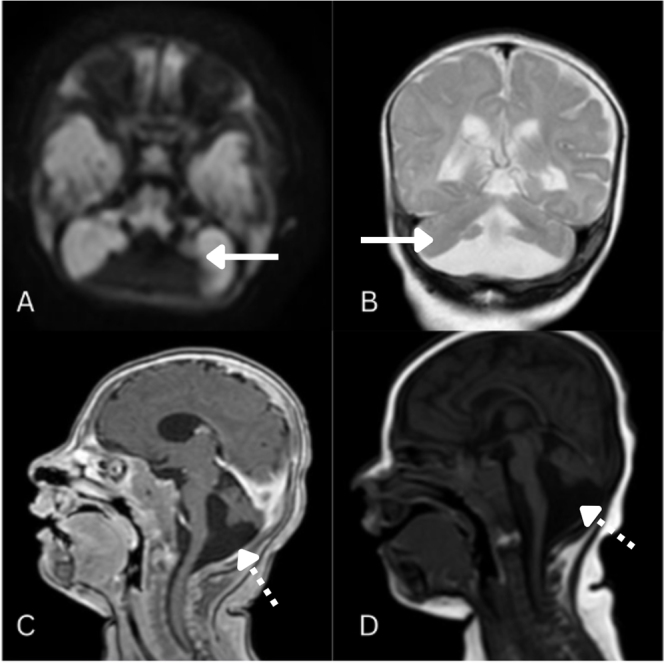
Case presentation: A 27-month-old female with recurrent seizures since infancy presented with generalized tonic-clonic movements, ocular deviation, and frothing, lasting 2 h. Examination revealed fever, tachycardia, tachypnea, and hypertonia. MRI at 5 months confirmed Dandy-Walker spectrum disorder with cerebellar vermis hypoplasia, a posterior fossa cyst, and fourth ventricle malformation. Electroencephalogram at 14 months showed diffuse encephalopathy with multifocal seizures, and fundoscopy revealed bilateral optic atrophy. TORCH (toxoplasmosis, rubella cytomegalovirus, herpes simplex, and HIV) screening was unremarkable. Despite antiseizure therapy with levetiracetam and phenytoin, persistent seizures required pediatric intensive care unit admission. Valproate (15 mg/kg/day, titrated to 20 mg/kg/day) achieved seizure control.
Clinical discussion: This case underscores the complexity of Dandy-Walker spectrum disorder with status epilepticus in a 27-month-old female. No infectious source was identified, and lumbar puncture was declined. Seizure control required escalation of antiseizure therapy. Long-term neurodevelopmental, genetic, and neurometabolic evaluation is crucial for comprehensive management.
Conclusion: This case highlights the need for long-term neurodevelopmental, genetic, and neurometabolic evaluation for comprehensive management.
Keywords: Dandy–Walker spectrum; case report; optic atrophy; seizure disorder.
Copyright © 2025 The Author(s). Published by Wolters Kluwer Health, Inc.
Conflict of interest statement
Sponsorships or competing interests that may be relevant to content are disclosed at the end of this article. None.
Figures
References
-
- Barkovich AJ, Millen KJ, Dobyns WB. A developmental classification of malformations of the brainstem. Ann Neurol 2007;62:625–39. - PubMed
-
- Correa GG, Amaral LF, Vedolin LM. Neuroimaging of Dandy-Walker malformation: new concepts. Top Magn Reson Imaging 2011;22:303–12. - PubMed
-
- Riley DS, Barber MS, Kienle GS, et al. CARE guidelines for case reports: explanation and elaboration document. J Clin Epidemiol 2017;89:218–35. - PubMed
-
- Spennato P, Mirone G, Nastro A, et al. Hydrocephalus in Dandy-Walker malformation. Childs Nerv Syst 2011;27:1665–81. - PubMed
Publication types
LinkOut - more resources
Full Text Sources