


System dynamics modeling in support of community-based decision-making to reduce opioid overdose fatalities
- PMID: 40791632
- PMCID: PMC12336117
- DOI: 10.3389/fpubh.2025.1616032
System dynamics modeling in support of community-based decision-making to reduce opioid overdose fatalities
Abstract
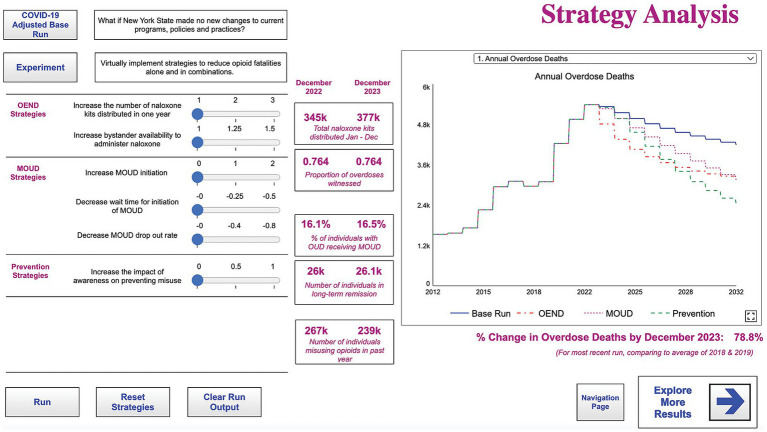
Both New York State (NYS) and the United States have experienced heightened levels of opioid overdose death and prevalence of opioid use in recent decades. While evidence-based practices (EBPs) to address opioid use and prevent overdose fatalities exist, their reach in many communities remains limited. Persistent systems-level barriers must be overcome to support and sustain effective EBP implementation. This paper describes the Systems Think Tank (STT), a community-engaged approach that promoted the use of systems thinking skills and system dynamics (SD) modeling for the purpose of local action planning and decision-making to select, employ, and monitor community-based strategies to prevent opioid overdose fatalities. A core modeling team launched the STT in support of the New York site of the HEALing Communities Study (NY HCS), a multi-site implementation research study funded by the HEAL Initiative. The modeling team worked collaboratively with purposively recruited NY HCS community coalitions located in counties across NYS. With the assistance of the modeling team, coalitions and their implementation teams explored SD modeling results and conducted strategy analyses using a web-based interface to simulate the local implementation of specific EBPs and inform action and sustainability planning. To describe the implementation of the STT, we reflect on our experiences with two NY HCS community coalitions and their implementation teams through two case studies. These case studies describe how SD modeling and systems thinking activities supported NY HCS coalitions during the CTH intervention by generating unique data and insights to inform coalition decision-making. We found that participation in the STT helped coalitions clarify the drivers of opioid overdose within their counties and identify potential effective strategies to mitigate overdose fatalities in the near future and long-term. The narratives presented in this paper may be useful for those incorporating SD modeling and systems thinking into community-engaged implementation research.
Keywords: community-engaged research; implementation science; opioid use disorder; system dynamics modeling; systems thinking.
Copyright © 2025 Canty, Lootens, Sabounchi, Thompson, Ganguly, Dsouza, Kilburn, Beloch, Hirsch, Huang, El-Bassel and Lounsbury.
Conflict of interest statement
The authors declare that the research was conducted in the absence of any commercial or financial relationships that could be construed as a potential conflict of interest. The author(s) declared that they were an editorial board member of Frontiers, at the time of submission. This had no impact on the peer review process and the final decision.
Figures


References
MeSH terms
LinkOut - more resources
Full Text Sources
Medical
