


Vascular risk factors and neuroimaging heterogeneity across different white matter hyperintensities distribution patterns
- PMID: 40792178
- PMCID: PMC12336115
- DOI: 10.3389/fnhum.2025.1633355
Vascular risk factors and neuroimaging heterogeneity across different white matter hyperintensities distribution patterns
Abstract
Background: Different white matter hyperintensities (WMHs) distribution patterns exhibit distinct clinical implications, but their underlying mechanisms remain unclear. This study explores vascular risk factors and neuroimaging features to elucidate their heterogeneity.
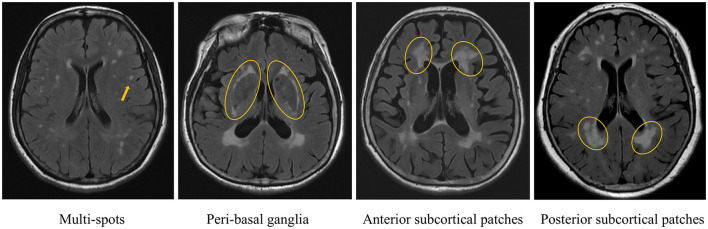
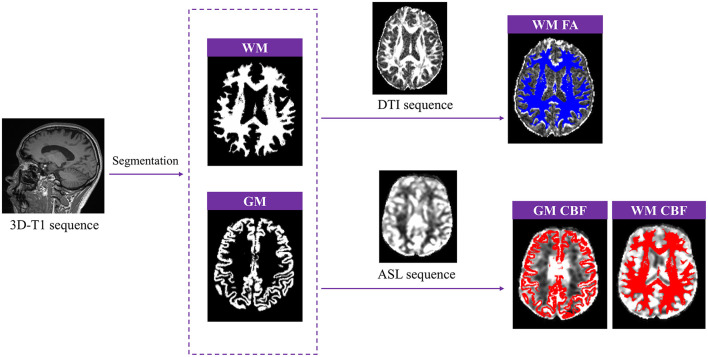
Methods: We retrospectively analyzed WMHs patients who underwent multimodal MRI at Zhejiang Hospital. Neuroimaging features included gray matter volume, white matter microstructure (Fractional anisotropy, FA), and cerebral blood flow (CBF) were assessed. Vascular risk factors and imaging features were compared across four different WMHs distribution patterns [multi-spots, peri-basal ganglia, anterior subcortical (SC) patches, and posterior SC patches]. Mediation analysis was performed to explore the role of imaging features on WMHs related cognitive impairment.
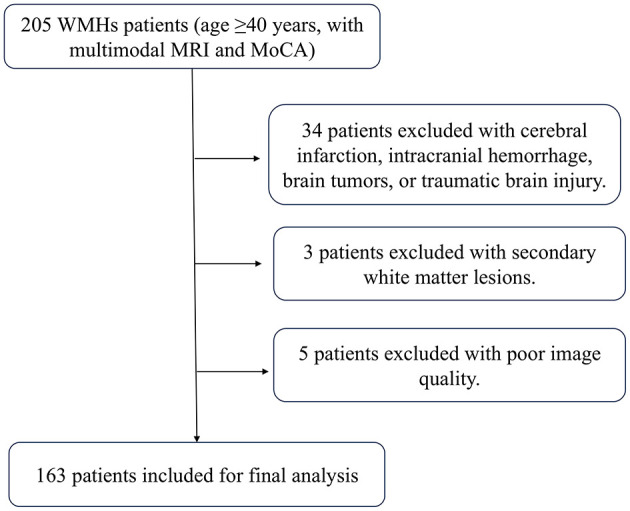
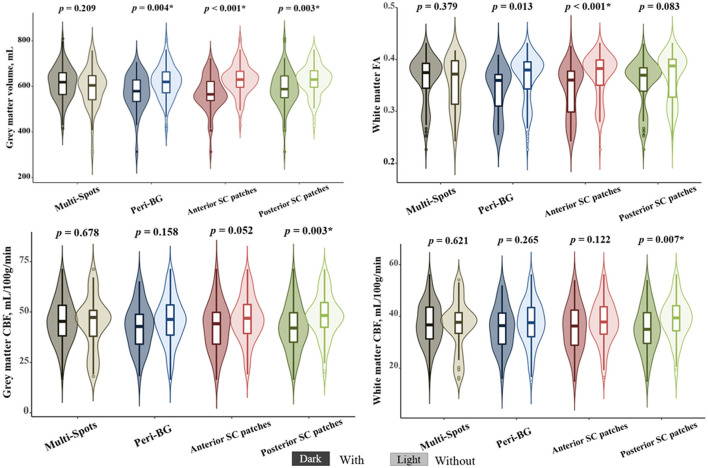
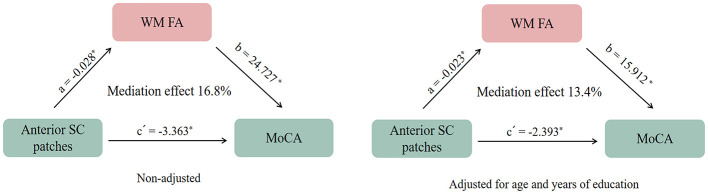
Results: A total of 163 patients were included in the final analysis. Among the four WMHs distribution patterns, hypertension was significantly more prevalent in patients with anterior SC patches [48 [85.7%] vs. 71 [66.4%], p = 0.008]. All WMH distribution patterns except multi-spots exhibited reduced gray matter volume (Bonferroni p < 0.0125). Notably, only patients with anterior SC patches exhibited a reduction in white matter FA (0.342 ± 0.049 vs. 0.370 ± 0.043, p < 0.001). Furthermore, patients with posterior SC patches displayed significantly lower CBF in both gray matter (42.65 ± 11.76 vs. 48.02 ± 10.97, p = 0.003) and white matter (35.25 ± 8.81 vs. 38.86 ± 8.07, p = 0.007). Mediation analysis revealed that white matter microstructural injury mediated the association between anterior SC patches WMHs and cognitive impairment [β = -0.371, Bootstrap 95% CI [-0.939, -0.006]].
Conclusion: This study demonstrates heterogeneity in vascular risk factors, gray matter volume, microstructural injury, and hypoperfusion across different WMHs patterns, underscoring the importance of subtype-specific mechanistic and therapeutic research.
Keywords: cerebral blood flow; cognitive impairment; heterogeneity; vascular risk factors; white matter hyperintensities; white matter microstructural injury.
Copyright © 2025 Wang, Zhuang, Fu, Mo, Zhai, Xu and Mou.
Conflict of interest statement
The authors declare that the research was conducted in the absence of any commercial or financial relationships that could be construed as a potential conflict of interest.
Figures
References
-
- Chang E., Argyelan M., Aggarwal M., Chandon T., Karlsgodt K., Mori S., et al. (2017). The role of myelination in measures of white matter integrity: combination of diffusion tensor imaging and two-photon microscopy of CLARITY intact brains. Neuroimage 147, 253–261. 10.1016/j.neuroimage.2016.11.068 - DOI - PMC - PubMed
-
- Combes A., O'Grady K., Rogers B., Schilling K., Lawless R., Visagie M., et al. (2022). Functional connectivity in the dorsal network of the cervical spinal cord is correlated with diffusion tensor imaging indices in relapsing-remitting multiple sclerosis. Neuroimage Clin. 35:103127. 10.1016/j.nicl.2022.103127 - DOI - PMC - PubMed
LinkOut - more resources
Full Text Sources
