


The effects of household water, sanitation, and hygiene on early childhood education enrollment: evidence from the 2022 Bangladesh demographic and health survey
- PMID: 40796821
- PMCID: PMC12341152
- DOI: 10.1186/s12889-025-23968-7
The effects of household water, sanitation, and hygiene on early childhood education enrollment: evidence from the 2022 Bangladesh demographic and health survey
Abstract
Background: Effective early childhood education (ECE) programs, including elementary schools, kindergartens, and daycare facilities, are instrumental in fostering cognitive, social, emotional, and motor development. Access to water, sanitation, and hygiene (WASH) facilities, as mandated by Sustainable Development Goals (SDGs) 6, is integral in bolstering health and enhancing educational engagement globally. This study examines the impact of WASH facilities and sociodemographic factors on ECE enrollment in Bangladesh.
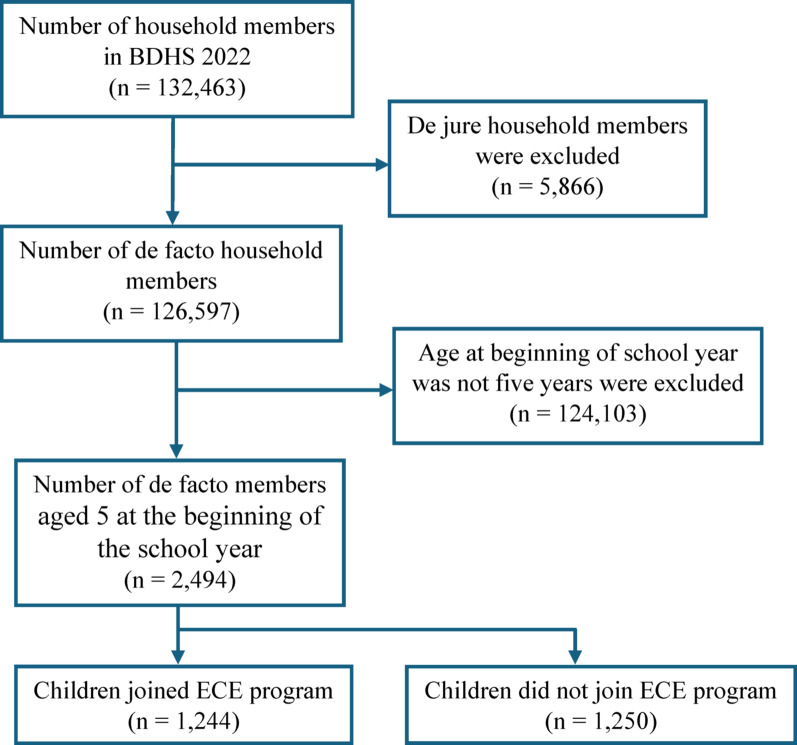
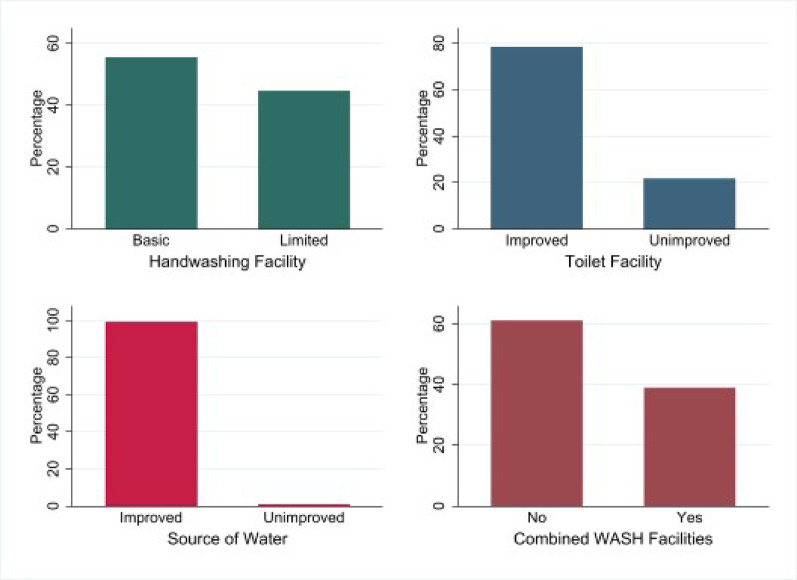
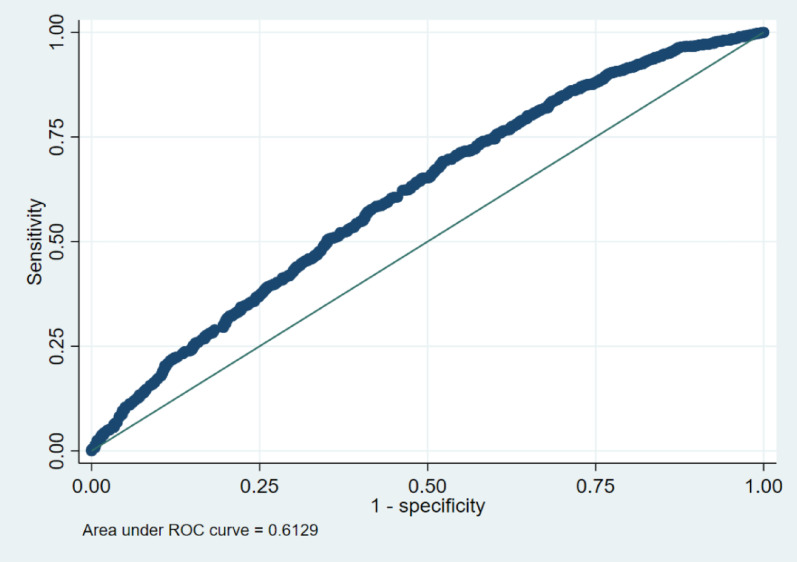
Methods: Data were extracted from the 2022 Bangladesh Demographic and Health Survey (BDHS), on which 2494 children's information and socioeconomic characteristics were analyzed. The outcome variable was ECE enrollment, and the exposure variable was WASH facilities-defined as having an improved water source, an improved nonshared toilet, and a basic handwashing facility-at the household level. Crude and adjusted logistic regression models were applied to determine significant associations between ECE enrollment and WASH facilities, including other covariates.
Results: Children from households with basic handwashing facilities presented greater odds of ECE enrollment (AOR = 1.33, 95% CI 1.00-1.76, p value = 0.043), whereas improved toilet facilities were correlated with a greater chance of participation (AOR = 1.24, 95% CI 0.97-1.59, p value = 0.085). Treating drinking water significantly increased the probability of enrollment (AOR = 1.55, 95% CI 1.15-2.90, p value = 0.004). Regional disparities were mentionable; children in Rangpur (AOR = 1.94, 95% CI 1.33-2.81, p value = 0.001), Rajshahi (AOR = 1.47, 95% CI 1.01-2.13, p value = 0.043), Mymensingh (AOR = 1.39, 95% CI 0.97-1.99, p value = 0.096), and Khulna (AOR = 1.34, 95% CI 0.93-1.94, p value = 0.116) had higher odds of enrollment than Barishal did. Mothers' education is also a key determinant; children of mothers with secondary education were 40% more likely to enroll (AOR = 1.40, 95% CI 1.00-1.96, p value = 0.049), and those with higher-educated mothers exhibited a similar trend (AOR = 1.43, 95% CI 0.95-2.16, p value = 0.088) compared with children of mothers with no education.
Conclusions: Our findings highlight the significance of household access to water, sanitation, and hygiene (WASH) facilities in early childhood education enrollment in Bangladesh. To advance progress toward SDGs 4 (quality education) and 6 (clean water and sanitation), policymakers should prioritize well-established WASH facilities, maternal education programs, and region-specific strategies.
Keywords: BDHS; Bangladesh; Early childhood education enrollment; Hygiene; Regional disparities; Sanitation; Sustainable development goals; Water.
© 2025. The Author(s).
Conflict of interest statement
Declarations. Ethics approval and consent to participate: Not applicable, as the data used in this study are publicly available. Consent for publication: Not applicable. Clinical trial number: Not applicable. Competing interests: The authors declare no competing interests.
Figures
References
-
- Rashid R, Akkari A. A review of early childhood education (ECE) in Bangladesh: status and impact. Int J Educ. 2020;12(1):59. 10.5296/ije.v12i1.16150
-
- UNICEF. SDG Goal 4: Quality Education [Internet]. UNICEF DATA. 2025. Available from: https://data.unicef.org/sdgs/goal-4-quality-education/
-
- Akbari E, McCuaig K, Mehta S. Early childhood education report 2023. University of Toronto: Ontario Institute for Studies in Education; 2024. Available from: https://ecereport.ca/media/uploads/2023-overview/ecer_2023_overview-en.pdf
-
- Haque MN, Nasrin S, Yesmin MN, Biswas MHA. Universal pre-primary education: a comparative study. Am J Educ Res. 2013;1(1):31–6. Available from: https://pubs.sciepub.com/education/1/1/7/index.html
-
- UNESCO. Early Childhood Education and Care [Internet]. 2021. Available from: https://education.ec.europa.eu/document/early-childhood-education-and-care
MeSH terms
LinkOut - more resources
Full Text Sources
