


Universal public health insurance for Afghan refugees in Iran: a contextual analysis
- PMID: 40796851
- PMCID: PMC12345101
- DOI: 10.1186/s12992-025-01143-2
Universal public health insurance for Afghan refugees in Iran: a contextual analysis
Abstract
Background: The right to health for all individuals, including refugees, is recognized as one of the most fundamental human rights. However, refugees continue to face numerous barriers in accessing healthcare services. Iran has not yet achieved full coverage despite implementing a health insurance scheme for refugees. Therefore, this study aims to identify the contextual factors influencing the basic universal health insurance program for Afghan refugees in Iran using the PESTEL framework.
Methods: This qualitative study was conducted between October 2024 and March 2025. Data were collected through semi-structured interviews with 22 key individuals, including managers and experts from the Health Insurance Organization, the Bureau for Aliens and Foreign Immigrants Affairs (BAFIA), the United Nations High Commissioner for Refugees (UNHCR), refugee researchers, educated Afghan refugees, and healthcare service providers. Participants were selected through purposive sampling. Data analysis was conducted using framework analysis based on the PESTEL framework. MAXQDA 20 software was used to assist with data management and analysis.
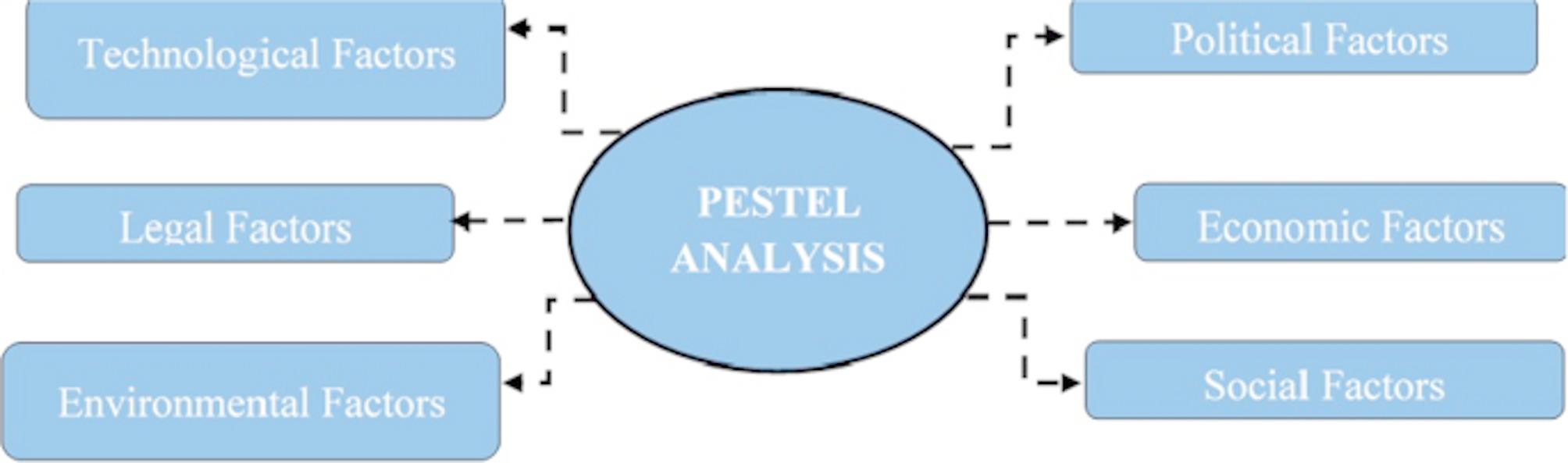
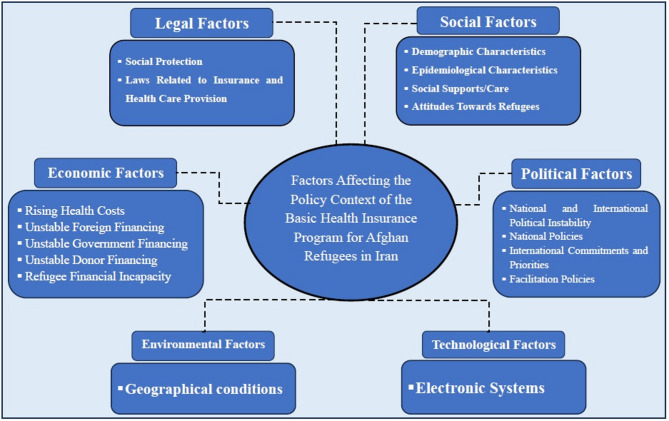
Results: The contextual determinants of the universal public health insurance policy for Afghan refugees in Iran were 61 factors that were categorized into six main themes and 17 sub-themes. The main themes identified in this study included political (four factors), economic (five factors), legal and regulatory (two factors), sociocultural (four factors), technological (one factor), and environmental factors (one factor).
Conclusion: Findings from this study, based on the PESTEL framework, revealed that the refugee health insurance policy in Iran is influenced by a range of political, economic, social, technological, legal, and environmental factors. To improve insurance coverage among refugees, policymakers-particularly senior health system managers-can create an enabling environment for equitable and sustainable access to healthcare services by strengthening information infrastructures, reforming financial and legal mechanisms, and enhancing intersectoral and international collaboration.
Clinical trial number: Not applicable.
Keywords: Health insurance; Health policy; Iran; Refugees; Universal public health insurance.
© 2025. The Author(s).
Conflict of interest statement
Declarations. Ethics approval and consent to participate: The study was conducted in accordance with the ethical standards of the Declaration of Helsinki and was approved by the Research Ethics Committee of Isfahan University of Medical Sciences (ethical code: IR.MUI.NUREMA.REC.1402.153). In order to comply with the ethical issues in this study, informed consent was obtained from the participants, and individuals have the right to withdraw and leave the study at any time they want. In addition, the objectives of the study will be explained to the participants at the beginning. Competing interests: The authors declare no competing interests.
Figures
Similar articles
-
Prescription of Controlled Substances: Benefits and Risks.2025 Jul 6. In: StatPearls [Internet]. Treasure Island (FL): StatPearls Publishing; 2025 Jan–. 2025 Jul 6. In: StatPearls [Internet]. Treasure Island (FL): StatPearls Publishing; 2025 Jan–. PMID: 30726003 Free Books & Documents.
-
Health equity and system resilience during crises - ensuring healthcare for refugees based on lessons from Iran's response to the 2021 Afghan migration.Int J Equity Health. 2025 Jul 1;24(1):191. doi: 10.1186/s12939-025-02564-6. Int J Equity Health. 2025. PMID: 40598462 Free PMC article.
-
Accreditation through the eyes of nurse managers: an infinite staircase or a phenomenon that evaporates like water.J Health Organ Manag. 2025 Jun 30. doi: 10.1108/JHOM-01-2025-0029. Online ahead of print. J Health Organ Manag. 2025. PMID: 40574247
-
Gender differences in the context of interventions for improving health literacy in migrants: a qualitative evidence synthesis.Cochrane Database Syst Rev. 2024 Dec 12;12(12):CD013302. doi: 10.1002/14651858.CD013302.pub2. Cochrane Database Syst Rev. 2024. PMID: 39665382
-
Stakeholders' perceptions and experiences of factors influencing the commissioning, delivery, and uptake of general health checks: a qualitative evidence synthesis.Cochrane Database Syst Rev. 2025 Mar 20;3(3):CD014796. doi: 10.1002/14651858.CD014796.pub2. Cochrane Database Syst Rev. 2025. PMID: 40110911
References
-
- Europe W. Roadmap to implemente the 2030 on agenda for sustainable development, Building on health 2020, the European policy for health and well-being. In. Geneva: WHO. 2017.
LinkOut - more resources
Full Text Sources
