


Risk factors for and prognosis of postoperative cardiac events in older patients with hip fractures: a retrospective cohort study
- PMID: 40797332
- PMCID: PMC12344940
- DOI: 10.1186/s13018-025-06175-3
Risk factors for and prognosis of postoperative cardiac events in older patients with hip fractures: a retrospective cohort study
Abstract
Background: Postoperative cardiac events (PCEs) are life threatening in older patients undergoing hip fracture surgery. This study aimed to investigate the risk factors for PCEs in these patients and to evaluate the impact of PCEs on all-cause mortality after surgery.
Methods: A retrospective review was performed of consecutive patients who underwent surgery for hip fractures at the Seventh Medical Center, Chinese PLA General Hospital, from January 2012 to December 2020. The patients were divided into a PCE group and a non-PCE group according to whether they experienced PCEs. Univariate and multivariate logistic regression analyses were employed to investigate the independent risk factors for PCEs. Kaplan‒Meier curves and log-rank tests were used to compare the cumulative mortality between the two groups, and a Cox proportional hazards regression model was used to estimate risk factors for mortality.
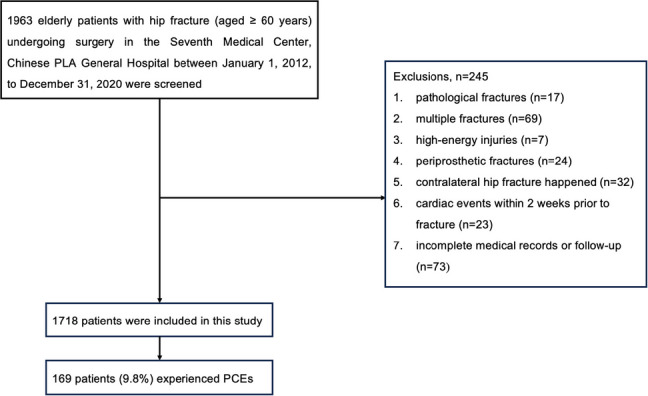
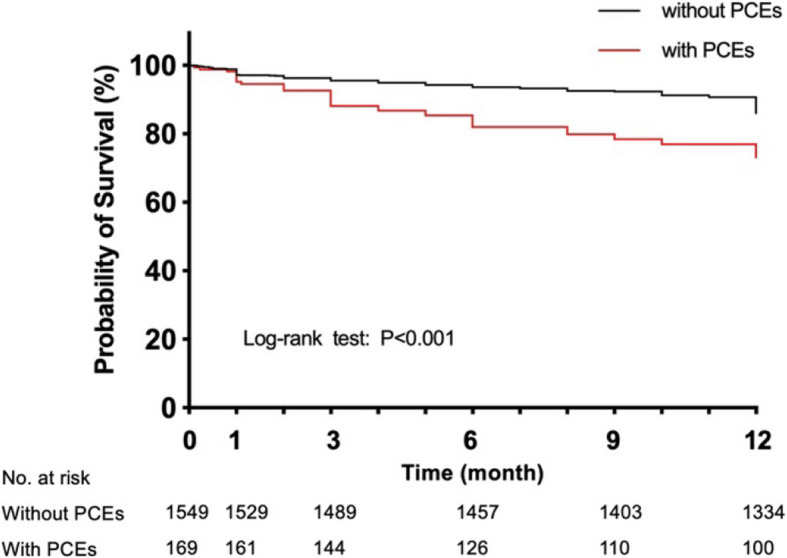
Results: We recruited 1718 patients, 169 of whom (9.8%) had experienced PCEs. Acute heart failure (66.9%, 113/169) was the most common PCE, followed by major arrhythmia (18.9%, 32/169) and acute coronary syndrome (14.2%, 24/169). Age ≥ 80 years (OR = 1.92, 95% CI = 1.29-2.91), male sex (OR = 1.55, 95% CI = 1.09-2.20), a history of arrhythmia (OR = 1.65, 95% CI = 1.07-2.48), preoperative deep vein thrombosis (DVT) (OR = 1.89, 95% CI = 1.00-3.43), a higher CCI score (OR = 2.12, 95% CI = 1.43-3.10) and an ASA classification of III or IV (OR = 1.80, 95% CI = 1.23-2.67) were independent risk factors for PCEs. Patients with PCEs had increased cumulative mortality within 1 year (P < 0.001), and PCEs were associated with 30-day mortality (adjusted HR = 2.05, 95% CI = 1.09-3.65).
Conclusions: PCEs are not uncommon after hip fracture surgery, and may affect mortality in the early postoperative period. Patients with advanced age, male sex, a history of arrhythmia, preoperative DVT, and a higher CCI score and ASA classification are more likely to develop PCEs. Strengthening perioperative care should be considered to avoid potential PCEs in patients with the above risk factors.
Keywords: Cardiac events; Elderly; Hip fracture; Mortality; Postoperative; Risk factor.
© 2025. The Author(s).
Conflict of interest statement
Declarations. Ethics approval and consent to participate: Institutional review board (IRB) approval was obtained. Competing interests: The authors declare no competing interests.
Figures
References
-
- Sing C-W, Lin T-C, Bartholomew S, Bell JS, Bennett C, Beyene K, Bosco-Levy P, Bradbury BD, Chan AHY, Chandran M, et al. Global Epidemiology of Hip Fractures: Secular Trends in Incidence Rate, Post-Fracture Treatment, and All-Cause Mortality. J Bone Miner Res. 2023;38(8):1064–75. - PubMed
MeSH terms
LinkOut - more resources
Full Text Sources
Medical
