


This is a preprint.
A synaptic mechanism for encoding the learned value of action-derived safety
- PMID: 40799534
- PMCID: PMC12340825
- DOI: 10.1101/2025.08.04.668532
A synaptic mechanism for encoding the learned value of action-derived safety
Abstract
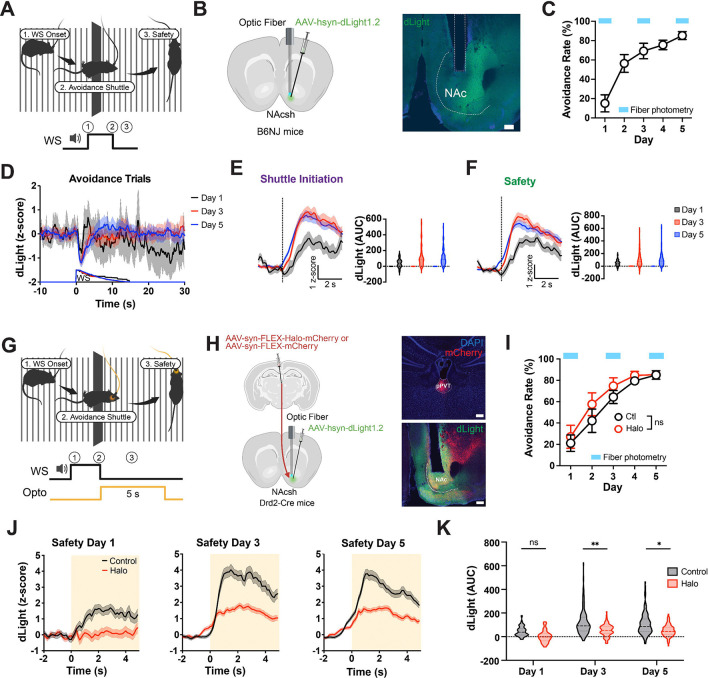
Motivated behavior is often framed in terms of biologically grounded outcomes, such as food or threat. Yet many motivated actions, like the pursuit of safety or agency, depend on outcomes that lack explicit sensory value and must instead be inferred from experience. Here, we identify a thalamostriatal circuit mechanism by which such internally constructed outcomes acquire motivational value. In mice performing an active avoidance task, neurons in the paraventricular thalamus (PVT) projecting to the nucleus accumbens (NAc) develop a safety-encoding signal that emerges following successful avoidance. This signal is experience-dependent and value-sensitive, diminishing upon devaluation of the instrumental contingency. Selective silencing of the PVT→NAc projection at safety onset disrupts avoidance persistence without impairing action-outcome learning, as confirmed by computational modeling of value updating based on prediction error. Mechanistically, PVT input recruits cholinergic interneurons (CINs) to modulate dopamine release and this influence depends on synaptic potentiation mediated by GluA2-lacking AMPA receptor insertion at PVT-CIN synapses. Disrupting this plasticity selectively impairs the avoidance response by blunting the motivational value of safety without affecting acquisition. These findings reveal how thalamic circuits assign value to abstract, internal outcomes, providing a framework for understanding how goals like safety are inferred, stabilized, and rendered behaviorally effective.
Figures



References
-
- De Martino B, Cortese A. Goals, usefulness and abstraction in value-based choice. Trends in Cognitive Sciences. 2023. Jan;27(1):65–80. - PubMed
-
- Mohammadi M, Bergado-Acosta JR, Fendt M. Relief learning is distinguished from safety learning by the requirement of the nucleus accumbens. Behavioural Brain Research. 2014. Oct;272:40–5. - PubMed
-
- Lovibond PF, Mitchell CJ, Minard E, Brady A, Menzies RG. Safety behaviours preserve threat beliefs: Protection from extinction of human fear conditioning by an avoidance response. Behaviour Research and Therapy. 2009. Aug;47(8):716–20. - PubMed
Publication types
Grants and funding
LinkOut - more resources
Full Text Sources
