


A polymeric nanovesicle delivers sulfopin and gemcitabine to remodel tumor microenvironment for enhanced chemoimmunotherapy against orthotopic pancreatic cancer
- PMID: 40799994
- PMCID: PMC12340398
- DOI: 10.1016/j.mtbio.2025.102153
A polymeric nanovesicle delivers sulfopin and gemcitabine to remodel tumor microenvironment for enhanced chemoimmunotherapy against orthotopic pancreatic cancer
Abstract
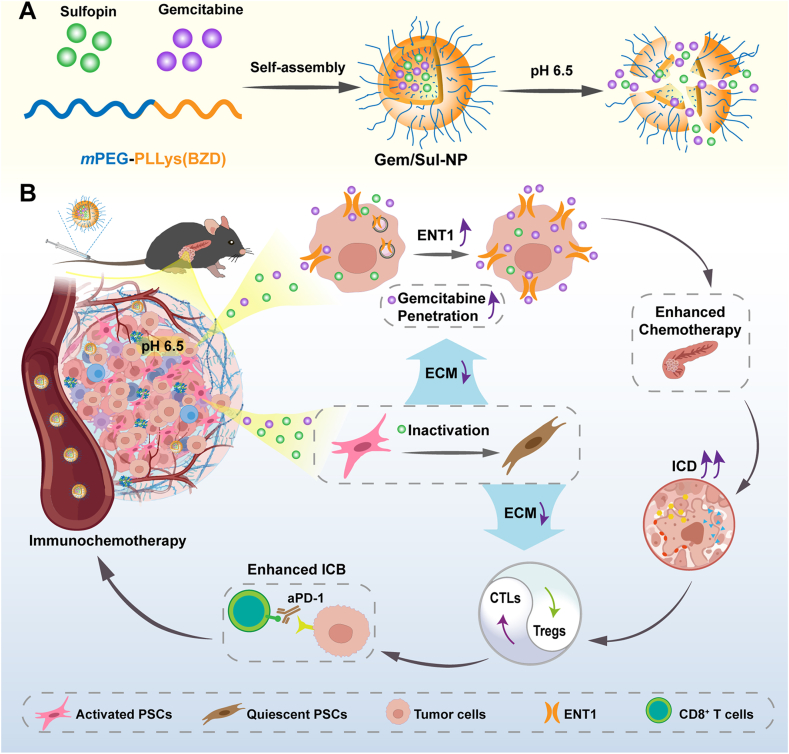
Pancreatic cancers are marked by a highly fibrotic extracellular matrix (ECM) that fosters an immunosuppressive tumor microenvironment (TME), severely limiting the effectiveness of traditional therapies. Emerging evidence suggests that ECM modulation represents a promising strategy to enhance treatment outcomes in pancreatic cancer. Herein, we developed a polymeric nanovesicle for the co-encapsulation and delivery of gemcitabine and prolyl isomerase Pin1 inhibitor sulfopin (Gem/Sul-NP). The engineered Gem/Sul-NP features a compact size of approximately 50 nm, facilitating improved accumulation and penetration within pancreatic tumor tissues. Additionally, the Gem/Sul-NP demonstrates pH-responsive characteristics, undergoing structural disintegration at the acidic pH of 6.5 to achieve controlled drug release in the TME, thereby facilitating synergistic antitumor effects. Sulfopin functions to inhibit pancreatic stellate cells (PSCs) activation, reducing ECM component secretion and disrupting stromal barriers. Besides, it upregulates the expression of the gemcitabine transporter equilibrative nucleoside transporter 1 (ENT1) on tumor cell membranes, thereby enhancing the cellular uptake of gemcitabine and its chemotherapeutic impact. Our in vivo studies confirmed that Gem/Sul-NP treatment effectively remodeled the immunosuppressive TME. When combined with anti-PD-1 therapy, this approach significantly increased CD8+IFNγ+ T cell infiltration, indicating its potential to create favorable conditions for synergistic chemoimmunotherapy against pancreatic cancers.
Keywords: Chemoimmunotherapy; Orthotopic pancreatic cancer; Pancreatic stellate cells; Polymeric nanovesicle; Tumor microenvironment remodeling.
© 2025 The Authors.
Conflict of interest statement
The authors declare that they have no known competing financial interests or personal relationships that could have appeared to influence the work reported in this paper.
Figures



References
-
- Shui L., Cheng K., Li X., Shui P., Zhou X., Li J., Yi C., Cao D. Study protocol for an open-label, single-arm, phase Ib/II study of combination of toripalimab, nab-paclitaxel, and gemcitabine as the first-line treatment for patients with unresectable pancreatic ductal adenocarcinoma. BMC Cancer. 2020;20:636. doi: 10.1186/s12885-020-07126-3. - DOI - PMC - PubMed
LinkOut - more resources
Full Text Sources
Research Materials
Miscellaneous
