. 2025 Aug 13;82(1):311.
doi: 10.1007/s00018-025-05845-z.

Quercetin alleviates acute pancreatitis by modulating glycolysis and mitochondrial function via PFKFB3 inhibition

Affiliations

Quercetin alleviates acute pancreatitis by modulating glycolysis and mitochondrial function via PFKFB3 inhibition

Hai Jiang et al. Cell Mol Life Sci. .

Abstract

Objective: Acute pancreatitis (AP) is a severe inflammatory disease associated with dysregulated glycolysis and mitochondrial dysfunction. This study investigates the therapeutic potential of quercetin, a novel PFKFB3 inhibitor, in modulating glycolysis and mitochondrial function to alleviate AP.

Methods: We conducted homology analysis of the PFKFB3 protein and identified quercetin as a potential inhibitor through molecular docking. In vitro experiments using a cerulein-induced inflammatory pancreatic cell model assessed the effects of quercetin on PFKFB3 expression, glycolysis, and mitochondrial function. In vivo validation was performed using an AP rat model to evaluate the impact on inflammation, tissue damage, and metabolic status.

Results: Quercetin significantly reduced PFKFB3 expression, inhibited glycolysis, and improved mitochondrial function in inflammatory pancreatic cells. In the AP rat model, quercetin treatment decreased serum amylase and lipase levels, reduced inflammatory markers (TNF-α and IL-6), and alleviated pancreatic tissue damage, as evidenced by histological analysis.

Conclusion: Quercetin effectively modulates glycolysis and mitochondrial function by inhibiting PFKFB3, thereby reducing inflammation and tissue damage in AP. These findings highlight the potential of quercetin as a novel therapeutic agent for AP.

Keywords: Acute Pancreatitis; Glycolysis; Mitochondrial Function; PFKFB3; Small Molecule Inhibitors.


Conflict of interest statement

Declarations. Ethics approval: All animal experiments were approved by the Animal Ethics Committee of the First Affiliated Hospital of Bengbu Medical University. This study does not involve any clinical ethics or human participants. Conflict of interest: The author declares no conflict of interest.

Figures

Fig. 1
Fig. 1
Structure of human PFKFB3 protein and homology comparison results. Note: (A) Schematic diagram of the PFKFB3 protein structure, displaying functional domains (Representative Domains and Domains), protein family, and homologous superfamily information, with name labels on the right, sourced from InterPro; (B) Three-dimensional structure of PFKFB3 (RCSB PDB id: 2dwo), sourced from RCSB PDB; (C) Fast family and domain prediction results for human, rat, and mouse PFKFB3 compared to the query sequence (Query Sequence), with the input sequence being the human PFKFB3 sequence (Uniprot Accession: Q16875). The red background indicates the alignment region, whereby a longer red region signifies higher similarity between the sequences, accompanied by annotations of predicted structural domains on the right
Fig. 2
Fig. 2
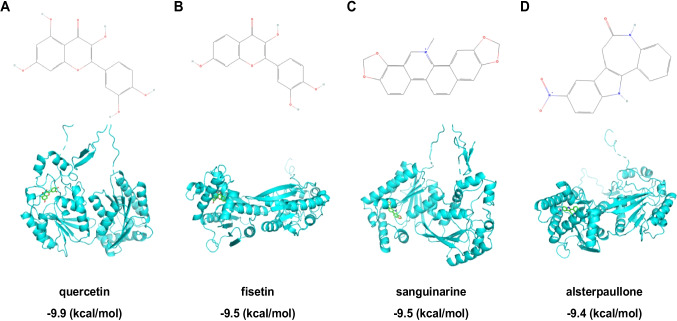
Molecular structures of four key small compounds and their molecular docking modes with PFKFB3. Note: (A-D) depict the structural formulas of quercetin (A), fisetin (B), sanguinarine (C), and alsterpaullone (D), along with their molecular docking modes with PFKFB3. The figures present the 3D structures of the small compounds and the secondary structure of the receptor protein
Fig. 3
Fig. 3
Regulatory effects of the PFKFB3 inhibitor quercetin on metabolism and oxidative stress in inflammatory pancreatic cells. Note: (A) Western blot analysis of PFKFB3 protein expression levels in inflammatory pancreatic cells induced by zymosan after treatment with four small molecule inhibitors. (B) Seahorse XF analyzer measurement of OCR in pancreatic cells after treatment with the compound quercetin. (C) Seahorse XF analyzer measurement of ECAR in pancreatic cells after treatment with the compound quercetin. (D) Western blot analysis of PFK-1 and LDH enzyme expression levels. (E) JC-1 staining of MMP in different cell groups. (F) ROS levels in different cell groups measured using a ROS detection kit. * indicates P < 0.05 compared to the Normal group, # indicates P < 0.05 compared to the Model group, all cell experiments were repeated three times
Fig. 4
Fig. 4
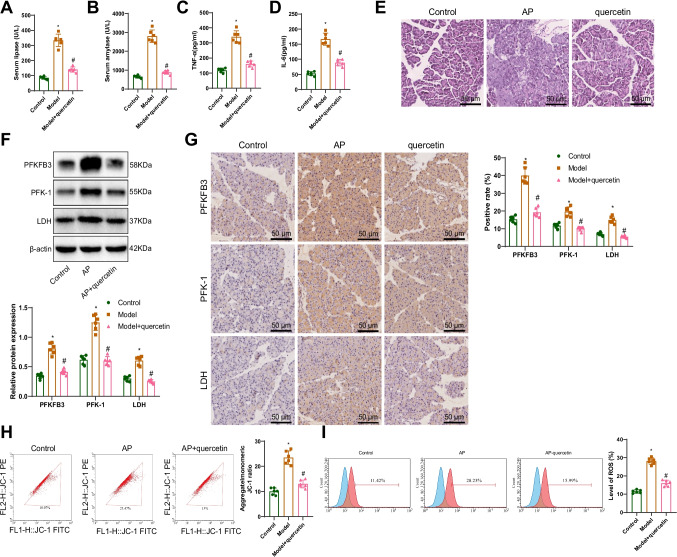
Improvement of inflammation and metabolism in a rat model of AP by PFKFB3 inhibitor quercetin. Note: (A, B) Measurement of serum amylase and lipase levels; (C, D) ELISA experiments to assess IL-6 and TNF-α secretion; (E) Pathological changes in rat pancreatic tissues observed using H&E staining (scale bar: 50 µm); (F) Detection of PFKFB3, PFK-1, and LDH expression in rat pancreatic tissues using the Western blot method; (G) Immunohistochemical analysis of PFKFB3, PFK-1, and LDH expression in rat pancreatic tissues (scale bar: 50 µm); (H) Assessment of MMP in rat pancreatic tissues of each group using JC-1 staining; (I) Measurement of ROS levels in rat pancreatic tissues of each group using an ROS detection kit. * Represents P < 0.05 compared to the Control group, # represents P < 0.05 compared to the AP group, with six rats in each group
Fig. 5
Fig. 5
PFKFB3 small molecule inhibitors mitigate AP by modulating glycolysis and mitochondrial function

References

    1. Szatmary P, Grammatikopoulos T, Cai W et al (2022) Acute pancreatitis: diagnosis and treatment. Drugs 82:1251–1276 - PMC - PubMed
    1. Zerem E, Kurtcehajic A, Kunosić S et al (2023) Current trends in acute pancreatitis: diagnostic and therapeutic challenges. World J Gastroenterol 29:2747–2763 - PMC - PubMed
    1. Li Y, Chen Y, Sun-Waterhouse D (2022) The potential of dandelion in the fight against gastrointestinal diseases: a review. J Ethnopharmacol 293:115272 - PubMed
    1. Bourgault J, Abner E, Manikpurage HD et al (2023) Proteome-wide mendelian randomization identifies causal links between blood proteins and acute pancreatitis. Gastroenterology 164:953-965.e3 - PubMed
    1. Kiss L, Fűr G, Pisipati S et al (2023) Mechanisms linking hypertriglyceridemia to acute pancreatitis. Acta Physiol 237(3):e13916 - PubMed

MeSH terms

LinkOut - more resources