


Naturally competent bacteria and their genetic parasites-a battle for control over horizontal gene transfer?
- PMID: 40802478
- PMCID: PMC12378983
- DOI: 10.1093/femsre/fuaf035
Naturally competent bacteria and their genetic parasites-a battle for control over horizontal gene transfer?
Abstract
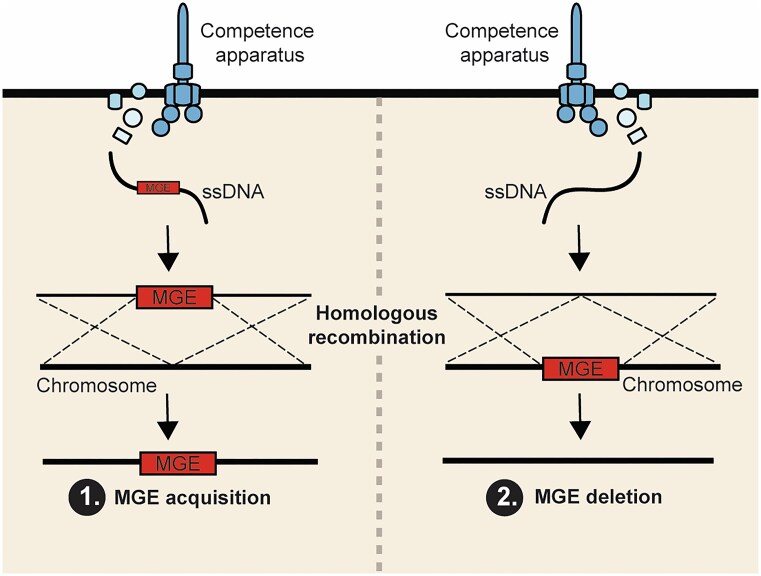
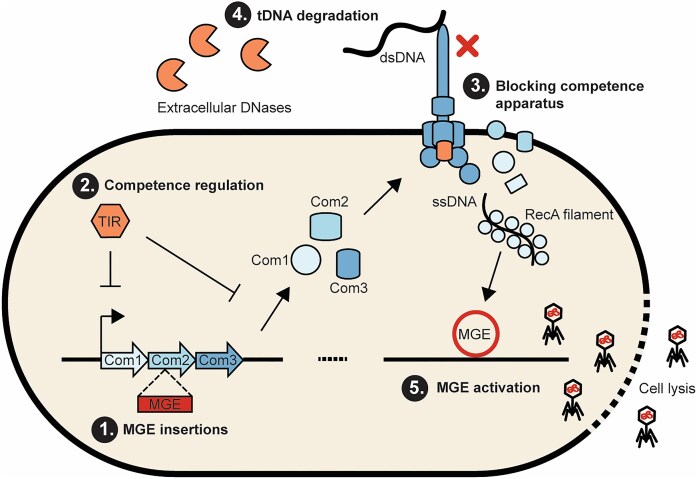
Host-mediated natural competence for transformation of DNA and mobile genetic element (MGE)-driven conjugation and transduction are key modes of horizontal gene transfer. While these mechanisms are traditionally believed to shape bacterial evolution by enabling the acquisition of new genetic traits, numerous studies have elucidated an antagonistic relationship between natural transformation and MGEs. A new role of natural transformation as a chromosome-curing mechanism has now been proposed. Experimental data, along with mathematical models, suggest that transformation can eliminate deleterious MGEs. Supporting this hypothesis, MGEs have been shown to use various mechanisms to decrease or block transformability, such as disrupting competence genes, regulating the development of competence, hindering DNA uptake machinery, producing DNases that target the exogenous (transforming) DNA, and causing lysis of competent cells. A few examples of synergistic relationships between natural transformation and MGEs have also been reported, with natural transformation facilitating MGE transfer and phages enhancing transformation by supplying extracellular DNA through lysis and promoting competence via kin discrimination. Given the complexity of the relationships between natural transformation and MGEs, the balance between antagonism and synergy likely depends on specific selection pressures in a given context. The evidence collected here indicates a continuous conflict over horizontal gene transfer in bacteria, with semiautonomous MGEs attempting to disrupt host-controlled DNA acquisition, while host competence mechanisms work to resist MGE interference.
Keywords: genetic diversity; mobile genetic element; natural competence; phage; transformation.
© The Author(s) 2025. Published by Oxford University Press on behalf of FEMS.
Conflict of interest statement
None declared.
Figures



References
Publication types
MeSH terms
Grants and funding
LinkOut - more resources
Full Text Sources
