


Dopamine signaling drives skin invasion by human-infective nematodes
- PMID: 40804046
- PMCID: PMC12350745
- DOI: 10.1038/s41467-025-62517-z
Dopamine signaling drives skin invasion by human-infective nematodes
Abstract
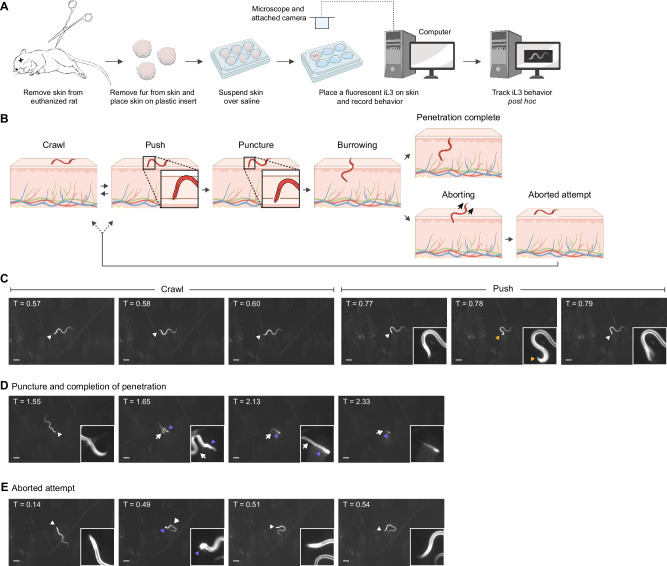
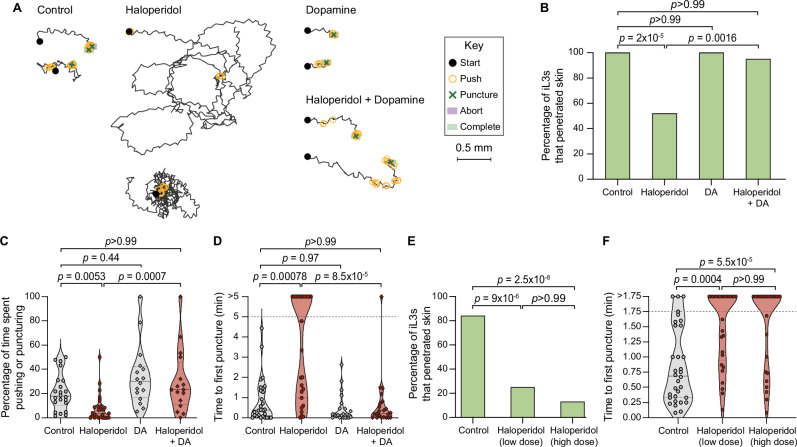
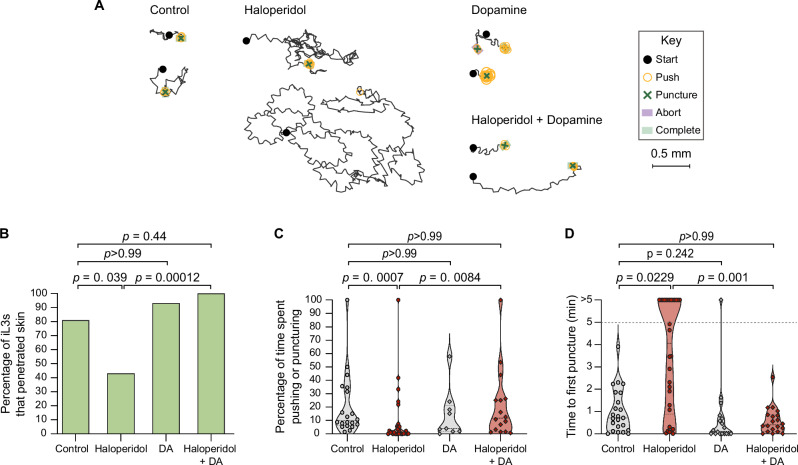
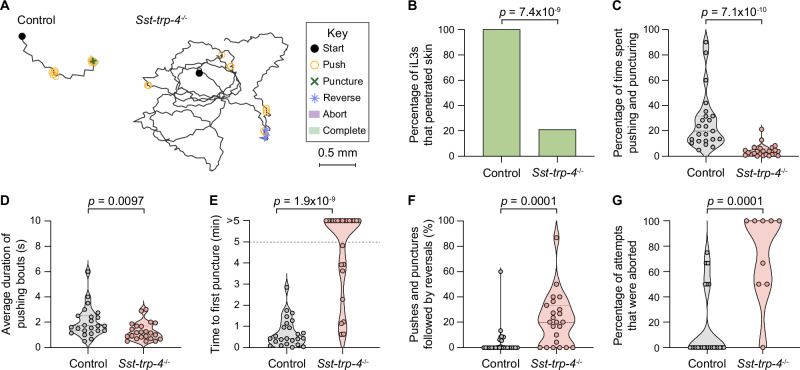
Skin-penetrating nematodes are one of the most prevalent causes of disease worldwide. The World Health Organization has targeted these parasites for elimination by 2030, but the lack of preventative measures is a major obstacle to this goal. Infective larvae enter hosts through skin and blocking skin penetration could prevent infection. However, in order to prevent worm ingress via the skin, an understanding of the behavioral and neural mechanisms that drive skin penetration is required. Here, we describe the skin-penetration behavior of the human-infective threadworm Strongyloides stercoralis. We show that S. stercoralis engages in repeated cycles of pushing, puncturing, and crawling on the skin surface before penetrating. Pharmacological inhibition of dopamine signaling inhibits these behaviors in S. stercoralis and the human hookworm Ancylostoma ceylanicum, suggesting a critical role for dopamine signaling in driving skin penetration across distantly related nematodes. CRISPR-mediated disruption of dopamine biosynthesis and chemogenetic silencing of dopaminergic neurons also inhibit skin penetration. Finally, inactivation of the TRPN channel TRP-4, which is expressed in the dopaminergic neurons, blocks skin penetration. Our results suggest that drugs targeting TRP-4 and other nematode-specific components of the dopaminergic pathway could be developed into topical prophylactics that block skin penetration, thereby preventing infections.
© 2025. The Author(s).
Conflict of interest statement
Competing interests: The authors declare no competing interests.
Figures
Update of
-
Dopamine signaling drives skin invasion by human-infective nematodes.bioRxiv [Preprint]. 2025 Jan 30:2025.01.29.635547. doi: 10.1101/2025.01.29.635547. bioRxiv. 2025. Update in: Nat Commun. 2025 Aug 13;16(1):7246. doi: 10.1038/s41467-025-62517-z. PMID: 39974984 Free PMC article. Updated. Preprint.
Similar articles
-
Dopamine signaling drives skin invasion by human-infective nematodes.bioRxiv [Preprint]. 2025 Jan 30:2025.01.29.635547. doi: 10.1101/2025.01.29.635547. bioRxiv. 2025. Update in: Nat Commun. 2025 Aug 13;16(1):7246. doi: 10.1038/s41467-025-62517-z. PMID: 39974984 Free PMC article. Updated. Preprint.
-
Prescription of Controlled Substances: Benefits and Risks.2025 Jul 6. In: StatPearls [Internet]. Treasure Island (FL): StatPearls Publishing; 2025 Jan–. 2025 Jul 6. In: StatPearls [Internet]. Treasure Island (FL): StatPearls Publishing; 2025 Jan–. PMID: 30726003 Free Books & Documents.
-
The generation of stable transgenic lines in the human-infective nematode Strongyloides stercoralis.G3 (Bethesda). 2024 Aug 7;14(8):jkae122. doi: 10.1093/g3journal/jkae122. G3 (Bethesda). 2024. PMID: 38839055 Free PMC article.
-
The Black Book of Psychotropic Dosing and Monitoring.Psychopharmacol Bull. 2024 Jul 8;54(3):8-59. Psychopharmacol Bull. 2024. PMID: 38993656 Free PMC article. Review.
-
Antidepressants for pain management in adults with chronic pain: a network meta-analysis.Health Technol Assess. 2024 Oct;28(62):1-155. doi: 10.3310/MKRT2948. Health Technol Assess. 2024. PMID: 39367772 Free PMC article.
References
-
- Riaz, M. et al. Prevalence, risk factors, challenges, and the currently available diagnostic tools for the determination of helminths infections in human. Eur. J. Inflamm.18, 1–15 (2020).
Grants and funding
- R01 AI175183/AI/NIAID NIH HHS/United States
- T32 GM145388/GM/NIGMS NIH HHS/United States
- T32 AI007323/AI/NIAID NIH HHS/United States
- DP2 AI184544/AI/NIAID NIH HHS/United States
- R01AR081337/U.S. Department of Health & Human Services | National Institutes of Health (NIH)
- T34 GM008563/GM/NIGMS NIH HHS/United States
- T32AI007323/U.S. Department of Health & Human Services | National Institutes of Health (NIH)
- F32AI174816/U.S. Department of Health & Human Services | National Institutes of Health (NIH)
- R01AI175183/U.S. Department of Health & Human Services | National Institutes of Health (NIH)
- T32GM145388/U.S. Department of Health & Human Services | National Institutes of Health (NIH)
- T34GM008563/U.S. Department of Health & Human Services | National Institutes of Health (NIH)
- F32 AI174816/AI/NIAID NIH HHS/United States
- DP2AI184544/U.S. Department of Health & Human Services | National Institutes of Health (NIH)
- R01 AR081337/AR/NIAMS NIH HHS/United States
LinkOut - more resources
Full Text Sources
