


A Qualitative Exploration of the Lived Experiences and Perspectives of Equine-Assisted Services Practitioners in the UK and Ireland
- PMID: 40805030
- PMCID: PMC12345575
- DOI: 10.3390/ani15152240
A Qualitative Exploration of the Lived Experiences and Perspectives of Equine-Assisted Services Practitioners in the UK and Ireland
Abstract
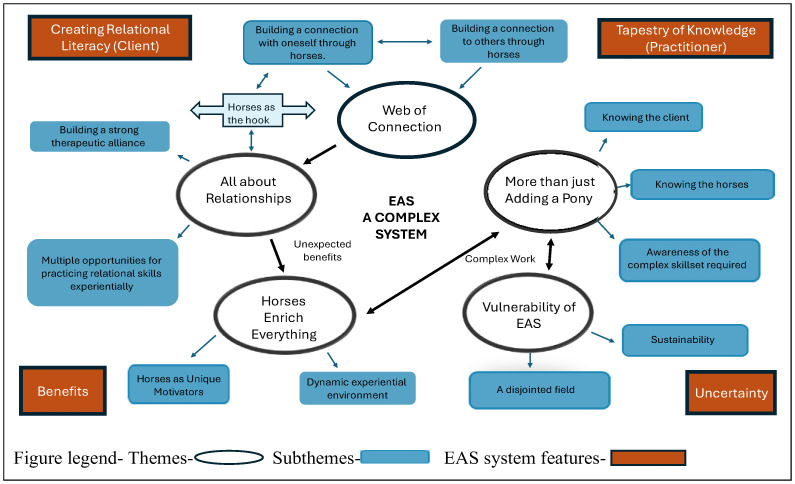
Equine-Assisted Services (EAS), which incorporate horses in a variety of ways in an effort to improve human wellbeing, have grown in popularity in recent years. Although much research has been conducted regarding the benefits that horses may provide for human health and wellbeing, little attention has been paid to practitioners' experiences and perspectives of the field, despite the fact they are uniquely positioned to advance our understanding of this area. This study aimed to explore practitioners' lived experiences of EAS, focusing on the benefits they observed, possible underlying mechanisms for any health benefits witnessed, and challenges faced in the area. Fifteen EAS practitioners from the UK/Ireland took part in qualitative semi-structured interviews, analysed using reflexive thematic analysis. Five themes were identified, three of which related to the horse's influence on building connections, relationships, and enriching the process, whilst the remainder explored challenges within the field of EAS. These themes were explored through the practitioners' lens, where possible linking them to our current understanding of human-animal interactions and related fields in the literature. Findings showed that horses, through EAS, were considered invaluable for building relationships, relational skills, and motivation to engage in whichever service was being provided. However, EAS was also viewed as complex. Concerns regarding competencies to practice, training, and lack of governance were expressed. These areas need further exploration and progress if EAS is to grow in efficacy and attain professional status.
Keywords: Equine-Assisted Services; equine and human wellbeing; horses; one health; practitioners; qualitative research; reflexive thematic analysis.
Conflict of interest statement
The authors declare no conflicts of interest.
Figures
Similar articles
-
Prescription of Controlled Substances: Benefits and Risks.2025 Jul 6. In: StatPearls [Internet]. Treasure Island (FL): StatPearls Publishing; 2025 Jan–. 2025 Jul 6. In: StatPearls [Internet]. Treasure Island (FL): StatPearls Publishing; 2025 Jan–. PMID: 30726003 Free Books & Documents.
-
Factors that influence participation in physical activity for people with bipolar disorder: a synthesis of qualitative evidence.Cochrane Database Syst Rev. 2024 Jun 4;6(6):CD013557. doi: 10.1002/14651858.CD013557.pub2. Cochrane Database Syst Rev. 2024. PMID: 38837220 Free PMC article. Review.
-
How lived experiences of illness trajectories, burdens of treatment, and social inequalities shape service user and caregiver participation in health and social care: a theory-informed qualitative evidence synthesis.Health Soc Care Deliv Res. 2025 Jun;13(24):1-120. doi: 10.3310/HGTQ8159. Health Soc Care Deliv Res. 2025. PMID: 40548558
-
What Matters Most? An Exploration of Quality of Life Through the Everyday Experiences of Autistic Young People and Adults.Autism Adulthood. 2025 May 28;7(3):312-323. doi: 10.1089/aut.2023.0127. eCollection 2025 Jun. Autism Adulthood. 2025. PMID: 40539216
-
The Lived Experience of Autistic Adults in Employment: A Systematic Search and Synthesis.Autism Adulthood. 2024 Dec 2;6(4):495-509. doi: 10.1089/aut.2022.0114. eCollection 2024 Dec. Autism Adulthood. 2024. PMID: 40018061 Review.
References
Grants and funding
LinkOut - more resources
Full Text Sources
