


Impact of Structural Empowerment, Thriving at Work, and Caregiver Reciprocity on the Psychological Empowerment of Home Care Workers in South Korea
- PMID: 40805841
- PMCID: PMC12346748
- DOI: 10.3390/healthcare13151809
Impact of Structural Empowerment, Thriving at Work, and Caregiver Reciprocity on the Psychological Empowerment of Home Care Workers in South Korea
Abstract
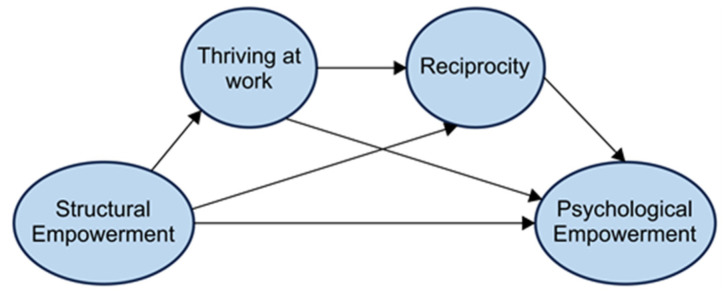
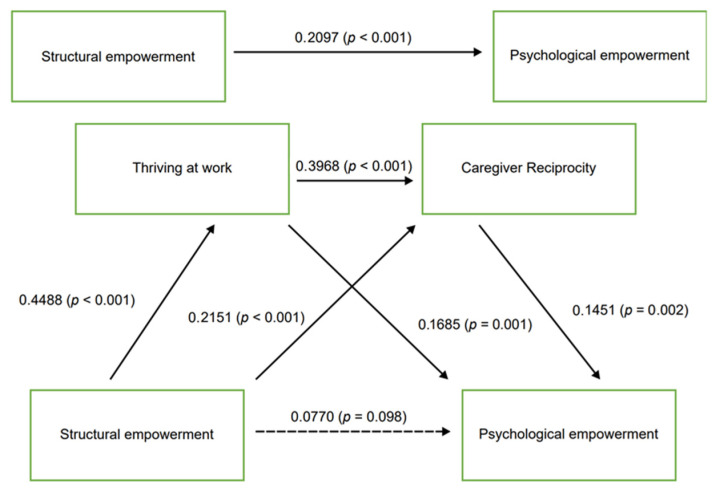
Objective: Given the critical workforce challenges in home care settings and the limited understanding of empowerment mechanisms in isolated work environments, this study aimed to examine how structural empowerment influences psychological empowerment among home care workers in South Korea through the mediating pathways of thriving at work and caregiver reciprocity. Based on Kanter's empowerment theory, we specifically investigated the serial mediation effects to understand the complex processes through which organizational support structures translate into enhanced worker empowerment. Methods: A cross-sectional survey was conducted with 192 home care workers. Data were analyzed using descriptive statistics, correlation analysis, and serial multiple mediation analysis using SPSS Process Macro Model 6. Results: Structural empowerment demonstrated significant positive correlations with thriving at work (r = 0.445, p < 0.001), caregiver reciprocity (r = 0.490, p < 0.001), and psychological empowerment (r = 0.337, p < 0.001). Thriving at work significantly influenced both caregiver reciprocity (β = 0.3968, p < 0.001) and psychological empowerment (β = 0.1685, p < 0.001). The serial mediation analysis revealed that the indirect effect of structural empowerment on psychological empowerment through thriving at work and caregiver reciprocity was statistically significant (indirect effect = 0.1327, 95% CI [0.0713, 0.1929]), with the model explaining 58% of the variance in psychological empowerment. Conclusions: Structural empowerment significantly enhances psychological empowerment among home care workers through the sequential mediation of thriving at work and caregiver reciprocity. Healthcare organizations should prioritize strengthening structural empowerment through comprehensive support systems and conducive work environments to optimize care quality and worker well-being.
Keywords: care workers; caregiver reciprocity; job thriving; psychological empowerment; structural empowerment.
Conflict of interest statement
The authors declare no conflicts of interest.
Figures
References
-
- Lee H., Kim H. Emotional labor of care worker in long-term care Facilities-Calling Impact on Burnout-Focusing on Chungcheongnam-do Province. J. Community Welf. 2022;80:83–107. doi: 10.15300/jcw.2022.80.1.83. - DOI
-
- Butler S.S., Kusmaul N. Perceptions of Empowerment Among Home Care Aides. Innov. Aging. 2019;3((Suppl. S1)):S704. doi: 10.1093/geroni/igz038.2588. - DOI
LinkOut - more resources
Full Text Sources
