


Subscapularis CT-Scan Evaluation in Patients with Proximal Humerus Fracture: Reverse Total Shoulder Arthroplasty Versus Hemi-Arthroplasty
- PMID: 40806878
- PMCID: PMC12347347
- DOI: 10.3390/jcm14155257
Subscapularis CT-Scan Evaluation in Patients with Proximal Humerus Fracture: Reverse Total Shoulder Arthroplasty Versus Hemi-Arthroplasty
Abstract
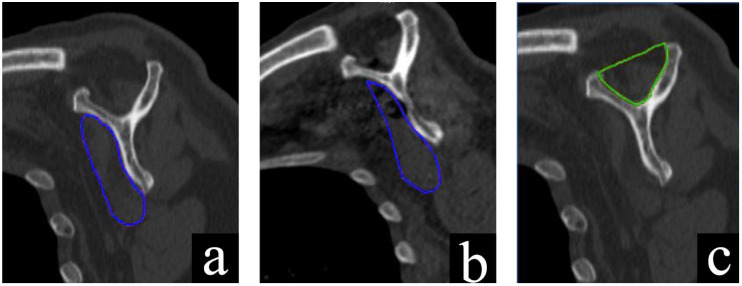
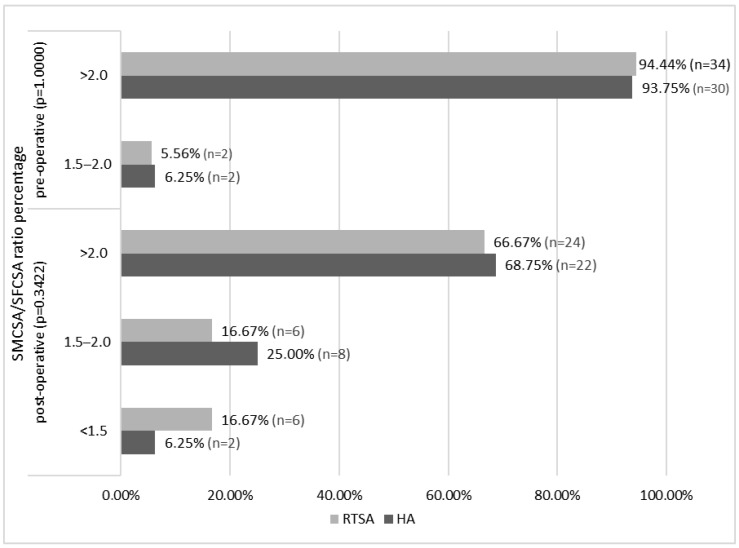
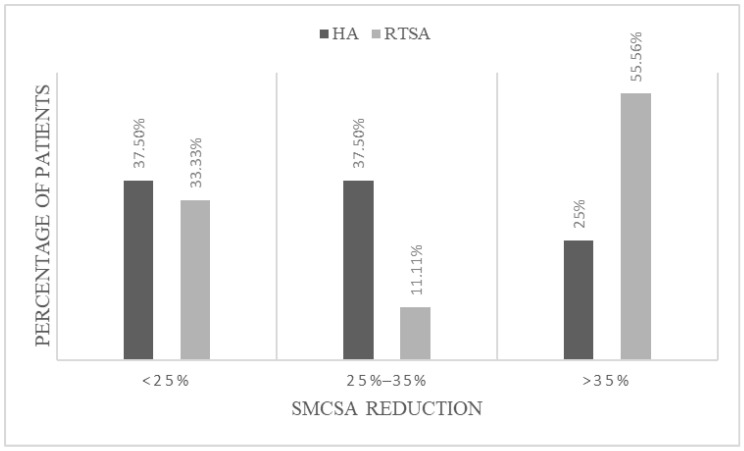
Background/Objectives: Hemiarthroplasty (HA) and Reverse Total Shoulder Arthroplasty (RTSA) are both reliable treatment options for complex proximal humerus fractures. The role of the subscapularis tendon is well-defined in HA, whereas it plays a controversial role in RTSA. The purpose of our study is to evaluate its role in patients with proximal humerus fractures treated with HA and RTSA and investigate its association with clinical outcomes. Methods: Sixty-eight consecutive patients with proximal humeral fracture were prospectively enrolled into the study from June 2015 to May 2020 (RTSA = 36; HA = 32). Pre- and postoperative shoulder CT scans were performed to measure the subscapularis muscle cross-sectional area (SMCSA) and the supraspinatus fossa cross-sectional area (SFCSA). The SMCSA/SFCSA ratio was employed to normalize measurements against individual patient anatomy. Patient reported outcomes (PROs) and range of motion (ROM) were evaluated at the final follow-up. Results: The RTSA group demonstrated superior patient-reported outcomes (PROs) and range of motion (ROM) compared to the HA group. Notably, the Constant Score was significantly higher in the RTSA group (58.00 vs. 38.50; p = 0.0001), as well as forward flexion (147.50° vs. 90.00°; p < 0.0001). A postoperative reduction in subscapularis size of >35% occurred more frequently in RTSA patients (55.6%) than in HA patients (25%) (p = 0.01). The loss of subscapularis surface was greater in the RTSA patients (p = 0.018). Conclusions: RTSA demonstrated better results compared to HA, providing better ROM and PROs. Postoperative reduction in subscapularis size was significantly higher in RTSA compared to HA. Subscapularis condition seems to show no correlation with functional outcome in RTSA.
Keywords: CT; HA; RTSA; humeral fracture; subscapularis tendon.
Conflict of interest statement
The authors declare no conflicts of interest.
Figures
References
-
- Calvo E., Morcillo D., Foruria A.M., Redondo-Santamaría E., Osorio-Picorne F., Caeiro J.R., GEIOS-SECOT Outpatient Osteoporotic Fracture Study Group Nondisplaced Proximal Humeral Fractures: High Incidence among Outpatient-Treated Osteoporotic Fractures and Severe Impact on Upper Extremity Function and Patient Subjective Health Perception. J. Shoulder Elb. Surg. 2011;20:795–801. doi: 10.1016/j.jse.2010.09.008. - DOI - PubMed
LinkOut - more resources
Full Text Sources
Miscellaneous
