


Alternative Arterial Access in Veno-Arterial ECMO: The Role of the Axillary Artery
- PMID: 40807034
- PMCID: PMC12347629
- DOI: 10.3390/jcm14155413
Alternative Arterial Access in Veno-Arterial ECMO: The Role of the Axillary Artery
Abstract
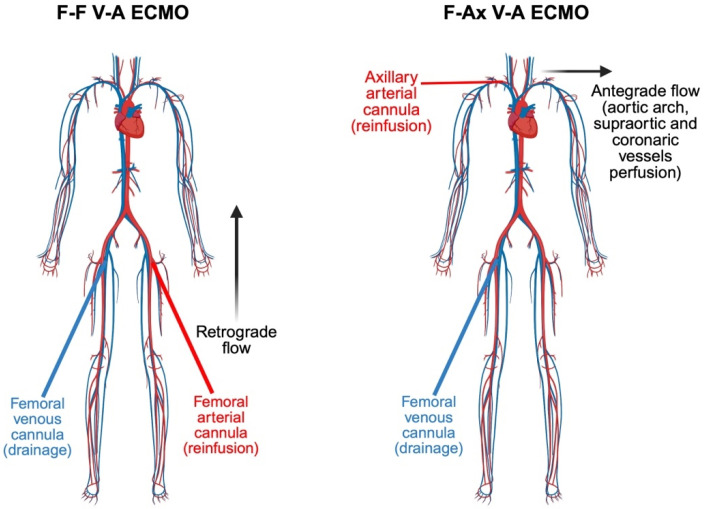
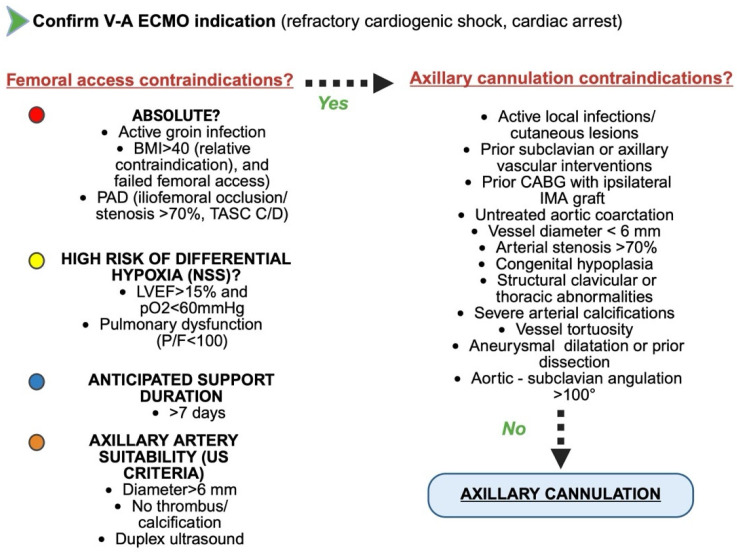
Background: Veno-arterial extracorporeal membrane oxygenation (V-A ECMO) is increasingly used to support patients with refractory cardiogenic shock or cardiac arrest. While femoral artery cannulation remains the most common arterial access, axillary artery cannulation has emerged as a valuable alternative in selected cases. Objective: This narrative review aims to synthesize current evidence and expert opinion on axillary artery cannulation in V-A ECMO, focusing on its technical feasibility, physiologic implications, and clinical outcomes. Methods: A comprehensive literature search was performed in PubMed and Scopus using relevant keywords related to ECMO, axillary artery, cannulation techniques, and outcomes. Emphasis was placed on prospective and retrospective clinical studies, expert consensus statements, and technical reports published over the past two decades. Results: Axillary cannulation provides antegrade aortic flow, potentially reducing the risk of differential hypoxia and improving upper body perfusion. However, the technique presents unique technical challenges and may carry risks such as hyperperfusion syndrome or arterial complications. Emerging data suggest favorable outcomes in selected patient populations when performed in experienced centers. Conclusions: Axillary cannulation represents a promising arterial access route in V-A ECMO, particularly in cases with contraindications to femoral cannulation or when upper-body perfusion is a concern. Further prospective studies are needed to better define patient selection criteria and long-term outcomes.
Keywords: ECMO cannulation; axillary ECMO; axillary artery cannulation; cannulation strategy; extracorporeal life support; femoro-axillary ECMO; femoro-axillary configuration; veno-arterial ECMO.
Conflict of interest statement
The authors declare no conflicts of interest.
Figures
References
-
- van Diepen S., Katz J.N., Albert N.M., Henry T.D., Jacobs A.K., Kapur N.K., Kilic A., Menon V., Ohman E.M., Sweitzer N.K., et al. American Heart Association Council on Clinical Cardiology; Council on Cardiovascular and Stroke Nursing; Council on Quality of Care and Outcomes Research; and Mission: Lifeline. Contemporary Management of Cardiogenic Shock: A Scientific Statement from the American Heart Association. Circulation. 2017;136:e232–e268. doi: 10.1161/CIR.0000000000000525. - DOI - PubMed
Publication types
LinkOut - more resources
Full Text Sources
Miscellaneous
