


How Much Variance Exists Among Published Definitions of Proximal Junctional Kyphosis? A Retrospective Cohort Study of Adult Spinal Deformity
- PMID: 40807090
- PMCID: PMC12347835
- DOI: 10.3390/jcm14155469
How Much Variance Exists Among Published Definitions of Proximal Junctional Kyphosis? A Retrospective Cohort Study of Adult Spinal Deformity
Abstract
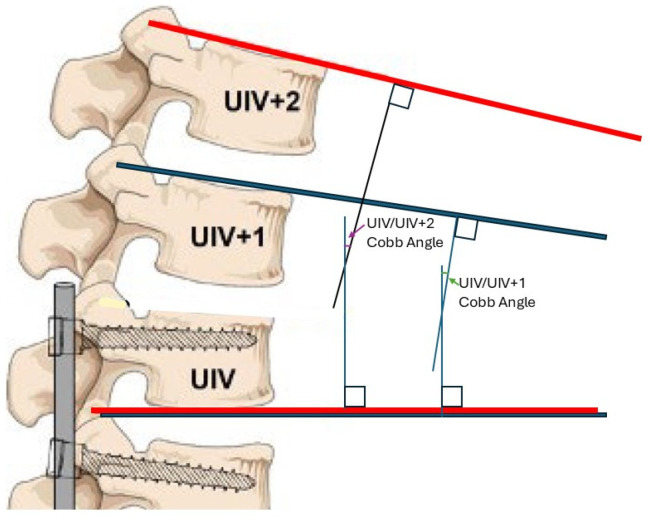
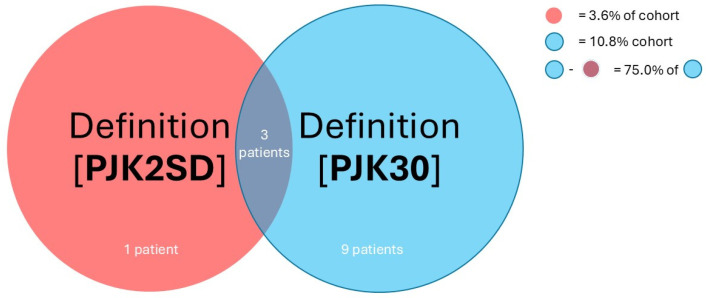
Background/Objectives: We sought to characterize the variance and overlap among definitions of Proximal Junctional Kyphosis (PJK) used in the adult spinal deformity (ASD) literature. PJK is defined as excess in PJK angle, a Cobb angle between the upper-instrumented vertebra (UIV) and a supra-adjacent vertebra (SAV), either one (UIV+1) or two (UIV+2) levels rostral of the UIV. No expert consensus exists for threshold angle or which SAV to use. Methods: A total of 116 thoracolumbar fusion patients ≥ 65 years old were reviewed. The UIV+1 and UIV+2 angles were measured. Six definitions of PJK from the literature were evaluated. These definitions were selected based on citation frequency, historical relevance, and accessibility through commonly used databases. Pearson's Chi-squared and pairwise comparisons were performed to evaluate the distinctness and agreement rates among these definitions. Results: The six definitions of PJK were as follows: [PJK20] PJK angle ≥ 20° with UIV+2 as the (SAV), [PJK10] PJK angle ≥ 10° with a >10° change from pre-op with UIV+2 as the SAV, [PJK2SD] PJK angle > 2 standard deviations from average with UIV+1 as the SAV, [PJK10+10] PJK angle ≥ 10° with a >10° change from pre-op with UIV+1 as the SAV, [PJK15] PJK angle > 15° with UIV+1 as the SAV, and [PJK30] PJK angle > 30° with UIV+2 as the SAV, or displaced rod fracture, or reoperation within 2 years for junctional failure, pseudoarthrosis, or rod fracture. [PJK10] and [PJK2SD] were the most distinct definitions while [PJK20], [PJK10+10], [PJK15], and [PJK30] showed no significant pairwise differences. [PJK2SD] was stringent, while definition [PJK30] included unique diagnostic information not captured by other definitions. Conclusions: The use of [PJK20], [PJK10+10], [PJK15], or [PJK30] is recommended for consistency, with [PJK15] presenting the best balance. Stringent [PJK2SD] may be beneficial for identifying severe PJK, though with low sensitivity. Overall, PJK definitions must be standardized for the consistent reporting of clinical outcomes and research comparability.
Keywords: adult spinal deformity; proximal junctional failure; proximal junctional kyphosis; reoperation; spinal deformity; spine; upper instrumented vertebrae.
Conflict of interest statement
The authors declare no conflicts of interest. CAM is a consultant for Kuros, Augmedics, SMAIO, Baxter Health, and SI-Bone. The research conducted to acquire the results of this study were not funded with any grants.
Figures
References
-
- Bridwell K.H., Lenke L.G., Cho S.K., Pahys J.M., Zebala L.P., Dorward I.G., Cho W., Baldus C., Hill B.W., Kang M.M. Proximal junctional kyphosis in primary adult deformity surgery: Evaluation of 20 degrees as a critical angle. Neurosurgery. 2013;72:899–906. doi: 10.1227/NEU.0b013e31828bacd8. - DOI - PubMed
-
- Glattes R.C., Bridwell K.H., Lenke L.G., Kim Y.J., Rinella A., Edwards C., 2nd Proximal junctional kyphosis in adult spinal deformity following long instrumented posterior spinal fusion: Incidence, outcomes, and risk factor analysis. Spine. 2005;30:1643–1649. doi: 10.1097/01.brs.0000169451.76359.49. - DOI - PubMed
LinkOut - more resources
Full Text Sources
Miscellaneous
