


Resveratrol as a Novel Therapeutic Approach for Diabetic Retinopathy: Molecular Mechanisms, Clinical Potential, and Future Challenges
- PMID: 40807437
- PMCID: PMC12348093
- DOI: 10.3390/molecules30153262
Resveratrol as a Novel Therapeutic Approach for Diabetic Retinopathy: Molecular Mechanisms, Clinical Potential, and Future Challenges
Abstract
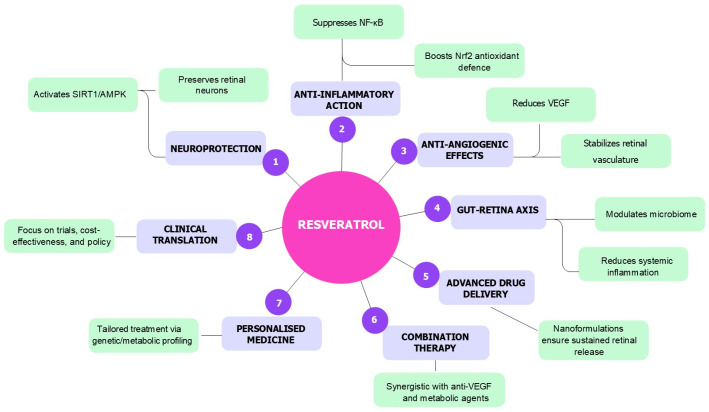
Diabetic retinopathy (DR) is a progressive, multifactorial complication of diabetes and one of the major global causes of visual impairment. Its pathogenesis involves chronic hyperglycaemia-induced oxidative stress, inflammation, mitochondrial dysfunction, neurodegeneration, and pathological angiogenesis, as well as emerging systemic contributors such as gut microbiota dysregulation. While current treatments, including anti-vascular endothelial growth factor (anti-VEGF) agents, corticosteroids, and laser photocoagulation, have shown clinical efficacy, they are largely limited to advanced stages of DR, require repeated invasive procedures, and do not adequately address early neurovascular and metabolic abnormalities. Resveratrol (RSV), a naturally occurring polyphenol, has emerged as a promising candidate due to its potent antioxidant, anti-inflammatory, neuroprotective, and anti-angiogenic properties. This review provides a comprehensive analysis of the molecular mechanisms by which RSV exerts protective effects in DR, including modulation of oxidative stress pathways, suppression of inflammatory cytokines, enhancement of mitochondrial function, promotion of autophagy, and inhibition of pathological neovascularisation. Despite its promising pharmacological profile, the clinical application of RSV is limited by poor aqueous solubility, rapid systemic metabolism, and low ocular bioavailability. Various routes of administration, including intravitreal injection, topical instillation, and oral and sublingual delivery, have been investigated to enhance its therapeutic potential. Recent advances in drug delivery systems, including nanoformulations, liposomal carriers, and sustained-release intravitreal implants, offer potential strategies to address these challenges. This review also explores RSV's role in combination therapies, its potential as a disease-modifying agent in early-stage DR, and the relevance of personalised medicine approaches guided by metabolic and genetic factors. Overall, the review highlights the therapeutic potential and the key translational challenges in positioning RSV as a multi-targeted treatment strategy for DR.
Keywords: angiogenesis; autophagy; diabetic retinopathy; drug delivery systems; gut-retina axis; inflammation; mitochondrial dysfunction; neuroprotection; oxidative stress; resveratrol.
Conflict of interest statement
The authors declare no conflicts of interest.
Figures
References
-
- Sun H., Saeedi P., Karuranga S., Pinkepank M., Ogurtsova K., Duncan B.B., Stein C., Basit A., Chan J.C.N., Mbanya J.C., et al. IDF Diabetes Atlas: Global, Regional and Country-Level Diabetes Prevalence Estimates for 2021 and Projections for 2045. Diabetes Res. Clin. Pract. 2022;183:109119. doi: 10.1016/j.diabres.2021.109119. - DOI - PMC - PubMed
Publication types
MeSH terms
Substances
LinkOut - more resources
Full Text Sources
Medical
