


Effects of Corn-Soybean Meal-Based Fermented Feed Supplementation on Growth Performance, Meat Quality, Fatty Acid Profiles, Nutritional Values, and Gut Microbiota of Lean-Type Finishing Pigs
- PMID: 40807578
- PMCID: PMC12345824
- DOI: 10.3390/foods14152641
Effects of Corn-Soybean Meal-Based Fermented Feed Supplementation on Growth Performance, Meat Quality, Fatty Acid Profiles, Nutritional Values, and Gut Microbiota of Lean-Type Finishing Pigs
Abstract
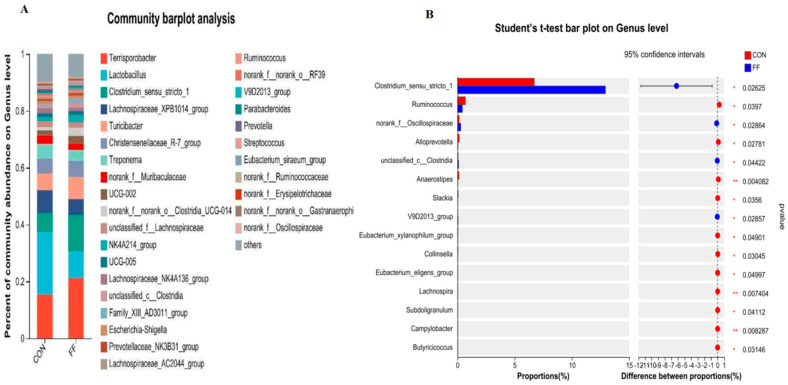
This research investigated the impact of corn-soybean meal-based fermented feed on the growth performance, pork quality, and fatty acid profiles of lean-type finishing pigs. A total of 80 lean-type growing DLY (Duroc × Landrace-Yorkshire) pigs were randomly assigned to 2 groups, with 5 replicates of 8 pigs per pen. The pigs in control group (CON group) were fed a basal diet, while the pigs in fermented feed group (FF group) were fed a diet supplemented with 10% fermented feed. The experimental period lasted 70 days. Results exhibited that pigs in FF group had a significant increase in final body weight and average daily gain (ADG) (p < 0.05) and had a significant decrease in the feed-to-gain ratio (F/G) (p < 0.05). The FF group also exhibited significant promotion in muscle intramuscular fat content, marbling score, and meat color and significantly reduced the meat shear force and drip loss (p < 0.05). Serum analysis indicated that fermented feed significantly elevated blood glucose, total cholesterol, triglyceride levels, and serum hormones such as insulin, leptin, and IGF-1 (p < 0.05). Additionally, fermented feed significantly elevated the levels of polyunsaturated fatty acids (PUFAs) and monounsaturated fatty acids (MUFAs), whereas it decreased the saturated fatty acids (SFAs) contents (p < 0.05). The fermented feed also significantly enhanced pork nutritional values (p < 0.05). The fermented feed increased the expression of IGF-1, SREBP1c, PDE3, PPARγ, SCD5, and FAT/CD36 mRNA (p < 0.05). Furthermore, microbial 16S rDNA analysis uncovered that FF supplementation significantly reduced the Campilobacterota phylum abundance, while increasing the genus abundances of Clostridium_sensu_stricto, norank_f_Oscillospiraceae, unclassified_c_Clostridia, and V9D2013 (p < 0.05). In summary, the results indicated that the microbial fermented feed exhibited the regulation effects on pork quality and nutritional values of lean-type pigs through regulating lipid metabolism and gut microbial composition.
Keywords: fatty acid profiles; fermented feed; growth performance; gut microbiota; lean-type finishing pigs; meat quality; nutritional values.
Conflict of interest statement
The authors declare no conflicts of interest.
Figures



References
-
- Shi H., Chen S., Zhou W., Xu J., Yang Z., Guo L., Li Q., Guo Q., Duan Y., Li J., et al. A Comprehensive Characterization of the Differences in Meat Quality, Nonvolatile and Volatile Flavor Substances Between Taoyuan Black and Duroc Pigs. Foods. 2025;14:1935. doi: 10.3390/foods14111935. - DOI - PMC - PubMed
-
- Xu C., Xiong P., Song W., Song Q., Hu Y., Song T., Ji H., Chen X., Zou Z. Effects of Fermented Navel Orange Pulp on Growth Performance, Carcass Characteristics, Meat Quality, Meat Nutritional Value, and Serum Biochemical Indicators of Finishing Tibetan Pigs. Foods. 2024;13:1910. doi: 10.3390/foods13121910. - DOI - PMC - PubMed
Grants and funding
LinkOut - more resources
Full Text Sources
Miscellaneous
