


Disease accumulation and distribution across the lifespan in Swedish centenarians and non-centenarians: a nationwide life course comparison of longevity and health resilience
- PMID: 40808965
- PMCID: PMC12341696
- DOI: 10.1016/j.eclinm.2025.103396
Disease accumulation and distribution across the lifespan in Swedish centenarians and non-centenarians: a nationwide life course comparison of longevity and health resilience
Abstract
Background: Previous research suggests that centenarians reach exceptional ages primarily by avoiding major diseases rather than surviving them. However, how they manage multiple conditions over the life course remains less understood. Examining the accumulation and distribution of diseases across lifespan can provide insights into mechanisms underlying their resilience.
Methods: We conducted a nationwide historical prospective study including all individuals born in Sweden between 1920 and 1922 (n = 274,108), tracking their health from age 70 for up to 30 years. Disease trajectories of centenarians were compared to those of shorter-lived peers using national health registers. We analysed disease burden, the rate of disease accumulation, and patterns of multimorbidity across age groups.
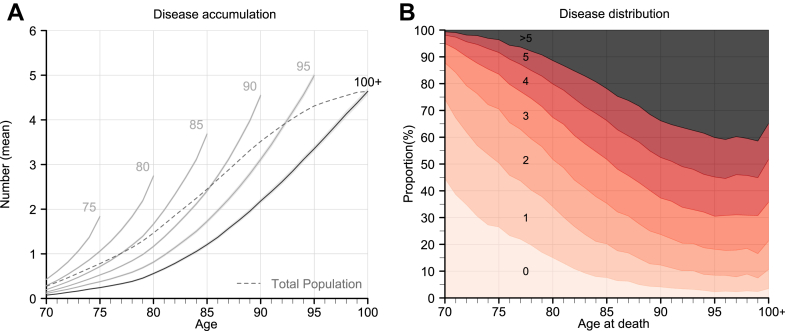
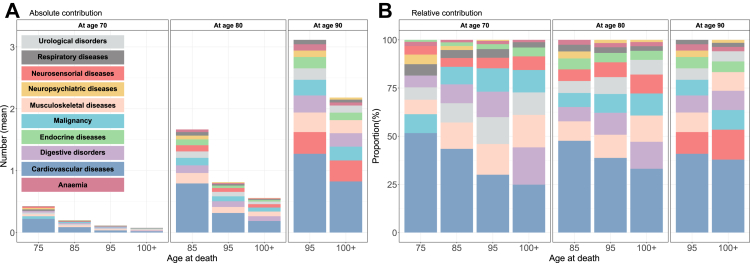
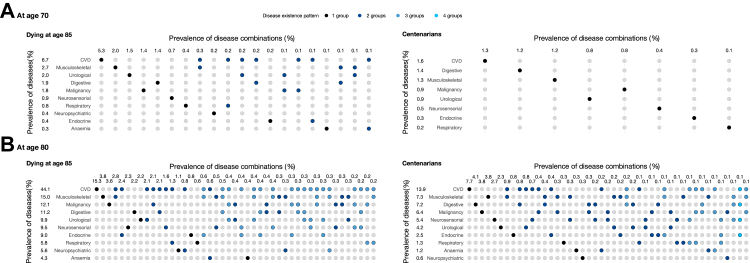
Findings: Centenarians had fewer diagnosed conditions and accumulated diseases at a slower rate than non-centenarians. Cardiovascular diseases were the most common diagnoses in all age groups, but contributed less to the overall disease burden among centenarians. In contrast, malignancies accounted for a relatively larger share of their disease profile. Neuropsychiatric conditions were consistently less common among centenarians, showing the largest relative difference across all ages. Centenarians also had fewer co-occurring diseases and were more likely to have conditions confined to a single disease group.
Interpretation: Our findings of a lower overall disease burden, a delayed onset of multiple conditions, and fewer co-occurring diseases over time among centenarians (compared to non-centenarians) suggest a preserved homeostatic capacity and sustained functional integrity in the face of cumulative physiological stressors. Future research should aim to identify genetic, epigenetic, and environmental factors underlying these patterns to inform early-life preventive strategies that promote longevity and resilience.
Funding: Karolinska Institutet.
Keywords: Birth cohort; Centenarians; Health resilience; Longevity; Multimorbidity; Prevalence.
© 2025 The Author(s).
Conflict of interest statement
YZ declares support from internal KID funding, a block grant for partial funding of doctoral education from Karolinska Institutet. KM declares research project grant from Swedish Research Council for Health, Working Life and Welfare (FORTE) and being a board member of the National Screening Board at the Swedish National Board of Health and Welfare during the past 36 months. All other authors declare no competing interests.
Figures
References
-
- Willcox D.C., Willcox B.J., Wang N.C., He Q., Rosenbaum M., Suzuki M. Life at the extreme limit: phenotypic characteristics of supercentenarians in Okinawa. J Gerontol A Biol Sci Med Sci. 2008;63(11):1201–1208. - PubMed
LinkOut - more resources
Full Text Sources
