Pregnancy in patients with pulmonary hypertension: a systematic review and meta-analysis with meta-regression
- PMID: 40809209
- PMCID: PMC12340376
- DOI: 10.21037/jtd-2025-430
Pregnancy in patients with pulmonary hypertension: a systematic review and meta-analysis with meta-regression
Abstract
Background: Pregnancy in patients with significant pulmonary hypertension (PH) is a contraindication due to high maternal and fetal mortality. However, recent data shows that an increasing number of women with PH are successfully carrying pregnancies to term, likely because of advancements in multidisciplinary care and treatment. This systematic review and meta-analysis aims to evaluate recent outcomes and identify risk factors associated with morbidity and mortality in this high-risk group.
Methods: An unrestricted search was conducted across MEDLINE, EMBASE, and Cochrane databases for studies on outcomes in pregnant patients with PH from inception until May 30, 2024. For one-group analyses, event rates and 95% confidence interval (CI) were calculated using a random-effects model. Meta-regression was performed with Comprehensive Meta-Analysis version 4, employing covariates in logistic regression models. For two-group comparisons, odd ratios (ORs) and 95% CIs were calculated using Review Manager version 5.4 utilizing a random-effects model.
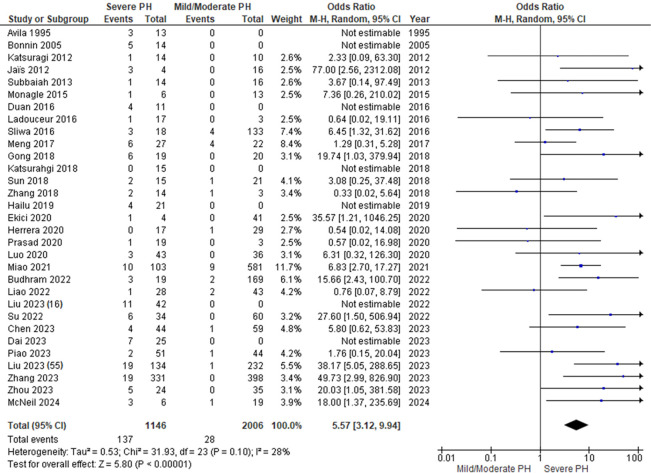
Results: Fifty-one studies involving 4,583 pregnant patients with PH were included. The maternal mortality rate was 7.6% (95% CI: 5.8-9.9%). Most deaths (93%) occurred in the postpartum period. Severe PH was associated with a significantly higher rate of maternal mortality compared to mild/moderate PH with OR 5.57 (95% CI: 3.12-9.94). Higher systolic pulmonary artery pressure (sPAP) was associated with a higher mortality rate with a regression coefficient of 0.96. Similarly, the presence of Eisenmenger syndrome (ES) was linked to a higher mortality rate with a regression coefficient of 1. Severe PH was also associated with higher rates of abortion (OR =3.64, 95% CI: 2.61-5.09), prematurity (OR =2.52, 95% CI: 1.66-3.81), and small gestational age (OR =3.96, 95% CI: 2.96-5.29) compared with mild/moderate PH.
Conclusions: Although the outcomes of pregnant patients with PH continue to improve, severe PH continues to be associated with a high mortality rate, abortion rate, prematurity, and small gestational age. Our findings support the existing consensus against pregnancy in severe PH and emphasize the need for thorough, individualized discussions about risks for patients with mild/moderate PH.
Keywords: Pulmonary hypertension (PH); maternal mortality; pregnancy; systolic pulmonary artery hypertension.
Copyright © 2025 AME Publishing Company. All rights reserved.
Conflict of interest statement
Conflicts of Interest: All authors have completed the ICMJE uniform disclosure form (available at https://jtd.amegroups.com/article/view/10.21037/jtd-2025-430/coif). C.G.M. serves as an unpaid editorial board member of Journal of Thoracic Disease from February 2025 to January 2027. The other authors have no conflicts of interest to declare.
Figures

References
LinkOut - more resources
Full Text Sources