


Application of machine learning in combination with mechanistic modeling to predict plasma exposure of small molecules
- PMID: 40809487
- PMCID: PMC12342024
- DOI: 10.3389/fsysb.2023.1180948
Application of machine learning in combination with mechanistic modeling to predict plasma exposure of small molecules
Abstract
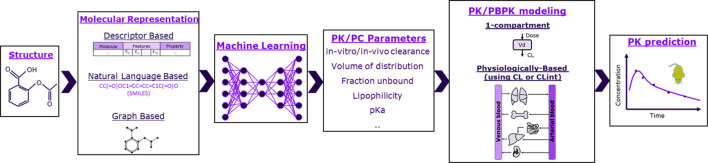
Prediction of a new molecule's exposure in plasma is a critical first step toward understanding its efficacy/toxicity profile and concluding whether it is a possible first-in-class, best-in-class candidate. For this prediction, traditional pharmacometrics use a variety of scaling methods that are heavily based on pre-clinical pharmacokinetic (PK) data. We here propose a novel framework based on which preclinical exposure prediction is performed by applying machine learning (ML) in tandem with mechanism-based modeling. In our proposed method, a relationship is initially established between molecular structure and physicochemical (PC)/PK properties using ML, and then the ML-driven PC/PK parameters are used as input to mechanistic models that ultimately predict the plasma exposure of new candidates. To understand the feasibility of our proposed framework, we evaluated a number of mechanistic models (1-compartment, physiologically based pharmacokinetic (PBPK)), PBPK distribution models (Berezhkovskiy, PK-Sim standard, Poulin and Theil, Rodgers and Rowland, and Schmidt), and PBPK parameterizations (using in vivo, or in vitro clearance). For most of the scenarios tested, our results demonstrate that PK profiles can be adequately predicted based on the proposed framework. Our analysis further indicates some limitations when liver microsomal intrinsic clearance (CLint) is used as the only clearance pathway and underscores the necessity of investigating the variability emanating from the different distribution models when providing PK predictions. The suggested approach aims at earlier exposure prediction in the drug development process so that critical decisions on molecule screening, chemistry design, or dose selection can be made as early as possible.
Keywords: PBPK; QSAR; artificial intelligence; drug discovery; machine learning; model-based drug development; pharmacokinetics.
Copyright © 2023 Mavroudis, Teutonico, Abos and Pillai.
Conflict of interest statement
All authors of this article are employees of Sanofi.
Figures
References
-
- Antontsev V., Jagarapu A., Bundey Y., Hou H., Khotimchenko M., Walsh J., et al. (2021). A hybrid modeling approach for assessing mechanistic models of small molecule partitioning in vivo using a machine learning-integrated modeling platform. Sci. Rep. 11 (1), 11143. 10.1038/s41598-021-90637-1 - DOI - PMC - PubMed
-
- Awad M., Khanna R. (2015). “Support vector regression,” in Efficient learning machines: Theories, concepts, and applications for engineers and system designers (Berkeley, CA: Apress; ), 67–80.
LinkOut - more resources
Full Text Sources
Other Literature Sources
