Particulate Constituents and Posttransplant Outcomes Among Kidney Transplant Recipients
- PMID: 40810939
- PMCID: PMC12355287
- DOI: 10.1001/jamanetworkopen.2025.27142
Particulate Constituents and Posttransplant Outcomes Among Kidney Transplant Recipients
Abstract
Importance: Total particulate matter with a diameter of 2.5 µm or less (PM2.5) has been found to be associated with adverse posttransplant outcomes among kidney transplant (KT) recipients. However, PM2.5 is a complex mixture of multiple constituents, all of which have different toxicity profiles, so it is not clear which constituents are most associated with adverse outcomes among KT recipients.
Objective: To investigate the associations between PM2.5 constituents and post-KT outcomes among KT recipients.
Design, setting, and participants: This cohort study was conducted among patients who received a KT between January 2000 and December 2016 and lived in the contiguous United States. Follow-up continued through December 2021, and data were analyzed from August 2023 to May 2025.
Exposures: Fifteen PM2.5 constituents (including elemental carbon, ammonium, nitrate, organic carbon [OC], sulfate [SO42-], bromine, calcium, copper, iron, potassium, nickel [Ni], lead [Pb], silicon, vanadium, and zinc) at the zip code of residence prior to KT, estimated from ensembled machine learning models.
Main outcomes and measures: Adverse post-KT outcomes included acute rejection, delayed graft function (DGF), death-censored graft failure (DCGF), and mortality. The association of PM2.5 constituents and the outcome were evaluated with weighted quantile sum regressions.
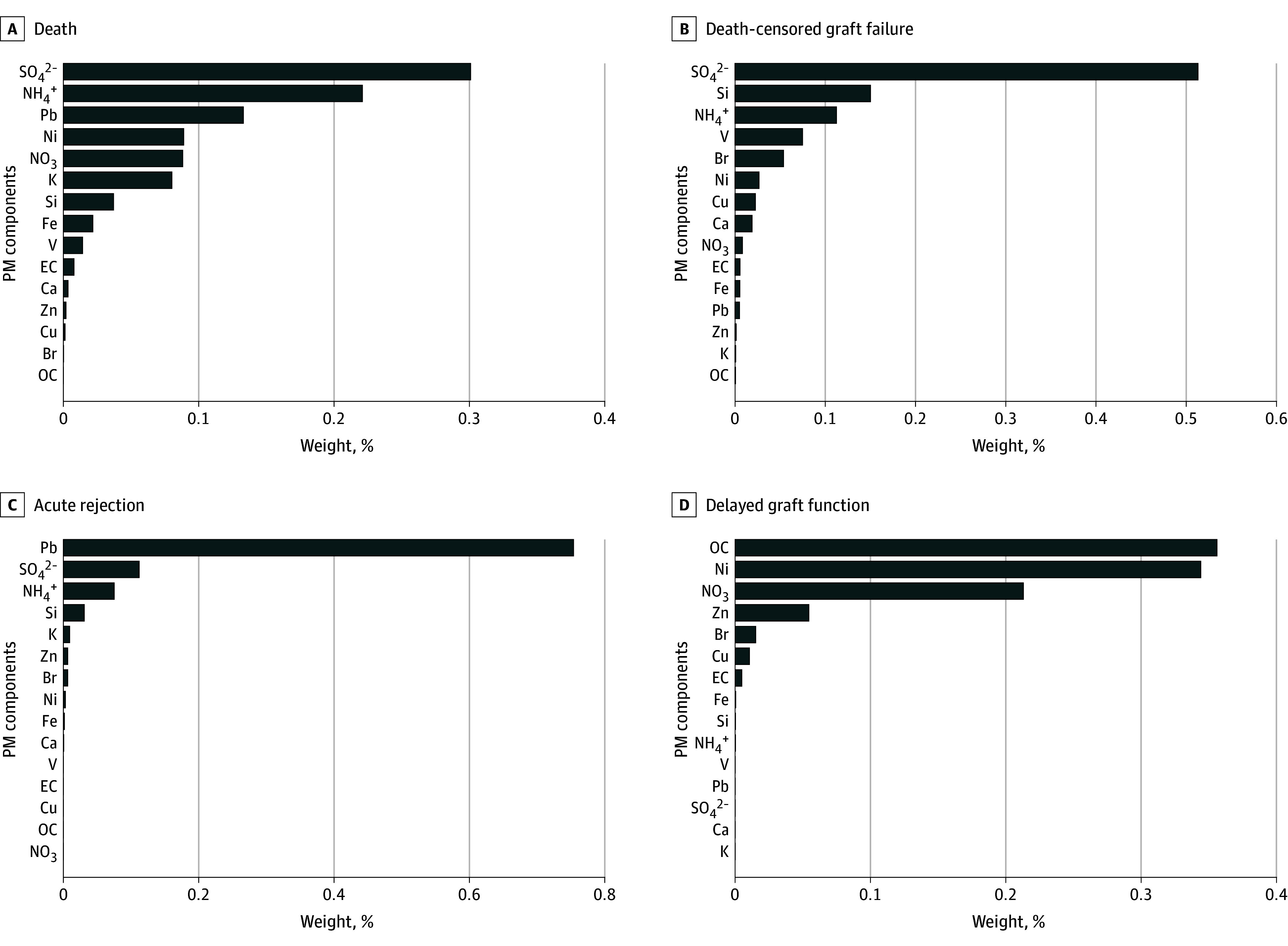
Results: In total, 192 587 KT recipients were included in the analysis (mean [SD] age at transplant, 51.56 [13.47] years; 75 021 [39.0%] female; 51 455 [26.7%] Black, 28 586 [14.8%] Hispanic, and 97 927 [50.8%] White). Each decile increase in the PM2.5 constituent mixture was associated with a 6.8% (95% CI, 5.8%-7.8%) and 3.6% (95% CI, 2.1%-5.1%) increase in the odds of DGF and acute rejection, respectively. OC and Ni contributed the largest weights to the observed association between PM2.5 mixture and DGF (OC: relative importance, 35.6%; Ni: relative importance, 34.4%), while Pb had the largest impact on acute rejection (relative importance, 75.0%). Each decile increase in PM2.5 constituent mixture was associated with a 4.7% (95% CI, 3.3%-6.3%) and 3.9% (95% CI, 2.5%-5.2%) increase in the hazard of DCGF and all-cause mortality, respectively. The constituent that contributed the largest weight to the observed association between PM2.5 mixture and long-term post-KT outcomes was SO42- (relative importance, 51.3%).
Conclusions and relevance: In this cohort study, PM2.5 constituents were associated with an increased risk of adverse posttransplant outcomes among KT recipients. Of the PM2.5 constituents included in this study, SO42- contributed most to long-term outcomes, while Pb, OC, and Ni were more associated with short-term outcomes.
Conflict of interest statement
Figures
References
-
- Calderón-Garcidueñas L, Solt AC, Henríquez-Roldán C, et al. Long-term air pollution exposure is associated with neuroinflammation, an altered innate immune response, disruption of the blood-brain barrier, ultrafine particulate deposition, and accumulation of amyloid beta-42 and alpha-synuclein in children and young adults. Toxicol Pathol. 2008;36(2):289-310. doi: 10.1177/0192623307313011 - DOI - PubMed
MeSH terms
Substances
LinkOut - more resources
Full Text Sources
Medical