


A novel early imaging biomarker for glymphatic function: Cerebral cortical arterial pulsatility index from 2-Minute phase-contrast MRI
- PMID: 40817009
- PMCID: PMC12501337
- DOI: 10.1016/j.tjpad.2025.100323
A novel early imaging biomarker for glymphatic function: Cerebral cortical arterial pulsatility index from 2-Minute phase-contrast MRI
Abstract
Background: Arterial pulsatility is one of the driving forces of glymphatic flow.
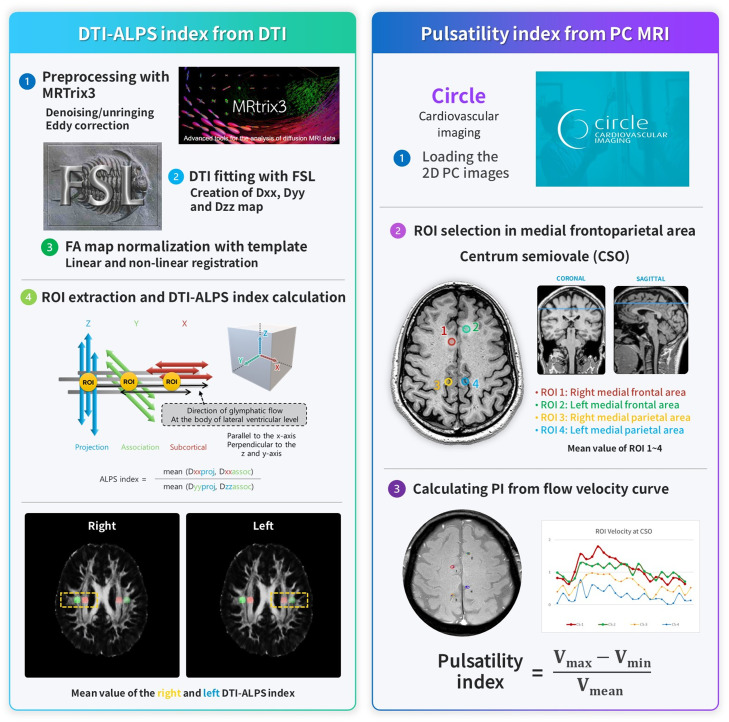
Objectives: To evaluate the feasibility of the pulsatility index (PI) of cortical arteries in the centrum semiovale (PICSO) as a novel non-invasive imaging biomarker for Alzheimer's disease (AD) in the context of glymphatic function.
Design: Retrospective cross-sectional study.
Setting: Single tertiary academic center equipped with both 3.0 T MRI systems.
Participants: A total of 160 individuals were enrolled: 50 healthy volunteers, 46 cognitively normal controls, and 64 AD patients who underwent diffusion tensor imaging (DTI) and 2D phase-contrast MRI.
Measurements: Diffusion Tensor Imaging Analysis along the Perivascular Space (DTI-ALPS) index and PICSO were assessed using 2D phase-contrast MRI. Correlations with age, DTI-ALPS index, and Mini-Mental State Examination (MMSE) scores were analyzed.
Results: PICSO was significantly higher in the AD group than those in healthy volunteers (P<0.001) and cognitively normal aging (P=0.001) groups. PICSO correlated positively with age (rho=0.613, P<0.001) and negatively with both the DTI-ALPS index (rho=-0.439, P<0.001) and MMSE scores (rho=-0.486, P<0.001) in total group.
Conclusion: PICSO derived from 2D phase-contrast 3.0T MRI may serve as a novel imaging biomarker for Alzheimer's disease in relation to glymphatic function.
Keywords: 2D Phase-contrast MRI; Alzheimer’s disease; Glymphatics; Pulsatility index.
Copyright © 2025. Published by Elsevier Masson SAS.
Conflict of interest statement
Declaration of competing interest The authors declare that they have no known competing financial interests or personal relationships that could have appeared to influence the work reported in this paper.
Figures




References
-
- De la Torre J. Impaired brain microcirculation may trigger Alzheimer's disease. Neurosci Biobehav Rev. 1994;18:397–401. - PubMed
-
- Knopman D. Cerebrovascular disease and dementia. Br J Radiol. 2007;80:S121–S127. - PubMed
-
- Roher A.E., Esh C., Rahman A., Kokjohn T.A., Beach T.G. Atherosclerosis of cerebral arteries in Alzheimer disease. Stroke. 2004;35:2623–2627. - PubMed
-
- Tormos A, Taléns Visconti R, Pérez Garrido S, Rius Pérez S. Vascular pathology: cause or effect in Alzheimer disease? 2018. - PubMed
MeSH terms
Substances
LinkOut - more resources
Full Text Sources
Medical
Research Materials
Miscellaneous
