


First the B cells fall, then the T cells follow: temporal immunological shift with ocrelizumab in multiple sclerosis
- PMID: 40819018
- PMCID: PMC12357791
- DOI: 10.1007/s00415-025-13297-5
First the B cells fall, then the T cells follow: temporal immunological shift with ocrelizumab in multiple sclerosis
Abstract
Background: Ocrelizumab (OCR) is a humanized anti-CD20 monoclonal antibody approved for multiple sclerosis (MS). While its efficacy has been attributed to early and sustained B cell depletion, emerging evidence suggests a broader immunomodulatory profile.
Objectives: To investigate temporal dynamics of OCR-induced immune modulation in MS by analyzing pathway enrichment score changes in transcriptomic data from peripheral blood mononuclear cells (PBMCs) at early (2 weeks) and late (6 months) timepoints following treatment initiation.
Methods: We analyzed publicly available microarray data (GSE228330) from PBMCs of 15 MS patients treated with OCR. Immune cell subpopulations were estimated using CIBERSORTx with the LM22 signature matrix. Gene Set Variation Analysis (GSVA) was applied to quantify immune-related pathway enrichment across three timepoints-baseline, 2 weeks, and 6 months.
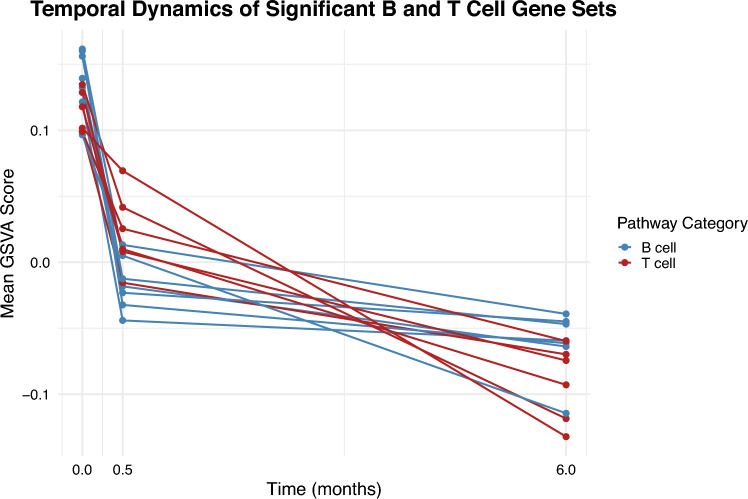
Results: Early effects were characterized by selective suppression of B cell-related pathways, including antigen presentation via MHC-II, B cell proliferation, and survival. These changes were accompanied by compensatory upregulation of anti-inflammatory and innate immune signaling (e.g., IL-10, monocyte chemotaxis). At 6 months, B cell pathway suppression persisted and deepened, while T cell-specific pathways (e.g., CD4+ T-cell activation and cytokine production) showed significant downregulation, indicating a delayed but substantial impact on adaptive cellular immunity. At 6 months, T reg compartment was reconfigured, with overall T reg transcription enhanced versus T effector cells, quiescent and thymic‑mature signatures reduced, and IL‑4-induced T reg program enriched.
Conclusions: OCR exerts a biphasic immunomodulatory effect, with rapid direct suppression of B cell pathways followed by delayed indirect modulation of T cell-mediated immunity.
Keywords: B cells; Gene set variation analysis; Multiple sclerosis; Ocrelizumab; T cells.
© 2025. The Author(s).
Conflict of interest statement
Declarations. Conflicts of interest: The authors declare that they have no conflict of interest.
Figures
References
-
- Bar-Or A, Calkwood JC, Chognot C, Evershed J, Fox EJ, Herman A, Manfrini M, McNamara J, Robertson DS, Stokmaier D, Wendt JK, Winthrop KL, Traboulsee A (2020) Effect of ocrelizumab on vaccine responses in patients with multiple sclerosis: the VELOCE study. Neurology 95(14):e1999–e2008. 10.1212/WNL.0000000000010380 - PMC - PubMed
-
- Gurski CJ, Hajiyeva Z, Veltri AJ, Fenton K, O’Dell S, Obeidat AZ, Dittel BN (2025) Elevated frequencies of activated memory B cells in multiple sclerosis are reset to healthy control levels after B cell depletion with Ocrelizumab. J Neuroimmunol 399:578502. 10.1016/j.jneuroim.2024.578502 - PMC - PubMed
-
- Abbadessa G, Miele G, Maida E, Vanore E, Cipriano L, Coppola C, Lavorgna L, Bonavita S (2023) Immunomodulatory effects of ocrelizumab and candidate biomarkers for monitoring treatment response in multiple sclerosis. Mult Scler 29(7):779–788. 10.1177/13524585221147635 - PubMed
-
- Fernández-Velasco JI, Kuhle J, Monreal E, Meca-Lallana V, Meca-Lallana J, Izquierdo G, Gascón-Giménez F, Sainz de la Maza S, Walo-Delgado PE, Maceski A, Rodríguez-Martín E, Roldán E, Villarrubia N, Saiz A, Blanco Y, Sánchez P, Carreón-Guarnizo E, Aladro Y, Brieva L, Íñiguez C, González-Suárez I, Rodríguez de Antonio LA, Masjuan J, Costa-Frossard L, Villar LM (2021) Effect of ocrelizumab in blood leukocytes of patients with primary progressive MS. Neurol Neuroimmunol Neuroinflamm 2:e940. 10.1212/NXI.0000000000000940 - PMC - PubMed
-
- Mathias A, Pantazou V, Perriot S, Canales M, Jones S, Oberholster L, Moulin M, Fenwick C, Bernard-Valnet R, Théaudin M, Pot C, Du Pasquier RA (2023) Ocrelizumab impairs the phenotype and function of memory CD8+ T cells: a 1-year longitudinal study in patients with multiple sclerosis. Neurol Neuroimmunol Neuroinflamm 10(2):e200084. 10.1212/NXI.0000000000200084 - PMC - PubMed
MeSH terms
Substances
LinkOut - more resources
Full Text Sources
Medical
Research Materials
