Anti-ribosomal-P protein antibodies and systemic lupus erythematosus (SLE): in a cross-sectional study of Danish adult patients with SLE, no significant association is found between anti-ribosomal-P and neuropsychiatric SLE
- PMID: 40819906
- PMCID: PMC12359534
- DOI: 10.1136/lupus-2025-001550
Anti-ribosomal-P protein antibodies and systemic lupus erythematosus (SLE): in a cross-sectional study of Danish adult patients with SLE, no significant association is found between anti-ribosomal-P and neuropsychiatric SLE
Abstract
Objective: The primary objective was to assess the prevalence of anti-ribosomal-P protein antibodies (anti-Rib-P) in a well-characterised Danish adult SLE cohort. Secondary objectives included (1) assessing any association between anti-Rib-P and neuropsychiatric SLE (NPSLE), (2) assessing any association between anti-Rib-P and characteristics of Danish patients with SLE and (3) assessing potential associations between selected autoantibodies and NPSLE.
Method: This cross-sectional study included 198 Danish patients with SLE from a population-based cohort. Patients meet the American College of Rheumatology's 1997 revised classification criteria for SLE and were 18 years of age or older. Anti-Rib-P were detected in serum using fluorescence enzyme immunoassay. ANA patterns were tested using indirect immunofluorescence on HEp-2 cells. Anti-double-stranded DNA antibody was examined by manual ELISA, and antibodies targeting Ro/SSA, La/SSB, Sm, RNP, Scl-70, Jo-1, Centromer B and Histone were examined on a Luminex instrument.
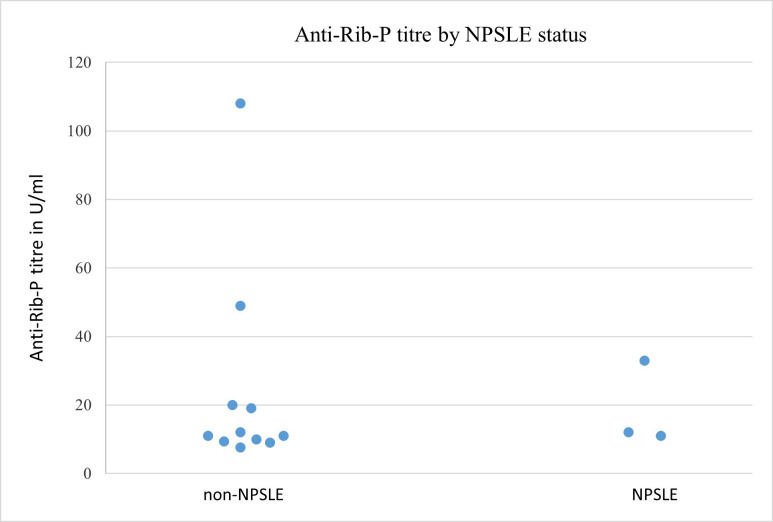
Results: We identified 14 (7.1%) patients with anti-Rib-P positive SLE, and 3 anti-Rib-P positive patients were diagnosed with NPSLE (21% of patients with NPSLE). There was no statistically significant association between anti-Rib-P and NPSLE. The mean anti-Rib-P titres in the patients with NPSLE did not differ significantly from patients without NPSLE patients' titres. We observed a significant association between anti-Rib-P positivity and disease activity measured by the SLEDAI-2K (SLE Disease Activity Index 2000) score. A stepwise logistic regression found an association between NPSLE and SLEDAI-2K and SLICC DI (SLE International Collaborating Clinics Damage Index) score.
Conclusion: This study could not confirm a role for anti-Rib-P in the identification of NPSLE. On the other hand, anti-Rib-P was associated with SLE disease activity as well as organ damage.
Keywords: Antibodies; Autoantibodies; Autoimmune Diseases; Autoimmunity; Lupus Erythematosus, Systemic.
© Author(s) (or their employer(s)) 2025. Re-use permitted under CC BY-NC. No commercial re-use. See rights and permissions. Published by BMJ Group.
Conflict of interest statement
Competing interests: None declared.
Figures
References
-
- Arinuma Y, Kikuchi H, Hirohata S. Anti-ribosomal P protein antibodies influence mortality of patients with diffuse psychiatric/neuropsychological syndromes in systemic lupus erythematous involving a severe form of the disease. Mod Rheumatol. 2019;29:612–8. doi: 10.1080/14397595.2018.1508801. - DOI - PubMed
MeSH terms
Substances
LinkOut - more resources
Full Text Sources
Medical
Research Materials
Miscellaneous