


Increasing temperatures counteract the evolutionary consequences of fishing in model of Northeast Arctic Cod (Gadus morhua)
- PMID: 40820176
- PMCID: PMC12358614
- DOI: 10.1038/s41598-025-15394-x
Increasing temperatures counteract the evolutionary consequences of fishing in model of Northeast Arctic Cod (Gadus morhua)
Abstract
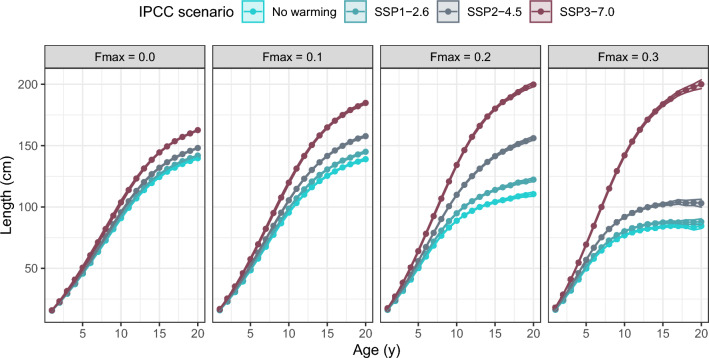
Fisheries and climate warming are two stressors known to induce evolutionary changes in fish life histories. While their independent effects have been well documented, their interactive effects are less charted, although likely important for sustainable fisheries management and conservation strategies. We investigated the evolutionary responses of the Northeast Arctic cod stock (Gadus morhua) to warming temperatures and fishing pressure using a mechanistic modeling approach. Our individual-based simulation model incorporates explicit energy and oxygen budgets, and a simplified genetics framework to capture the complex interactions among traits governing energy acquisition/allocation and maturation schedules. Our results provide a theoretical basis for positive consequences for this particular cod stock in a warming climate. Warmer temperatures increased the aerobic scope, which reduced natural mortality. We found that if food availability and temperature are not linked, a warming climate leads to larger population sizes. By selecting for maturation at larger sizes, adaptation to warming climate at least partially counteracts the evolutionary consequences of fishing, namely smaller body sizes and earlier maturation. Our findings emphasize the benefits of adaptive management approaches, considering fish as evolving organisms and integrating ocean warming into fisheries management strategies.
Keywords: Climate; Eco-evolutionary dynamics; Fishing pressure; IBM modelling.
© 2025. The Author(s).
Conflict of interest statement
Declarations. Competing interests: The authors declare no competing interests.
Figures




References
-
- The United Nations. Transforming our world: the 2030 Agenda for Sustainable Development. United Nations. (2015).
-
- FAO. The State of World Fisheries and Aquaculture 2022: Towards Blue Transformation. The State of World Fisheries and Aquaculture (SOFIA) 2022. Rome, Italy: FAO. 266 pp. isbn: 978-92-5-136364-5. 10.4060/cc0461en (2022).
-
- ICES. Arctic Fisheries Working Group (AFWG). Volume 3, Issue 58. International Council for the Exploration of the Seas, pp. 1–832 (2021).
MeSH terms
LinkOut - more resources
Full Text Sources
