


Regular nasal irrigation modulates nasal microbiota and improves symptoms in allergic rhinitis patients: a retrospective study
- PMID: 40821047
- PMCID: PMC12351610
- DOI: 10.62347/POVL4849
Regular nasal irrigation modulates nasal microbiota and improves symptoms in allergic rhinitis patients: a retrospective study
Abstract
Objectives: To evaluate the effects of regular nasal irrigation on nasal microbiota and symptom improvement in allergic rhinitis patients.
Methods: This retrospective study involved 202 allergic rhinitis patients. Participants were divided into a conventional treatment group (mometasone furoate spray and loratadine) and an observation group (nasal irrigation added to the conventional regimen). Nasal microbiota diversity, biofilm formation, nasal symptoms, and quality of life were assessed before and after a one month of treatment. A correlation analysis was performed to evaluate the relationships between nasal irrigation and clinical outcomes.
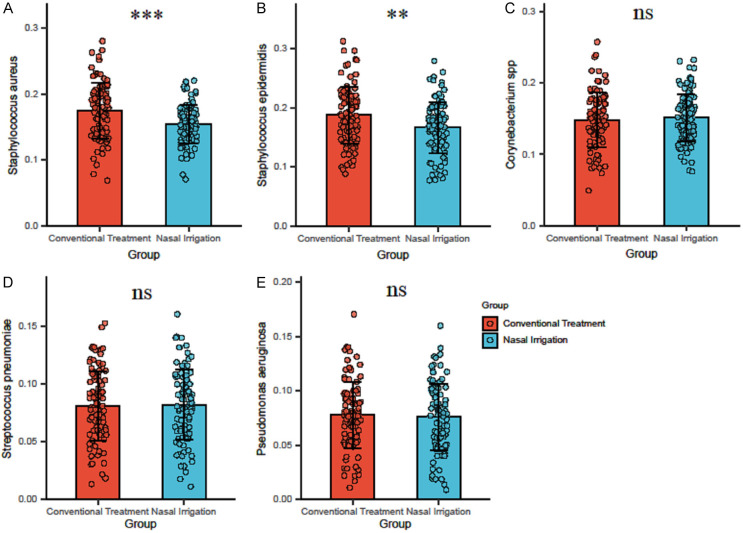
Results: The nasal irrigation group exhibited significant reductions in nasal microbiota richness (P = 0.014), biofilm-forming Staphylococcus aureus and Staphylococcus epidermidis (P < 0.001, P = 0.001, respectively), with improvements in nasal pruritus, rhinorrhea, congestion, and sneezing (all P < 0.05), compared to the conventional treatment group. Post-treatment, the nasal irrigation group showed more notable improvement in quality of life scores (P = 0.007). Correlation analysis revealed significant associations between nasal irrigation, reduced microbial richness, and symptom severity.
Conclusions: Regular nasal irrigation serves as an effective adjunctive treatment for allergic rhinitis by modulating nasal microbiota, alleviating symptoms, and enhancing quality of life.
Keywords: Allergic rhinitis; biofilm formation; nasal irrigation; nasal microbiota; quality of life; symptom improvement.
AJTR Copyright © 2025.
Conflict of interest statement
None.
Figures

References
-
- Wise SK, Damask C, Roland LT, Ebert C, Levy JM, Lin S, Luong A, Rodriguez K, Sedaghat AR, Toskala E, Villwock J, Abdullah B, Akdis C, Alt JA, Ansotegui IJ, Azar A, Baroody F, Benninger MS, Bernstein J, Brook C, Campbell R, Casale T, Chaaban MR, Chew FT, Chambliss J, Cianferoni A, Custovic A, Davis EM, DelGaudio JM, Ellis AK, Flanagan C, Fokkens WJ, Franzese C, Greenhawt M, Gill A, Halderman A, Hohlfeld JM, Incorvaia C, Joe SA, Joshi S, Kuruvilla ME, Kim J, Klein AM, Krouse HJ, Kuan EC, Lang D, Larenas-Linnemann D, Laury AM, Lechner M, Lee SE, Lee VS, Loftus P, Marcus S, Marzouk H, Mattos J, McCoul E, Melen E, Mims JW, Mullol J, Nayak JV, Oppenheimer J, Orlandi RR, Phillips K, Platt M, Ramanathan M Jr, Raymond M, Rhee CS, Reitsma S, Ryan M, Sastre J, Schlosser RJ, Schuman TA, Shaker MS, Sheikh A, Smith KA, Soyka MB, Takashima M, Tang M, Tantilipikorn P, Taw MB, Tversky J, Tyler MA, Veling MC, Wallace D, Wang Y, White A, Zhang L. International consensus statement on allergy and rhinology: allergic rhinitis - 2023. Int Forum Allergy Rhinol. 2023;13:293–859. - PubMed
-
- Vardouniotis A, Doulaptsi M, Aoi N, Karatzanis A, Kawauchi H, Prokopakis E. Local allergic rhinitis revisited. Curr Allergy Asthma Rep. 2020;20:22. - PubMed
-
- Okano M, Fujieda S, Gotoh M, Kurono Y, Matsubara A, Ohta N, Kamijo A, Yamada T, Nakamaru Y, Asako M, Sakurai D, Terada T, Yonekura S, Sakashita M, Okubo K. Executive summary: Japanese guidelines for allergic rhinitis 2020. Allergol Int. 2023;72:41–53. - PubMed
-
- Okubo K, Kurono Y, Ichimura K, Enomoto T, Okamoto Y, Kawauchi H, Suzaki H, Fujieda S, Masuyama K. Japanese guidelines for allergic rhinitis 2020. Allergol Int. 2020;69:331–345. - PubMed
-
- Choi S, Jung MA, Hwang YH, Pyun BJ, Lee JY, Jung DH, Ji KY, Kim T. Anti-allergic effects of Asarum heterotropoides on an ovalbumin-induced allergic rhinitis murine model. Biomed Pharmacother. 2021;141:111944. - PubMed
LinkOut - more resources
Full Text Sources