


Research progress of nano-based drug delivery systems based on stimuli-responsive materials for the treatment of lung diseases
- PMID: 40821672
- PMCID: PMC12350321
- DOI: 10.3389/fbioe.2025.1644007
Research progress of nano-based drug delivery systems based on stimuli-responsive materials for the treatment of lung diseases
Abstract
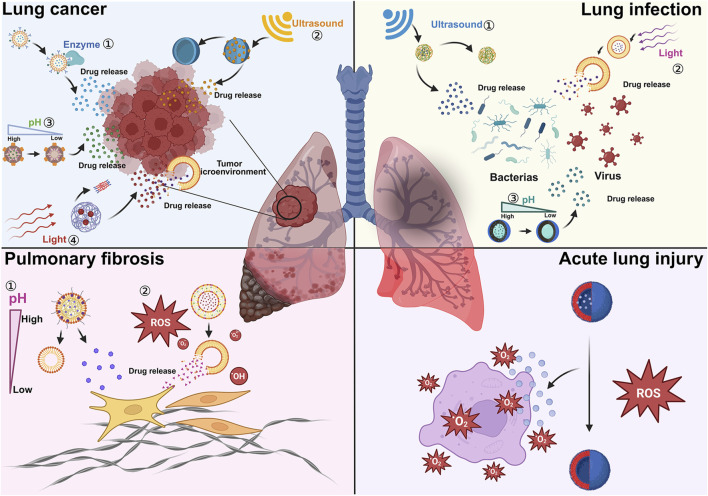
Since the lungs are directly connected to the external environment and have a rich blood supply, they are susceptible to damage and tumor growth. However, the pharmacokinetics of traditional drugs in the lungs are limited when administered orally or intravenously, posing challenges for clinical treatment. Compared to traditional drug delivery methods, nano-based drug delivery systems (NDDSs) have the advantages of high drug loading capacity, strong targeting, low cellular toxicity, and extended circulation time in the blood. Stimuli-responsive materials, often referred to as "smart" materials, are a class of functional materials that can change their properties in response to various stimuli in both internal and external environments. Therefore, stimuli-responsive materials have gradually become promising candidates for NDDSs. To date, many stimuli-responsive NDDSs have been developed for treating lung diseases. Our review primarily summarizes the novel NDDSs that have emerged in recent years for treating common benign and malignant lesions in the lungs, based on stimuli-responsive materials. Finally, we discussed the existing issues in stimuli-responsive NDDSs and looked forward to their future development prospects.
Keywords: NDDSs; internal and external environments; lung diseases; stimuli-responsive materials; treatment.
Copyright © 2025 Li, Huang, Li, Wen, Chen, Fan, Shen, Gong, Luo and Deng.
Conflict of interest statement
The authors declare that the research was conducted in the absence of any commercial or financial relationships that could be construed as a potential conflict of interest.
Figures
References
Publication types
LinkOut - more resources
Full Text Sources
