


Immunological microenvironment and targeted therapeutics in multiple sclerosis: new insights in crosstalk between immune niches and CNS
- PMID: 40821839
- PMCID: PMC12353690
- DOI: 10.3389/fimmu.2025.1604987
Immunological microenvironment and targeted therapeutics in multiple sclerosis: new insights in crosstalk between immune niches and CNS
Abstract
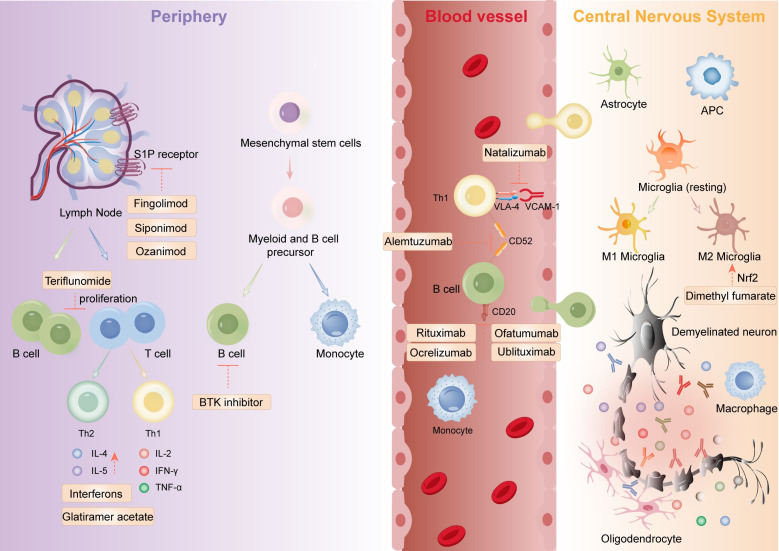
Multiple sclerosis (MS) is a chronic autoimmune disorder of the central nervous system (CNS) that predominantly affects young adults. However, current disease-modifying therapies demonstrate limited efficacy in addressing progressive disease subtypes, underscoring the urgent need for novel therapeutic strategies. Here, we systematically review the neuroimmune interactions underlying the pathogenesis of MS, with a focus on three key aspects: the immune niche, immune cell types, and cell-based therapies. We first discuss the evolution of brain-immune concepts, from early notions of immune privilege to modern understandings of brain-border immune niches (meninges, choroid plexus, and perivascular spaces). These compartments serve as critical interfaces where peripheral immune cells interact with CNS-resident immune cells. We then analyze the roles of specific immune cell subsets (e.g., T/B cells, myeloid cells and microglia) in disease progression, highlighting their functional heterogeneity across different MS subtypes. Furthermore, we highlight emerging MS immunotherapies-including chimeric antigen receptor (CAR) T regimens, mesenchymal stem cell interventions, microbiome modulation, and nanodelivery systems, which strategically target mechanistic nodes spanning neuroimmune niche regulation, inflammatory cascade blockade, and CNS neurorestorative capacities.
Keywords: autoimmune; cerebral immune niches; multiple sclerosis; neuroimmune; targeted therapy.
Copyright © 2025 Sun, Zhang, Wang, Lee, Yang, Zhou, Chang, Hu and Zhou.
Conflict of interest statement
The authors declare that the research was conducted in the absence of any commercial or financial relationships that could be construed as a potential conflict of interest.
Figures

References
Publication types
MeSH terms
LinkOut - more resources
Full Text Sources
Medical
