


Water Absorption Capacity and Agricultural Utility of Biopolymer-Based Hydrogels: A Systematic Review and Meta-Analysis
- PMID: 40821875
- PMCID: PMC12355620
- DOI: 10.1021/acspolymersau.5c00019
Water Absorption Capacity and Agricultural Utility of Biopolymer-Based Hydrogels: A Systematic Review and Meta-Analysis
Abstract
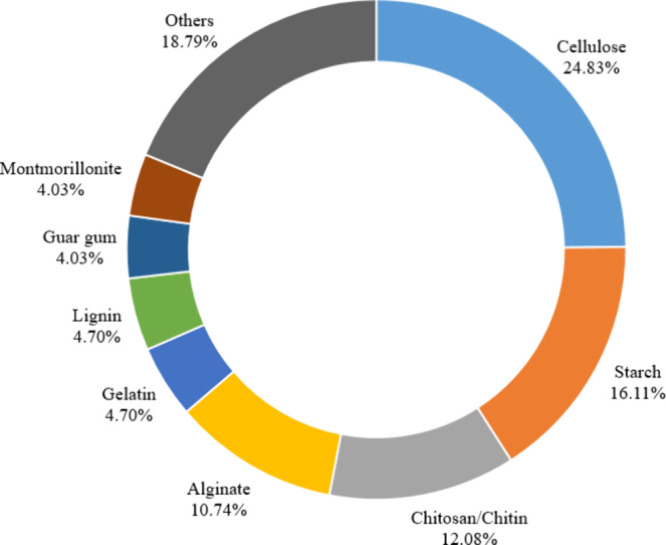
This review aims to elucidate the relationship between hydrogel composition and water absorption capacity, with a focus on biobased hydrogels, the influence of their constituents on water absorption, and their relevance to agricultural applications. The most frequently used biopolymers are cellulose, starch, chitosan/chitin, and alginate, all of which are derivable from agroindustrial waste, offering sustainable and environmentally friendly sourcing. These polymers possess a high amount of hydrophilic functional groups, enhancing their affinity for water and enabling the formation of highly absorbent hydrogels. Cross-linking agents further affect the hydrogel's swelling capacity by altering the number of available hydrophilic groups. Among them, N,N'-methylenebis-(acrylamide) is the most prevalent due to its ability to form stable networks, favoring high water absorption. However, concerns persist regarding their persistence in soil and potential environmental toxicity upon degradation. Citric acid has emerged as a promising alternative, reflecting a shift toward environmentally safer strategies. Beyond water absorption and retention, hydrogels exhibit potential as carriers for fertilizers and bioactive compounds, enabling the controlled release and availability in soil. A few studies included in this review have explored the incorporation of beneficial microorganisms, such as , , and , into hydrogel matrices, offering a clean and effective approach for agricultural enhancement that remains underexplored. This review highlights the connection between hydrogel composition and water absorption properties, identifying ecofriendly alternatives for hydrogel synthesis and applications in agriculture. It also reveals gaps in the development of sustainable, efficient hydrogels that could contribute to more environmentally friendly practices.
Keywords: agriculture; agroindustrial waste; biopolymers; cross-linking; fertilizer carriers; mass swelling; soil conditioners; sustainable materials.
© 2025 The Authors. Published by American Chemical Society.
Figures




References
-
- Guilherme M. R., Aouada F. A., Fajardo A. R., Martins A. F., Paulino A. T., Davi M. F. T., Rubira A. F., Muniz E. C.. Superabsorbent Hydrogels Based on Polysaccharides for Application in Agriculture as Soil Conditioner and Nutrient Carrier: A Review. Eur. Polym. J. 2015;72:365–385. doi: 10.1016/j.eurpolymj.2015.04.017. - DOI
-
- Tariq Z., Iqbal D. N., Rizwan M., Ahmad M., Faheem M., Ahmed M.. Significance of Biopolymer-Based Hydrogels and Their Applications in Agriculture: A Review in Perspective of Synthesis and Their Degree of Swelling for Water Holding. RSC Adv. 2023;13(35):24731–24754. doi: 10.1039/D3RA03472K. - DOI - PMC - PubMed
-
- Sroka K., Sroka P.. Superabsorbent Hydrogels in the Agriculture and Reclamation of Degraded Areas. Sustainability. 2024;16(7):2945. doi: 10.3390/su16072945. - DOI
Publication types
LinkOut - more resources
Full Text Sources