


Resistance or compliance? The impact of algorithmic awareness on people's attitudes toward online information browsing
- PMID: 40823401
- PMCID: PMC12354539
- DOI: 10.3389/fpsyg.2025.1563592
Resistance or compliance? The impact of algorithmic awareness on people's attitudes toward online information browsing
Abstract
Introduction: With the pervasive integration of big data algorithms into daily life, individuals increasingly rely on algorithmic filtering to access information of interest, yet simultaneously face the risk of confinement within "information cocoons." This study examines how algorithmic awareness influences people's attitudes toward online information browsing.
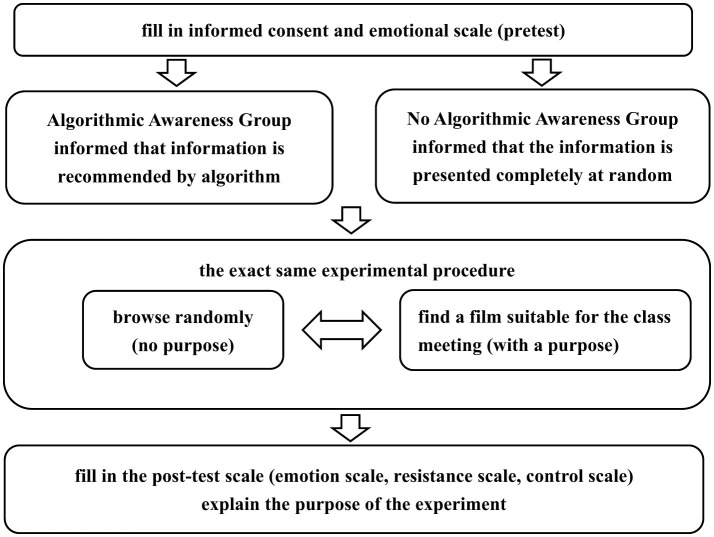
Methods: Using a 2 × 2 mixed design (algorithmic awareness × browsing purpose), this study reveals the mediating roles of perceived power and internal control. Participants performed simulated information-seeking tasks where all content was randomly presented (eliminating actual algorithmic bias). Mediating roles of perceived power and internal control were analyzed using PROCESS macro.
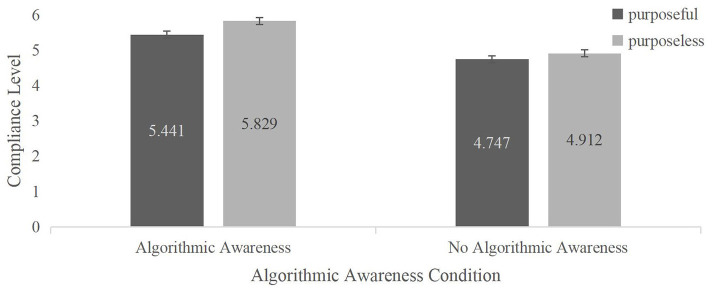
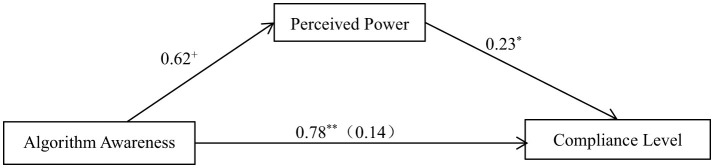
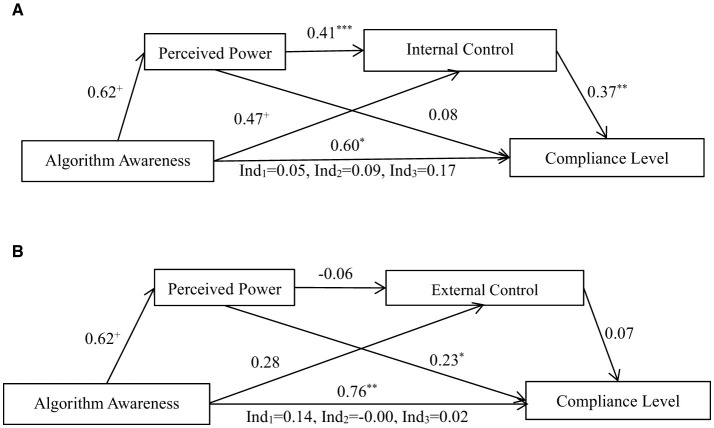
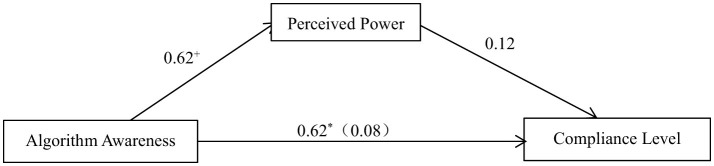
Results: Algorithmic awareness significantly increases people's compliance, especially when they browse online information with a certain purpose, despite all information in the experiment being presented randomly. Algorithmic awareness increases people's sense of power and internal control over information, which, in turn, increases algorithmic compliance behavior.
Discussion: Results reveal that algorithmic awareness reshapes user behavior through psychological empowerment, even in algorithm-neutral environments. By studying the influencing factors of mobile new media users' compliance and resistance to algorithms, this study is helpful in assisting users to eliminate their state of technological unconsciousness and achieve good algorithmic use.
Keywords: algorithmic consciousness; compliance; internal control; perceived power; resistance.
Copyright © 2025 Yuan, Shi, Su and Zhang.
Conflict of interest statement
The authors declare that the research was conducted in the absence of any commercial or financial relationships that could be construed as a potential conflict of interest.
Figures
References
-
- Anderson C., Galinsky A. D. (2006). Power, optimism, and risk-taking. Eur. J. Soc. Psychol. 36, 511–536. 10.1002/ejsp.324 - DOI
-
- Bao L. L., Zhao Y. R. (2023). Research on the factors affecting the manipulation of short video users by algorithms - from the perspective of information technology identification. Modern Publ. 5, 40–54. 10.3969/j.issn.2095-0330.2023.05.005 - DOI
-
- Beer D. (2009). Power through the algorithm? Participatory web cultures and the technological unconscious. New Media Soc. 11, 985–1002. 10.1177/1461444809336551 - DOI
-
- Beer D. (2017). The social power of algorithms. Inf. Commun. Soc. 20, 1–13. 10.1080/1369118X.2016.1216147 - DOI
LinkOut - more resources
Full Text Sources
