Review
. 2025 Aug 18;30(1):760.
doi: 10.1186/s40001-025-03003-6.

Emerging biomarkers for early cancer detection and diagnosis: challenges, innovations, and clinical perspectives

Affiliations
Review

Emerging biomarkers for early cancer detection and diagnosis: challenges, innovations, and clinical perspectives

Sameen Zafar et al. Eur J Med Res. .

Abstract

Early detection and accurate cancer diagnosis are crucial for improving patient outcomes and survival rates. This review presents a comprehensive and updated synthesis of emerging biomarkers, essential for providing non-invasive, efficient, and reliable methods to identify cancer in its early stages. An extensive literature review focuses on recent studies and advancements in both traditional and emerging biomarkers, including circulating tumor DNA (ctDNA), exosomes, liquid biopsies, microRNAs (miRNAs), and immunotherapy biomarkers, which show promising potential for early cancer detection. Liquid biopsies, nanobiosensors, artificial intelligence, and next-generation sequencing (NGS) are transforming biomarker discovery and application. Key challenges include low concentration and fragmentation, as well as clearance of ctDNA, the complexity of exosome isolation, inter-patient variability in miRNA expression, and the absence of clinical standardization. We also highlight the translational barriers in low-resource settings and suggest strategies for future implementation. We also underscore the limited diagnostic accessibility in low-resource settings, emphasizing the importance of equity in future applications. Future research should prioritize overcoming current challenges, promoting multidisciplinary collaboration, and creating standardized protocols to enhance the clinical utility of this approach.

Keywords: Biomarker; Cancer; Diagnosis; Exosomes; Expression; Immunotherapy; Liquid biopsy; MiRNA.


Conflict of interest statement

Declarations. Ethics approval and consent to participate: Not applicable. Consent for publication: Not applicable. Competing interests: Prof. Dr. Javad Sharifi-Rad serves as an Associate Editor for European Journal of Medical Research. However, he was not involved in the peer-review or editorial decision-making process for this manuscript. The authors declare no other competing interests.

Figures
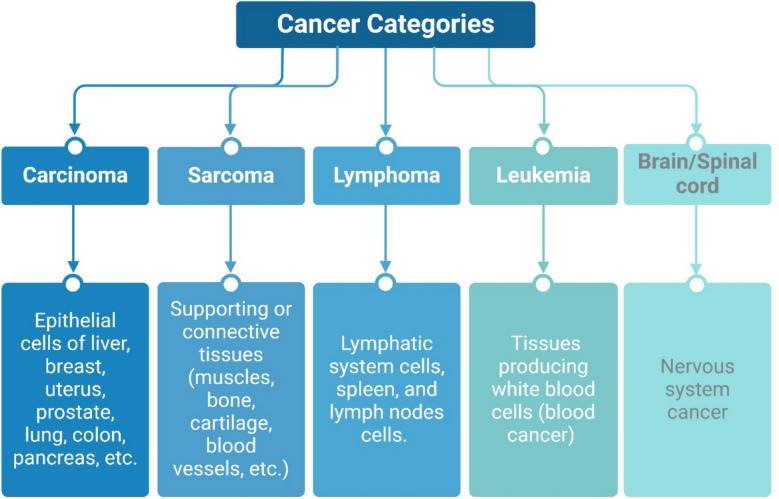
Fig. 1
Fig. 1
Main Cancer Categories. As outlined above, the primary cancer categories are defined based on the specific human tissues they affect
Fig. 2
Fig. 2
Potential applications of cancer biomarkers. Cancer biomarkers can be applied to various cancer control categories during relevant periods, serving as decision-making molecules at the critical stages of pre-diagnosis, diagnosis, prognosis, and treatment of cancers
Fig. 3
Fig. 3
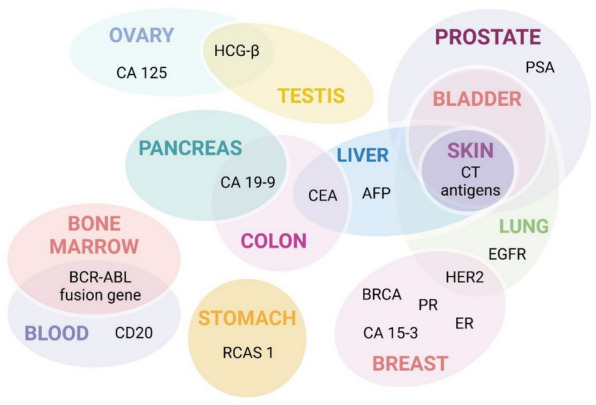
Biomarkers are employed for several cancers. Cancer biomarkers used for clinical application
Fig. 4
Fig. 4
Application of circulating tumor DNA in cancer. In the tumor microenvironment, cells undergo necrosis, apoptosis, pyroptosis, and phagocytosis, releasing their DNA as soluble debris known as circulating tumor DNA (ctDNA) (left). This ctDNA is present in liquid biopsies and has clinical applications in cancer diagnosis, prognosis, and monitoring treatment response (right)
Fig. 5
Fig. 5
Application of extracellular vesicles in cancer. Exosomes are derived not only from intraluminal vesicles within multivesicular bodies (MVBs) but also from the budding of the plasma membrane. Early endosomes mature into late endosomes or multivesicular bodies (MVBs), which can then be directed to either the secretory or degradative pathways. In contrast, microvesicles are produced by direct budding from the cell membrane, while apoptotic bodies form during programmed cell death. Exosomes are spherical structures enclosed by a lipid bilayer and contain a variety of complex molecules, including proteins, mRNA, miRNA, ncRNA, and DNA (left). The initial biofluid sample contains extracellular vesicles (EVs), suspended proteins, and debris. Subsequently, ultracentrifugation results in a pellet of EVs mixed with proteins, which can be further purified using discontinuous ultracentrifugation or density gradient ultracentrifugation. These methods separate proteins and EVs based on their density. Other techniques include ultrafiltration, size exclusion chromatography, and asymmetrical flow field-flow fractionation for separate molecules based on size or hydrodynamic radius. Precipitation-based isolation utilizes compounds such as polyethylene glycol (PEG) to concentrate particles. In contrast, immunoaffinity isolation employs antibodies to capture specific EV populations, though it does not isolate all EV types (right)
Fig. 6
Fig. 6
Liquid biopsy in cancer. Liquid biopsies, such as those obtained from saliva, urine, blood, plasma, and breast milk, have potential clinical value in managing tumors (left). These non-invasive or minimally invasive techniques are primarily being developed to identify biomarkers for early diagnosis, prognosis prediction, and targeted treatments (right)
Fig. 7
Fig. 7
MicroRNA in cancer. MicroRNA (miRNA) genes are transcribed by RNA polymerase II (Pol II) to produce primary transcripts (pri-miRNAs). These are processed by the Drosha complex, generating ~ 70 nucleotide (nt) pre-miRNAs. Pre-miRNAs are recognized by exportin 5 (XPO5) for export to the cytoplasm, where the enzyme Dicer, TRBP (TAR RNA-binding protein; also known as TARBP2), and Argonaute (AGO) 1–4 further process pre-miRNA into miRNA duplexes. The miRNA duplex is incorporated into the RNA-induced silencing complex (RISC), where one strand is removed, leaving a single-stranded miRNA. This miRNA binds to the 3′ UTR of target mRNAs, primarily through its seed sequence, inducing post-transcriptional gene silencing by promoting mRNA degradation and inhibiting translation (top). MicroRNAs are associated with the hallmarks of cancer, influencing specific cellular functions across various cancer types. Frequently, a single microRNA or a set of microRNAs can influence multiple hallmarks, with a dominant mechanism that may vary depending on the tissue type, highlighting the diverse pathways they regulate. The upregulation or downregulation of these microRNAs plays a crucial role in cancer progression (bottom)
Fig. 8
Fig. 8
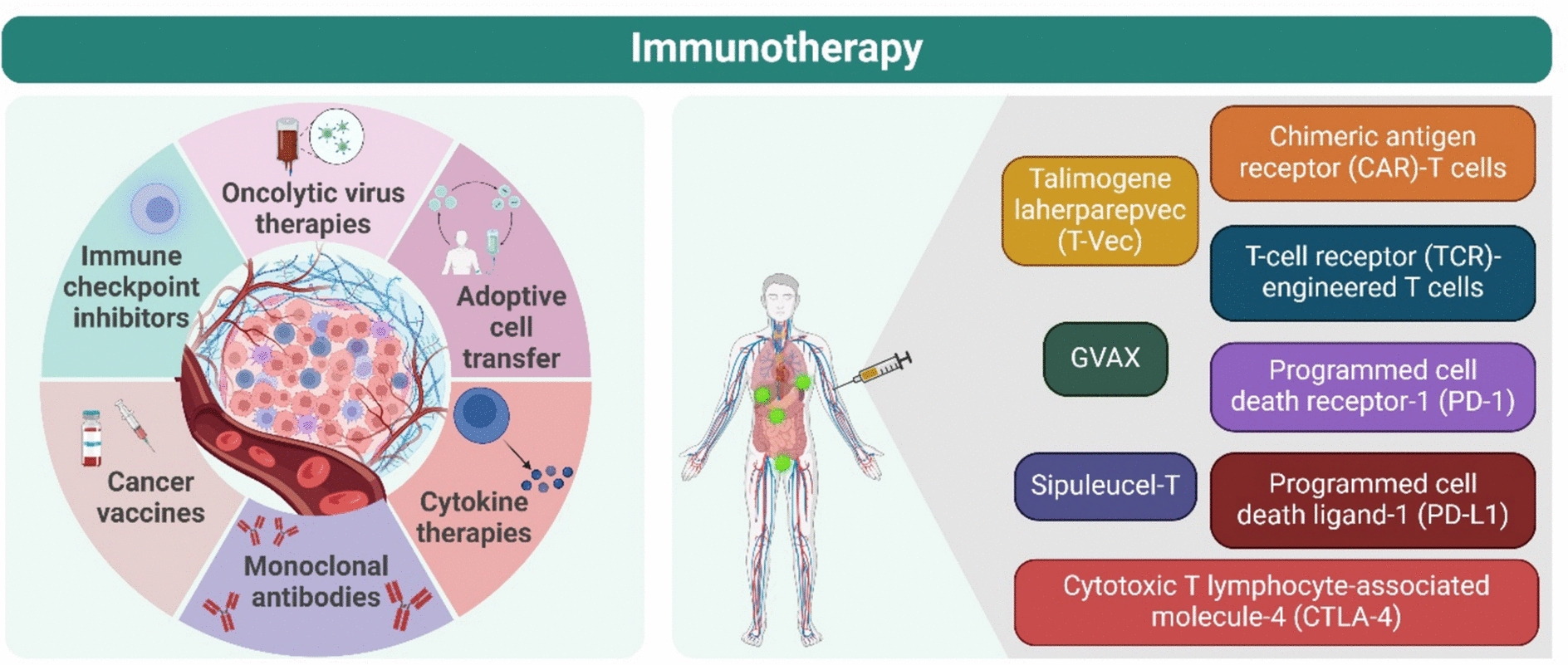
Immunotherapy biomarkers. Major immunotherapy categories included oncolytic virus therapies, immune checkpoint inhibitors (ICIs), cancer vaccines, cytokine therapies, cancer immunotherapy, adoptive cell transfer, and monoclonal antibodies. Oncolytic virus therapies utilize modified viruses to infect and destroy cancer cells, triggering immune responses. For instance, talimogene laherparepvec (T-Vec), a modified herpes virus, is approved for treating advanced melanoma, showcasing the progress made in virus-based cancer treatments. Cancer vaccines activate the immune system by targeting tumor-specific antigens. Critical research identified melanoma antigens that trigger T-cell responses, leading to the development of vaccines targeting these proteins. Dendritic cell (DC)-based vaccines are especially promising, as DCs efficiently present antigens to T cells, enhancing immune responses. Sipuleucel-T, approved for prostate cancer, is one example. Whole tumor cell vaccines, such as GVAX, have also shown potential in treating multiple cancer types. Cytokine therapies: cytokines, immune system messengers, play a crucial role in cancer immunotherapy. Interleukin-2 (IL-2) and interferon-alpha (IFN-α) are key cytokines that stimulate immune responses against cancer. IL-2 helps expand T cells, and high doses have been effectively used to treat metastatic cancers. IFN-α boosts anti-tumor immunity by promoting T-cell activity and tumor cell death. However, their use as monotherapies is limited by toxicity, leading to combination therapies for better outcomes. Adoptive Cell Transfer (ACT) utilizes a patient’s immune cells, particularly T cells, to fight cancer. T cells are expanded or genetically modified outside the body and reinfused to target tumors. Chimeric antigen receptor (CAR)-T cells and T-cell receptor (TCR)-engineered cells are two advanced ACT approaches, both revealing significant success in treating cancers such as leukemia and melanoma. CAR-T cells recognize cancer cell antigens, while TCR-T cells target tumor-specific proteins, resulting in promising clinical outcomes. Immune Checkpoint Inhibitors (ICIs) are a breakthrough in immunotherapy, blocking cancer’s ability to evade immune detection. These therapies target molecules such as CTLA-4, PD-1, and PD-L1, thereby suppressing immune responses. Blocking these pathways reinvigorates T cells to attack tumors. Ipilimumab, a CTLA-4 inhibitor, was the first approved ICI, followed by PD-1 and PD-L1 inhibitors, which have shown remarkable efficacy in treating various cancers
Fig. 9
Fig. 9
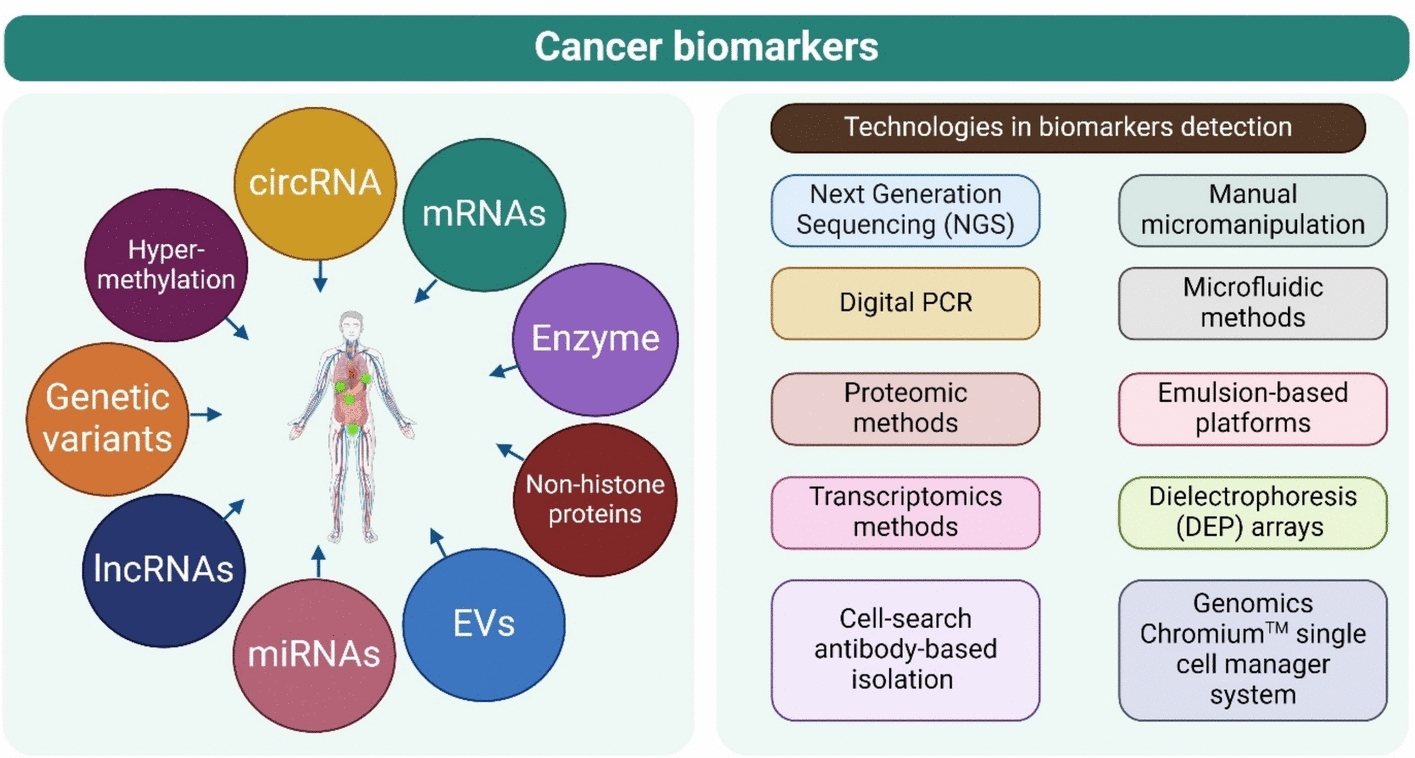
Cancer biomarkers and their advanced technologies for detection

References

    1. Institute NC. Cancer statistics 2024 [Available from: https://www.cancer.gov/about-cancer/understanding/statistics.
    1. Buchanan AH, Lennon AM, Rego SP, Choudhry OA, Elias PZ, Sadler JR, et al. Long-term clinical outcomes of cancers diagnosed following detection by a blood-based multi-cancer early detection (MCED) test. J Clin Oncol. 2023;41(16_suppl):3037.
    1. Isakova Dilnoza B, Farmankulova YR. Innovative Technologies in Early Diagnosis of Precancer and Cancer Diseases of the Cervix. J Med Genet Clin Biol. 2024;1(9):610.
    1. Adil S, Faiz M, Jawad A, Haseeb A, Muhammad A, Adnan A. The role of early diagnosis and intervention in improving outcomes for lung cancer. Innov Res Appl Biol Chem Sci. 2024;2(1):126–32.
    1. Garg P, Mohanty A, Ramisetty S, Kulkarni P, Horne D, Pisick E, et al. Artificial intelligence and allied subsets in early detection and preclusion of gynecological cancers. Biochimica et Biophysica Acta (BBA). 2023;1878(6): 189026. - PubMed

LinkOut - more resources