


Review
doi: 10.1038/s44259-025-00145-9.
Plasmid copy number as a modulator in bacterial pathogenesis and antibiotic resistance
Affiliations
- PMID: 40826263
- PMCID: PMC12361487
- DOI: 10.1038/s44259-025-00145-9
Item in Clipboard
Review
Plasmid copy number as a modulator in bacterial pathogenesis and antibiotic resistance
NPJ Antimicrob Resist.
.
Abstract
Plasmid copy number (PCN), the average number of plasmids per bacterial cell, links gene dosage to key traits such as host fitness, virulence, antibiotic resistance and evolutionary potential. Although often viewed as static, PCN is a dynamic, regulated trait responsive to environmental cues and selection pressures. This review examines the regulatory mechanisms controlling PCN and its impact on the trade-offs between bacterial fitness, virulence cost, and antibiotic resistance.
© 2025. The Author(s).
Conflict of interest statement
Competing interests: The authors declare no competing interests.
Figures
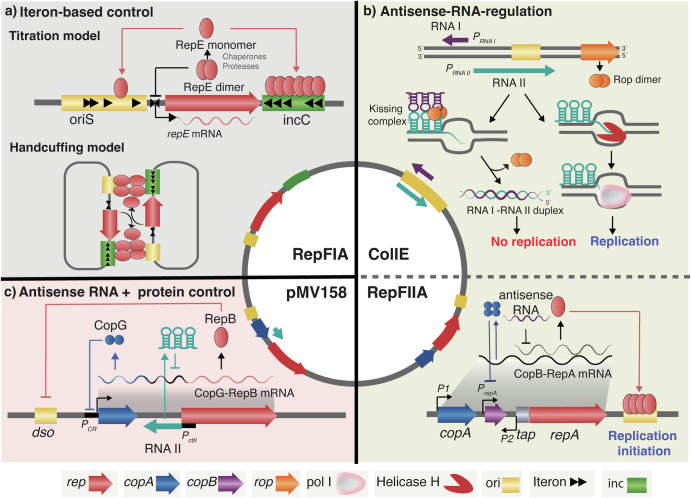
Inner plasmids illustrate the gene organization of minimal regulatory units for each mechanism. a Iteron‑based control: A minimal iteron‑regulated replicon contains an origin of replication (ori) with multiple direct repeats (iterons) that specifically bind Rep monomers. Additional iterons downstream of the rep gene modulate PCN via two non–mutually exclusive mechanisms: titration, where excess iterons sequester free Rep monomers and reduce initiation; and handcuffing, where Rep–iteron complexes from different plasmid molecules interact, forming “handcuffs” that block Rep assembly at the ori. b ColE1‑type antisense RNA control (upper part): The ColE1 plasmid ori drives transcription of an RNA pre‑primer (RNA II), which hybridizes to the template DNA forming R‑loop, and is processed by RNase H, allowing replication to initiate by DNA Pol I. Copy number is limited by RNA I, a 108 bp antisense RNA transcribed convergently. RNA I rapidly base‑pairs with RNA II, aided by the Rop protein, preventing R‑loop formation and primer maturation. Fast turnover of RNA I ensures dynamic regulation in response to physiological conditions. RepFIIA plasmid (lower part): Replication initiates at the ori site downstream of the repA gene, whose translation is coupled to the upstream tap leader peptide. A weak constitutive promoter, P1, drives transcription of the copB–tap–repA operon (copB-repA-mRNA), while a stronger downstream promoter, P2, is kept inactive by CopB repressor binding. CopA antisense RNA inhibits tap translation, indirectly reducing RepA synthesis. c Combined protein–RNA control in pMV158. In the streptococcal plasmid pMV158, repB (encoding initiator) and copG (encoding repressor) form an operon driven by promoter pcr. CopG protein binds pcr to auto‑repress repB transcription. A second promoter, pctII, produces a small antisense RNA (ctRNA II), which binds the leader region of the copG‑repB mRNA, blocking RepB translation. Together, CopG and ctRNA II regulate PCN via coordinated transcriptional and translational repression of the replication initiator,.
References
-
- Nordström, K. Control of plasmid replication-how do DNA iterons set the replication frequency?. Cell63, 1121–1124 (1990). - PubMed
-
- del Solar, G., Acebo, P. & Espinosa, M. Replication control of plasmid pLS1: efficient regulation of plasmid copy number is exerted by the combined action of two plasmid components, CopG and RNA II. Mol. Microbiol.18, 913–924 (1995). - PubMed
-
- Brockhurst, M. A. & Harrison, E. Ecological and evolutionary solutions to the plasmid paradox. Trends Microbiol.30, 534–543 (2022). - PubMed
Publication types
Grants and funding
LinkOut - more resources
Full Text Sources
