


Wild jackdaws learn to tolerate juveniles to exploit new foraging opportunities
- PMID: 40829650
- PMCID: PMC12364576
- DOI: 10.1098/rsbl.2025.0179
Wild jackdaws learn to tolerate juveniles to exploit new foraging opportunities
Abstract
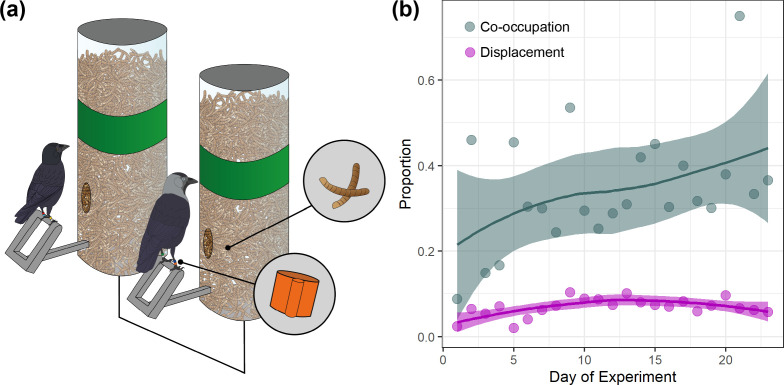
Social tolerance can enhance access to resources and is thought to be crucial in facilitating the evolution of cooperation, social cognition and culture, but it is unknown whether animals can optimize their social tolerance through learning. We presented wild jackdaws (Corvus monedula) with a novel social information problem using automated feeders. Juveniles could always feed (simulating a situation where juveniles were sources of information about a new resource) but adults could only access food if they inhibited their tendency to displace juveniles and instead showed tolerance by occupying an adjacent feeder perch. Accordingly, adults learned to tolerate juveniles, with some evidence they generalized across juveniles as a cohort. The ability to learn to tolerate sources of valuable information, and generalize across cohorts of informed individuals, may facilitate adaptive responses in the face of environmental change and help to explain the success of jackdaws in human-dominated environments.
Keywords: aggression; flexibility; generalization; information use; learning; social; social information; social structure; tolerance.
Conflict of interest statement
We declare we have no competing interests.
Figures

References
-
- Cronin KA, Sánchez A. 2012. Social dynamics and cooperation: the case of nonhuman primates and its implications for human behavior. Adv. Complex Syst. 15, 1250066. ( 10.1142/s021952591250066x) - DOI
-
- Coelho CG, Garcia-Nisa I, Ottoni EB, Kendal RL. 2024. Social tolerance and success-biased social learning underlie the cultural transmission of an induced extractive foraging tradition in a wild tool-using primate. Proc. Natl Acad. Sci. USA 121, e2322884121. ( 10.1073/pnas.2322884121) - DOI - PMC - PubMed
-
- Cieri RL, Churchill SE, Franciscus RG, Tan J, Hare B. 2014. Craniofacial feminization, social tolerance, and the origins of behavioral modernity. Curr. Anthropol. 55, 419–443. ( 10.1086/677209) - DOI
MeSH terms
Grants and funding
LinkOut - more resources
Full Text Sources
