


Associations of adolescent menstrual symptoms with school absences and educational attainment: analysis of a prospective cohort study
- PMID: 40830094
- PMCID: PMC12365126
- DOI: 10.1038/s41539-025-00338-x
Associations of adolescent menstrual symptoms with school absences and educational attainment: analysis of a prospective cohort study
Abstract
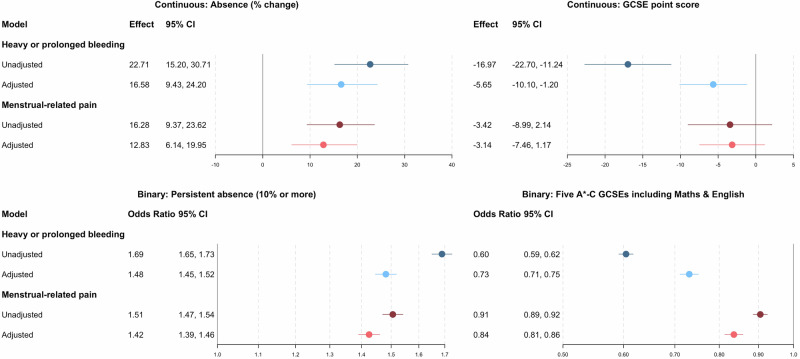
Menstrual symptoms may negatively impact academic achievement, but rigorous population-based studies are lacking. 2,698 participants from the Avon Longitudinal Study of Parents and Children (ALSPAC) self-reported heavy or prolonged bleeding and menstrual pain during adolescence and multivariable regression were used to estimate associations with linked data on absences and attainment at age 15/16, adjusting for confounders. Heavy or prolonged bleeding and pain were associated with missing 1.7 (16.58% increase) and 1.2 (12.83% increase) additional days of school per year, respectively, and 48% and 42% higher odds of persistent (≥10%) absence. Heavy or prolonged bleeding was associated with lower examination scores (-5.7 points) and 27% lower odds of achieving five standard passes. The association between pain and attainment was weaker but still present (-3.14 points; 95% CI: -7.46, 1.17; 16% lower odds of five standard passes). Greater research and support are needed to prevent adolescents' menstrual symptoms impacting their academic achievement.
© 2025. The Author(s).
Conflict of interest statement
Competing interests: The authors declare no competing interests.
Figures

References
-
- Iacovides, S., Avidon, I. & Baker, F. C. What we know about primary dysmenorrhea today: a critical review. Hum. Reprod. Update21, 762–778 (2015). - PubMed
-
- Bitzer, J., Serrani, M. & Lahav, A. Women’s attitudes towards heavy menstrual bleeding, and their impact on quality of life. Open Access J. Contracept.21, 10.2147/oajc.s38993 (2013).
-
- Parker, M. A., Sneddon, A. E. & Arbon, P. The menstrual disorder of teenagers (MDOT) study: Determining typical menstrual patterns and menstrual disturbance in a large population-based study of Australian teenagers. BJOG117, 185–192 (2010). - PubMed
-
- Harlow, S. & Campbell, O. Epidemiology of menstrual disorders in developing countries: a systematic review. BJOG111, 6–16 (2004). - PubMed
-
- Armour, M. et al. The prevalence and academic impact of dysmenorrhea in 21,573 young women: a systematic review and meta-analysis. J. Womens Health28, 1161–1171 (2019). - PubMed
Grants and funding
LinkOut - more resources
Full Text Sources
