


Outcomes of perfluorocarbon liquid vs. posterior retinotomy as adjuncts during pars-plana vitrectomy for the surgical repair of rhegmatogenous retinal detachment: a randomized clinical trial
- PMID: 40830767
- PMCID: PMC12362867
- DOI: 10.1186/s12886-025-04271-w
Outcomes of perfluorocarbon liquid vs. posterior retinotomy as adjuncts during pars-plana vitrectomy for the surgical repair of rhegmatogenous retinal detachment: a randomized clinical trial
Abstract
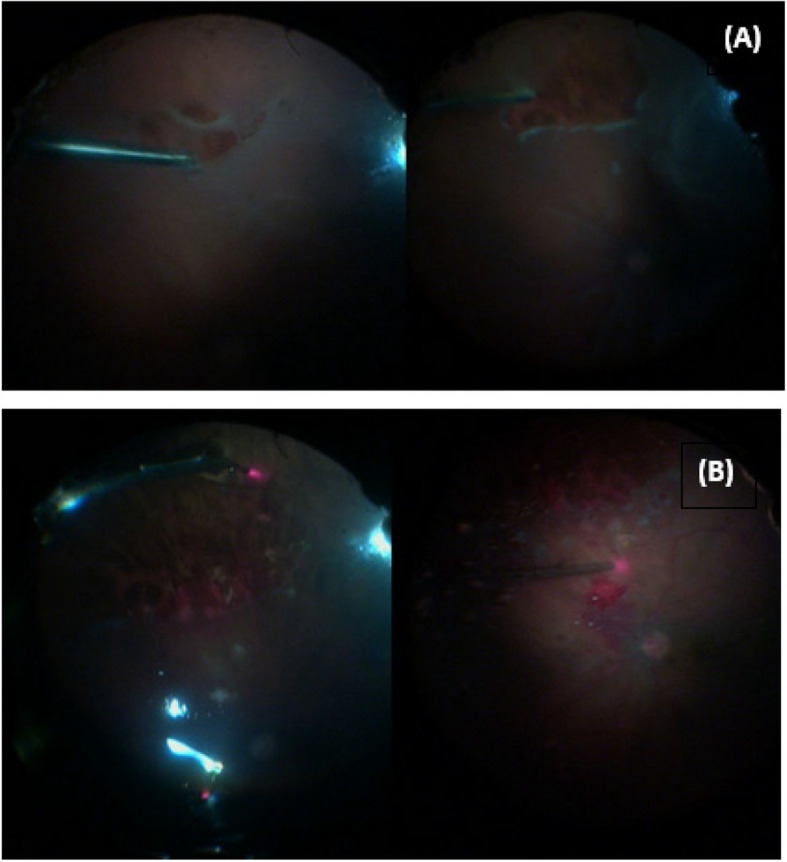
Purpose: Rhegmatogenous retinal detachment (RRD) is a sight-threatening condition requiring prompt surgical intervention. Various adjunctive techniques are employed to enhance subretinal fluid drainage and retinal reattachment. This study aimed to evaluate the outcomes of perfluorocarbon liquid (PFCL) versus posterior retinotomy (PR) during pars plana vitrectomy (PPV) for RRD, focusing on anatomical success, visual acuity, intraocular pressure (IOP), and complications.
Methods: This is a prospective randomized controlled trial that included 58 eyes with RRD, divided into Group A (PFCL, n = 29) and Group B (PR, n = 29). Preoperative assessments included best-corrected visual acuity (BCVA), IOP, axial length, lens status, macula status, and PVR grade. Outcomes were evaluated at 1 week, 1 month, 2 months, and 3 months postoperatively. Primary outcomes included retinal reattachment rates and the number of operations; secondary outcomes included BCVA, IOP changes, complications like cataract development, retinal redetachment, epiretinal membrane (ERM) formation, and single-surgery success.
Results: Retinal reattachment rates were comparable (76% in Group A vs. 66% in Group B, p = 0.387), as well as the number of operations (p = 0.375). Moreover, BCVA improved significantly in both groups (p < 0.05), with no intergroup differences. IOP increased postoperatively in both groups (p < 0.001), with no significant differences. No differences were observed in cataract formation or retinal redetachment. However, ERM incidence was significantly higher in the PR group (27% vs. 11%, p = 0.049).
Conclusion: PFCL and PR are effective for RRD repair, with similar anatomical and visual outcomes. However, PFCL may reduce ERM risk, making it preferable in certain cases. These findings guide surgical decision-making and highlight the need for further research.
Trial registration: The study was retrospectively registered at ClinicalTrials.gov (NCT06919211) on April 4, 2025.
Keywords: Epiretinal membrane; Pars plana vitrectomy; Perfluorocarbon liquid; Posterior retinotomy; Rhegmatogenous retinal detachment.
© 2025. The Author(s).
Conflict of interest statement
Declarations. Ethics approval and consent to participate: This study was conducted following the principles of the Declaration of Helsinki and was approved by the Institutional Review Board (IRB) of the Faculty of Medicine, Al-Azhar University (Approval No. [Ophth._19/2024Med.Research]), Cairo, Egypt. Written informed consent was obtained from all participants before enrollment. Consent for publication: All authors have reviewed and approved the final manuscript for publication. Competing interests: The authors declare no competing interests.
Figures


References
-
- Laíns I, Wang JC, Cui Y, Katz R, Vingopoulos F, Staurenghi G, et al. Retinal applications of swept source optical coherence tomography (OCT) and optical coherence tomography angiography (OCTA). Prog Retin Eye Res. 2021;84: 100951. 10.1016/j.preteyeres.2021.100951. - PubMed
-
- Sen P, Shaikh S, Shetty S, Goswami A, Deshmukh K. Retinal Detachment. Retina: Medical & Surgical Management. 2 ed.: Jaypee Brother Medical Publisher; 2022. p. 449.
-
- Vo LV, Ryan EH, Ryan CM, Shah GK, Gupta OP, Capone A Jr., et al. Posterior retinotomy vs perfluorocarbon liquid to aid drainage of subretinal fluid during primary rhegmatogenous retinal detachment repair (PRO study report no. 10). J VitreoRetin Dis. 2020;4(6):494–8. 10.1177/2474126420941372. - PMC - PubMed
Publication types
MeSH terms
Substances
Associated data
LinkOut - more resources
Full Text Sources
Medical
Research Materials
Miscellaneous
