


Multi-ancestry meta-analysis of keloids uncovers novel susceptibility loci in diverse populations
- PMID: 40835838
- PMCID: PMC12368108
- DOI: 10.1038/s41467-025-62945-x
Multi-ancestry meta-analysis of keloids uncovers novel susceptibility loci in diverse populations
Abstract
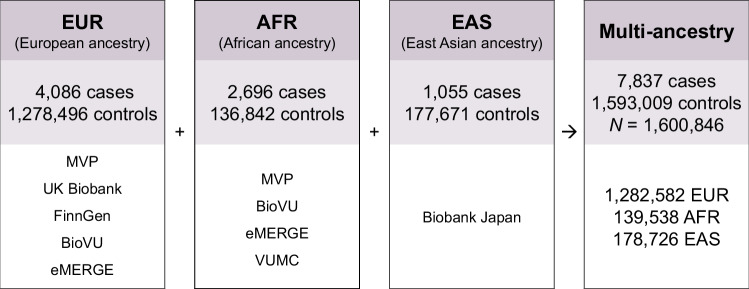
Keloids are raised scars that grow beyond original wound boundaries, resulting in pain and disfigurement. Reasons for keloid development are not well-understood, and current treatment options are limited. Keloids are more likely to occur in darker-skinned individuals of African and Asian descent than in Europeans. We performed a genome-wide association study (GWAS) examining keloid risk across and within continental ancestry groups, incorporating 7837 cases and 1,593,009 controls. We detected 26 loci in the multi-ancestry analysis, 12 of which replicated in an independent dataset. Heritability estimates were 6%, 21%, and 34% for the European, East Asian, and African ancestry analyses, respectively. Genetically predicted gene expression and colocalization analyses identified 27 gene-tissue pairs, nine in skin and fibroblasts. Pathway analyses implicated integrin signaling and upstream regulators involved in cancer, fibrosis, and sex hormone signaling. This investigation nearly quintuples the number of keloid-associated risk loci, illuminating biological processes in keloid pathology.
© 2025. The Author(s).
Conflict of interest statement
Competing interests: The authors declare no competing interests.
Figures


Update of
-
Multi-ancestry meta-analysis of keloids uncovers novel susceptibility loci in diverse populations.medRxiv [Preprint]. 2025 Jan 31:2025.01.28.25321288. doi: 10.1101/2025.01.28.25321288. medRxiv. 2025. Update in: Nat Commun. 2025 Aug 20;16(1):7770. doi: 10.1038/s41467-025-62945-x. PMID: 39974034 Free PMC article. Updated. Preprint.
References
-
- Jeschke, M. G. et al. Scars. Nat. Rev. Dis. Prim.9, 64 (2023). - PubMed
-
- Marneros, A. G. & Krieg, T. Keloids-clinical diagnosis, pathogenesis, and treatment options. J. Dtsch Dermatol Ges.2, 905–913 (2004). - PubMed
-
- Niessen, F. B., Spauwen, P. H., Schalkwijk, J. & Kon, M. On the nature of hypertrophic scars and keloids: a review. Plast. Reconstr. Surg.104, 1435–1458 (1999). - PubMed
Publication types
MeSH terms
Grants and funding
LinkOut - more resources
Full Text Sources
