


Understanding the interplay between epidemiological and social cognitve drivers of behaviour change during the Covid-19 pandemic
- PMID: 40836048
- PMCID: PMC12368148
- DOI: 10.1038/s41598-025-14644-2
Understanding the interplay between epidemiological and social cognitve drivers of behaviour change during the Covid-19 pandemic
Abstract
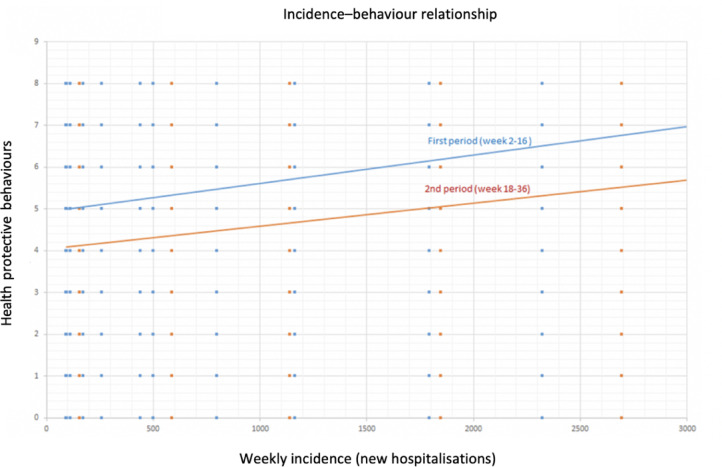
Since the COVID-19 pandemic, there is growing evidence that the social epidemiological context may play a crucial role in the adoption of health protective behaviours in response to emerging infectious diseases. Yet, our understanding of how and why these behaviours are influenced by the epidemiological forces remains relatively limited. This repeated, cross-sectional investigation examines the extent to which the association between the socio-epidemiological context and protective behaviour was mediated by a series of common social cognitive factors from leading models of health behaviour during the COVID-19 epidemic in France. Representative samples of the French population completed an online, self-report survey at seventeen intervals (March-November 2020), with approximately 2000 participants in each survey wave. Results indicate that both contextual and social cognitive variables largely drove the adoption of protective behaviours over time. However, social cognitive variables only partially mediated the effect of the epidemiological context on protective behaviour (physical distancing and hygiene measures), suggesting that unknown factors may be operating in addition to those commonly used in these models. These findings highlight the need for future research to consider the epidemiological context, and further possible mediating variables, when modelling determinants of social cognitions and preventive behaviour, and above all, to broaden its focus to include neglected underlying psychological mechanisms involved in the behavioural response to epidemics.
Keywords: COVID-19; Epidemic context; Epidemiological context; France; Protective behaviours; Social cognitive factors.
© 2025. The Author(s).
Conflict of interest statement
Declarations. Competing interests: The authors declare no competing interests. Ethical approval: This study was conducted in compliance with the French national guidelines for ethical research in the social and human sciences. The research was declared to the EHESP School of Public Health Office for Personal Data Protection (Rennes, France) [Reference: MR 2510110520], and approved by the ethics committee of the University Hospital Institute, Méditerranée Infection (Marseille France) [Decision No. 2020-022]. Informed consent was obtained from participants.
Figures


References
-
- Schneider, C. R. et al. COVID-19 risk perception: a longitudinal analysis of its predictors and associations with health protective behaviours in the united Kingdom. J. Risk Res.24 (3–4), 294–313. 10.1080/13669877.2021.1890637 (2021). - DOI
MeSH terms
Grants and funding
LinkOut - more resources
Full Text Sources
Medical
