


Dietary risk factors and cancer mortality burden from 1990 to 2021: a comparative study of China and global regions with varying sociodemographic development levels based on the Global Burden of Disease database
- PMID: 40837434
- PMCID: PMC12360945
- DOI: 10.3389/fnut.2025.1628792
Dietary risk factors and cancer mortality burden from 1990 to 2021: a comparative study of China and global regions with varying sociodemographic development levels based on the Global Burden of Disease database
Abstract
Objective: To analyze temporal trends of diet-attributable cancer mortality in China (1990-2021), compare patterns between China and regions with varying development levels, and explore gender-specific characteristics to inform targeted prevention strategies.
Study design: Cross-sectional and time-series analyses.
Methods: We conducted cross-sectional and time-series analyses of nine dietary risk factors across China, the global region, and five Socio-demographic Index (SDI) - stratified regions. Joinpoint regression models quantified temporal trends through Annual Percent Change (APC) and Average Annual Percent Change (AAPC).
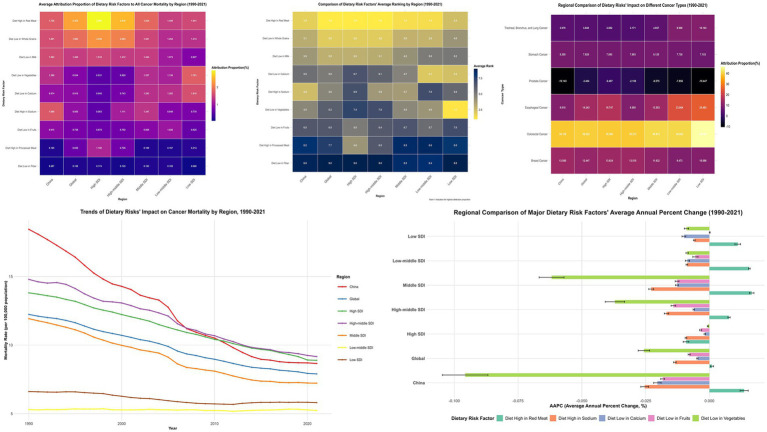
Results: Diet-attributable cancer deaths in China decreased from 9.9% (95% CI: 2.2-20.5%) to 6.3% (95% CI: 2.1-12.8%) during 1990-2021. China's 2021 attribution (6.3%) was below the global average (6.8%), exceeding high-SDI regions (5.8%) but below middle-SDI regions (7.4%). Low vegetable intake showed the largest decline (3.0 to 0.3%), while high red meat consumption increased (1.6 to 2.0%). Red meat's impact was greater in females, while inadequate plant consumption affected males more significantly. Dietary factors most influenced colorectal cancer in China (39.2%). China's diet-attributable cancer mortality decreased by 53.0% (from 18.4 to 8.7 per 100,000), exceeding global reductions (35.5%).
Conclusion: This study identified distinct regional patterns in diet-attributable cancer mortality. China's profile reflects its transition between development levels-decreasing vegetable-deficiency risks while increasing red meat consumption. Globally, attribution patterns are shifting from plant food inadequacy toward animal product excess, with persistent gender disparities.
Keywords: Global Burden of Disease (GBD); cancer mortality; dietary risk factors; regional comparison; socio-demographic index.
Copyright © 2025 Zhao, Ruan, Xiang, Zhang, Yang and Wang.
Conflict of interest statement
The authors declare that the research was conducted in the absence of any commercial or financial relationships that could be construed as a potential conflict of interest.
Figures



References
-
- World Cancer Report . Cancer research for cancer prevention. Lyon (FR): International Agency for Research on Cancer; (2020). - PubMed
-
- Abbasi-Kangevari M, Abd-Allah F, Adekanmbi V, GBD 2019 Risk Factors Collaborators . Global burden of 87 risk factors in 204 countries and territories, 1990–2019: a systematic analysis for the global burden of disease study 2019. Lancet. (2020) 396:1223–49. doi: 10.1016/S0140-6736(20)30752-2 - DOI - PMC - PubMed
LinkOut - more resources
Full Text Sources
