


Associated factors of spontaneous reperfusion in patients with acute ST-segment elevation myocardial infarction before primary percutaneous coronary intervention
- PMID: 40837650
- PMCID: PMC12361933
- DOI: 10.4314/ahs.v25i2.12
Associated factors of spontaneous reperfusion in patients with acute ST-segment elevation myocardial infarction before primary percutaneous coronary intervention
Abstract
Background: This is a retrospective analysis of the relationship between preoperative factors and spontaneous reperfusion (SR) in infarct-related arteries (IRAs) in patients with ST-segment elevation myocardial infarction (STEMI) undergoing percutaneous coronary intervention (PCI).
Methodology: 834 patients who were classified into the SR group (TIMI flow grade 2-3) and non-spontaneous reperfusion (NSR) group (TIMI flow grade 0-1) based on coronary angiography. The baseline characteristics and preoperative factors of the two groups were analyzed.
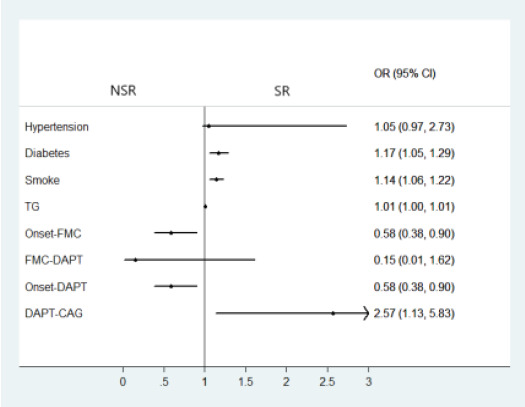
Results: Compared with the NSR group, the SR group had shorter time from symptom onset to first medical contact (P=0.002) and from symptom onset to antiplatelet loading (P=0.003), however, there was no statistically significant difference in the mode of admission and loading of antiplatelet drugs between the two groups. Multivariate logistic regression analysis indicated that diabetes history, smoking history, triglyceride level, time from symptom onset to first medical contact, time from symptom onset to antiplatelet loading, and time from antiplatelet loading to coronary angiography were all factors influencing SR were all factors influencing SR.
Conclusion: The occurrence of SR is related to early medical contact and timely use of antiplatelet drugs. Patients with diabetes history, smoking history, higher triglyceride level may benefit more.
Keywords: Acute ST-segment elevation myocardial infarction; preoperative factors; spontaneous reperfusion.
© 2025 He W et al.
Conflict of interest statement
The authors declared no conflict of interest.
Figures
References
-
- Hu S, Yang Y, Liu L, et al. [Summary of the 2018 Report on Cardiovascular Diseases in China] Chinese Circukiticn Journal. 2019;034(003):209–220.
-
- Puymirat E, Simon T, Steg PG, Schiele F, Gueret P, Blanchard D, et al. Association of changes in clinical characteristics and management with improvement in survival among patients with ST-elevation myocardial infarction. JAMA-J Am Med Assoc. 2012;308:998–1006. - PubMed
-
- Gale CP, Allan V, Cattle BA, Hall AS, West RM, Timmis A, et al. Trends in hospital treatments, including revascularisation, following acute myocardial infarction, 2003-2010: a multilevel and relative survival analysis for the National Institute for Cardiovascular Outcomes Research (NICOR) Heart. 2014;100:582–589. - PubMed
-
- [2019 Chinese Society of Cardiology (CSC) guidelines for the diagnosis and management of patients with ST-segment elevation myocardial infarction] Zhonghua Xin Xue Guan Bing Za Zhi. 2019;47:766–783. - PubMed
MeSH terms
Substances
LinkOut - more resources
Full Text Sources
Research Materials
Miscellaneous