


Association between metabolism and low back pain: a cross-sectional study
- PMID: 40841650
- PMCID: PMC12369122
- DOI: 10.1186/s13018-025-06218-9
Association between metabolism and low back pain: a cross-sectional study
Abstract
Background: While pervious studies have identified metabolic imbalance as a key driver of intervertebral disc degeneration, few studies explored the relationship between metabolic and low back pain directly. We aimed to explore the relationships between two critical metabolic factors-insulin resistance and obesity-and low back pain (LBP), thereby providing novel insights for the integrated management of patients with LBP.
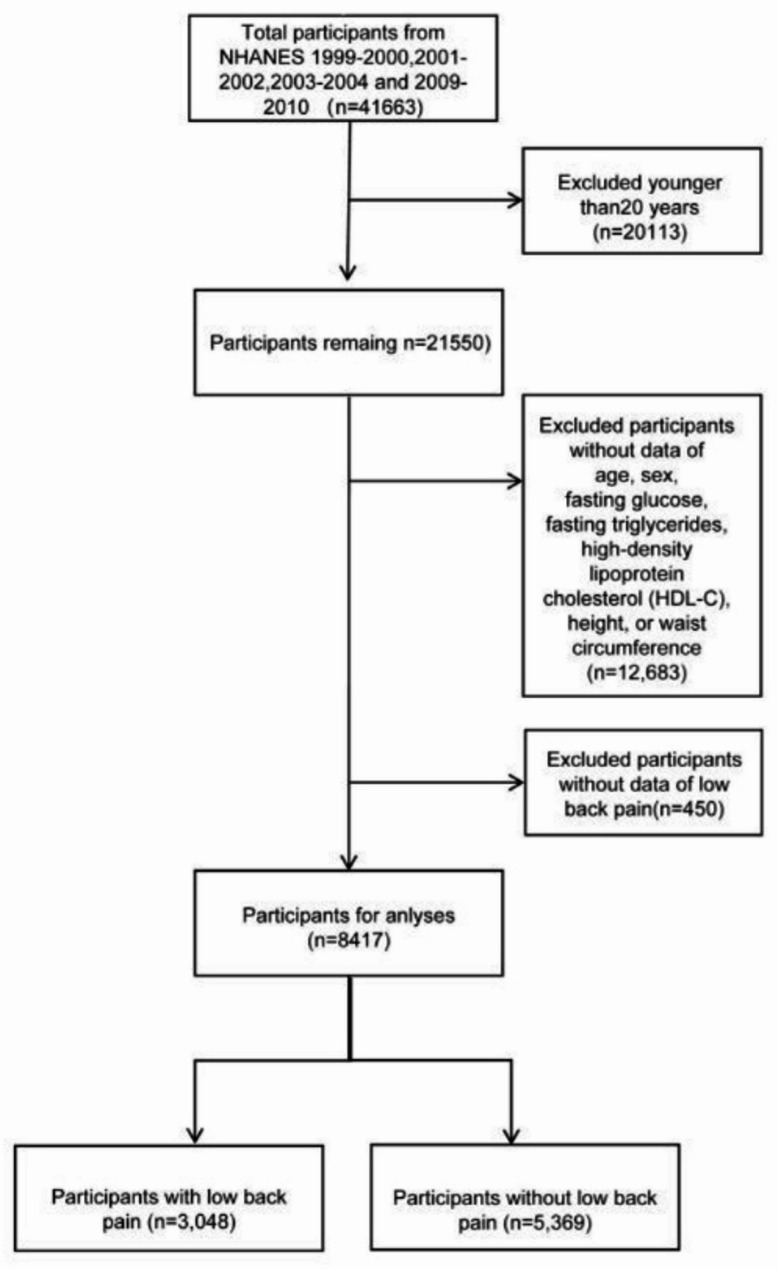
Methods: We enrolled 41663 participants from four NHANES survey cycles (1999-2004 and 2009-2010). The Metabolic Score for Insulin Resistance (METS-IR) and Body Roundness Index (BRI) were utilized to investigate the associations of insulin resistance and visceral obesity with LBP.Weighted logistic regression models were constructed to evaluate associations between MetS-IR/BRI and LBP, reported as odds ratios (ORs) with 95% confidence intervals (CIs). Using Restricted Cubic Splines (RCS) to assess potential nonlinear relationships. ROC curve analysis quantified diagnostic performance through area under the curve (AUC) estimation. Subgroup analyses and interaction tests were conducted to ensure the robustness of the findings.
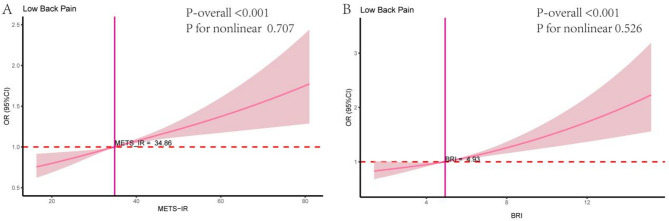
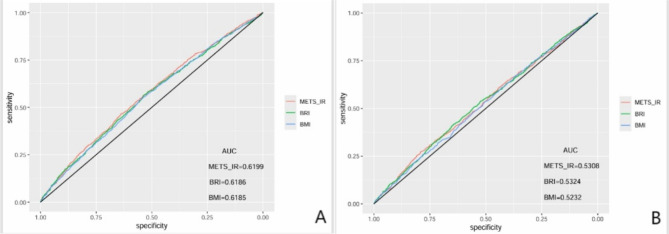
Results: Multivariable regression analysis revealed significant positive associations between MetS-IR/BRI and LBP after adjusting for all potential confounders (MetS-IR: OR = 1.013, 95% CI: 1.008-1.018; BRI: OR = 1.072, 95% CI: 1.047-1.098) and these associations remained consistent across all subgroups. RCS analysis revealed no significant nonlinear associations between the METS-IR, BRI and LBP. In the ROC analysis, METS-IR showed the highest area under the ROC curve in females, followed by BRI and BMI.
Conclusions: In conclusion, within a nationally representative sample of U.S. adults with low back pain, we identified significant positive correlations between METS-IR/BRI and LBP. These findings underscore the importance of maintaining healthy metabolic status, providing valuable insights for further research.
Keywords: BRI; Cross sectional study; Insulin resistance; Low back pain; METS-IR; NHANES.
© 2025. The Author(s).
Conflict of interest statement
Declarations. Ethics approval and consent to participate: The study was approved by the Ethics Review Board of the National Center for Health Statistics (NCHS), and all participants signed informed consent.This study used previously collected deidentified data, which was deemed exempt from review by the Ethics Committee of qilu hospital, shandong university. Competing interests: The authors declare no competing interests.
Figures

References
-
- Knezevic NN, et al. Low back pain. Lancet. 2021;398(10294):78–92. - PubMed
-
- Shim GY, et al. Global, regional, and National burden of spine pain, 1990–2019: A systematic analysis of the global burden of disease study 2019. Arch Phys Med Rehabil. 2024;105(3):461–9. - PubMed
-
- Vlaeyen JWS, et al. Low back pain. Nat Rev Dis Primers. 2018;4(1):52. - PubMed
-
- Hartvigsen J, et al. What low back pain is and why we need to pay attention. Lancet. 2018;391(10137):2356–67. - PubMed
MeSH terms
Grants and funding
LinkOut - more resources
Full Text Sources
Miscellaneous
