


Clinical course and management challenges in Lafora disease: a narrative analysis in an Apulian cohort
- PMID: 40841971
- PMCID: PMC12369230
- DOI: 10.1186/s13023-025-03976-x
Clinical course and management challenges in Lafora disease: a narrative analysis in an Apulian cohort
Abstract
Background: Lafora disease (LD) is an ultra-rare, autosomal recessive neurodegenerative disorder characterized by the accumulation of Lafora bodies in the brain, leading to drug-resistant epilepsy, myoclonus, progressive dementia, and cerebellar dysfunction. This retrospective study describes the clinical course and management challenges of LD in a cohort of patients from the Apulia region of Southern Italy, where the disease prevalence appears to be higher than in other populations.
Methods: We retrospectively analyzed clinical, electroencephalographic, and management data from six unrelated families with a confirmed diagnosis of LD, followed at the Neurology Unit of the Scientific Institute Casa Sollievo della Sofferenza Hospital between 2010 and 2024. Demographic information, clinical presentation, treatment history, disease progression, and outcomes were collected.
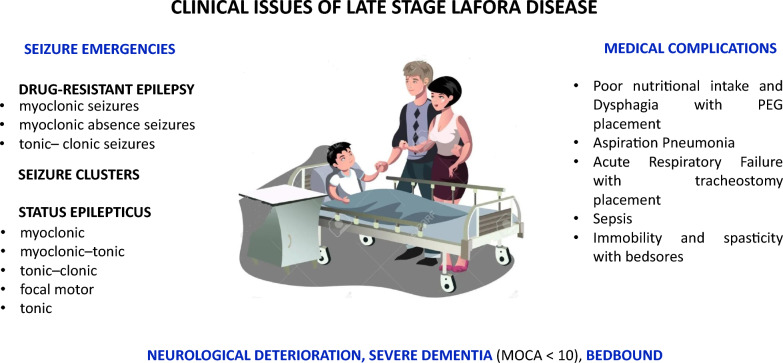
Results: Our analysis identified three distinct electroclinical stages: an initial Presenting Symptoms Stage with the onset of seizures and subsequent development of myoclonus; a Progressive Neurodegeneration Stage characterized by drug-resistant epilepsy, dementia, and ataxia; and a Terminal Stage marked by severe disability, frequent seizure emergencies, and medical complications. Management in the late stages proved particularly challenging, requiring a multidisciplinary approach to address refractory seizures, status epilepticus, and medical complications such as aspiration pneumonia and respiratory failure. Home-based care, with specialized team support, played a crucial role in minimizing hospitalizations.
Discussion: Our findings underscore the importance of early diagnosis and a multidisciplinary approach in the management of LD. The late stages of the disease are characterized by significant clinical challenges necessitating close collaboration among neurologists, epileptologists, and other healthcare professionals, supported by effective home-based care. The apparent higher prevalence in Apulia warrants further investigation into potential genetic or environmental factors.
Conclusion: This study highlights the significant clinical burden of LD and emphasizes the importance of multidisciplinary management, particularly in the advanced stages. Home-based care supported by specialized teams and caregivers is essential for optimizing patient well-being. Further research is needed to identify early biomarkers and develop targeted therapies for this devastating condition.
Keywords: Electroclinical features; Lafora disease; Late stage; Management; Medical complications; Status epilepticus.
© 2025. The Author(s).
Conflict of interest statement
Declarations. Ethical approval and consent to participate: Not applicable. Consent for publication: Not applicable. Conflicts of interest: We declare that there are no conflicts of interest. We confirm that we have read the Journal’s position on issues involved in ethical publication and affirm that this report is consistent with those guidelines.
Figures

References
-
- d’Orsi G, Lalla A, Palumbo O, Di Claudio MT, Valenzano A, Sabetta A, Lopopolo A, Di Muro E, Palumbo P, Copetti M, Carella M, Avolio A. The presenting symptoms of Lafora disease: an electroclinical and genetic study in five Apulian (Southern Italy) families. Seizure. 2020;83:145–53. - PubMed
-
- Tassinari CA, Bureau-Paillas M, Dalla Bernardina B, Picornell-Darder I, Mouren MC, Dravet C, Roger J. La Maladie de Lafora. Rev EEG Neurophysiol. 1978;1:107–22. - PubMed
MeSH terms
Substances
LinkOut - more resources
Full Text Sources
Medical
Research Materials
