


Diagnostic Prediction Models for Primary Care, Based on AI and Electronic Health Records: Systematic Review
- PMID: 40845324
- PMCID: PMC12373303
- DOI: 10.2196/62862
Diagnostic Prediction Models for Primary Care, Based on AI and Electronic Health Records: Systematic Review
Abstract
Background: Artificial intelligence (AI)-based diagnostic prediction models could aid primary care (PC) in decision-making for faster and more accurate diagnoses. AI has the potential to transform electronic health records (EHRs) data into valuable diagnostic prediction models. Different prediction models based on EHR have been developed. However, there are currently no systematic reviews that evaluate AI-based diagnostic prediction models for PC using EHR data.
Objective: This study aims to evaluate the content of diagnostic prediction models based on AI and EHRs in PC, including risk of bias and applicability.
Methods: This systematic review was performed according to the PRISMA (Preferred Reporting Items for Systematic Reviews and Meta-Analyses) guidelines. MEDLINE, Embase, Web of Science, and Cochrane were searched. We included observational and intervention studies using AI and PC EHRs and developing or testing a diagnostic prediction model for health conditions. Two independent reviewers (LH and AC) used a standardized data extraction form. Risk of bias and applicability were assessed using PROBAST (Prediction Model Risk of Bias Assessment Tool).
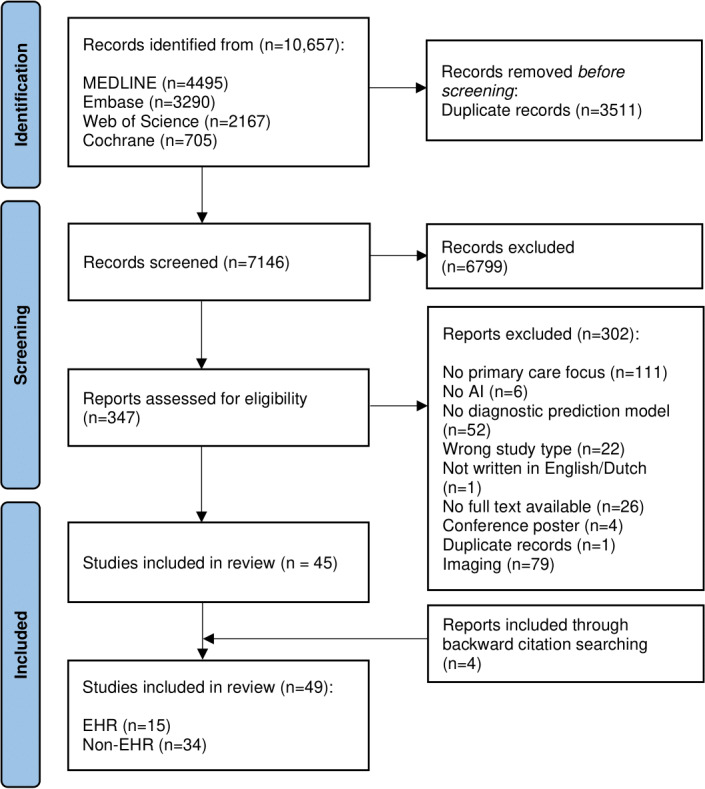
Results: From 10,657 retrieved records, a total of 15 papers were selected. Most EHR papers focused on 1 chronic health care condition (n=11, 73%). From the 15 papers, 13 (87%) described a study that developed a diagnostic prediction model and 2 (13%) described a study that externally validated and tested the model in a PC setting. Studies used a variety of AI techniques. The predictors used to develop the model were all registered in the EHR. We found no papers with a low risk of bias, and high risk of bias was found in 9 (60%) papers. Biases covered an unjustified small sample size, not excluding predictors from the outcome definition, and the inappropriate evaluation of the performance measures. The risk of bias was unclear in 6 papers, as no information was provided on the handling of missing data and no results were reported from the multivariate analysis. Applicability was unclear in 10 (67%) papers, mainly due to lack of clarity in reporting the time interval between outcomes and predictors.
Conclusions: Most AI-based diagnostic prediction models based on EHR data in PC focused on 1 chronic condition. Only 2 papers tested the model in a PC setting. The lack of sufficiently described methods led to a high risk of bias. Our findings highlight that the currently available diagnostic prediction models are not yet ready for clinical implementation in PC.
Keywords: AI; AI-based diagnostic; EHR; applicability; artificial intelligence; assessment tool; decision-making; electronic health records; primary care; systematic review.
© Liesbeth Hunik, Asma Chaabouni, Twan van Laarhoven, Tim C olde Hartman, Ralph T H Leijenaar, Jochen W L Cals, Annemarie A Uijen, Henk J Schers. Originally published in JMIR Medical Informatics (https://medinform.jmir.org).
Conflict of interest statement
Figures
References
-
- Collins GS, Dhiman P, Andaur Navarro CL, et al. Protocol for development of a reporting guideline (TRIPOD-AI) and risk of bias tool (PROBAST-AI) for diagnostic and prognostic prediction model studies based on artificial intelligence. BMJ Open. 2021 Jul 9;11(7):e048008. doi: 10.1136/bmjopen-2020-048008. doi. Medline. - DOI - PMC - PubMed
Publication types
MeSH terms
LinkOut - more resources
Full Text Sources
