


Cascade amplification of therapeutic payloads for cancer immunotherapy
- PMID: 40851032
- PMCID: PMC12375736
- DOI: 10.1038/s42003-025-08735-z
Cascade amplification of therapeutic payloads for cancer immunotherapy
Abstract
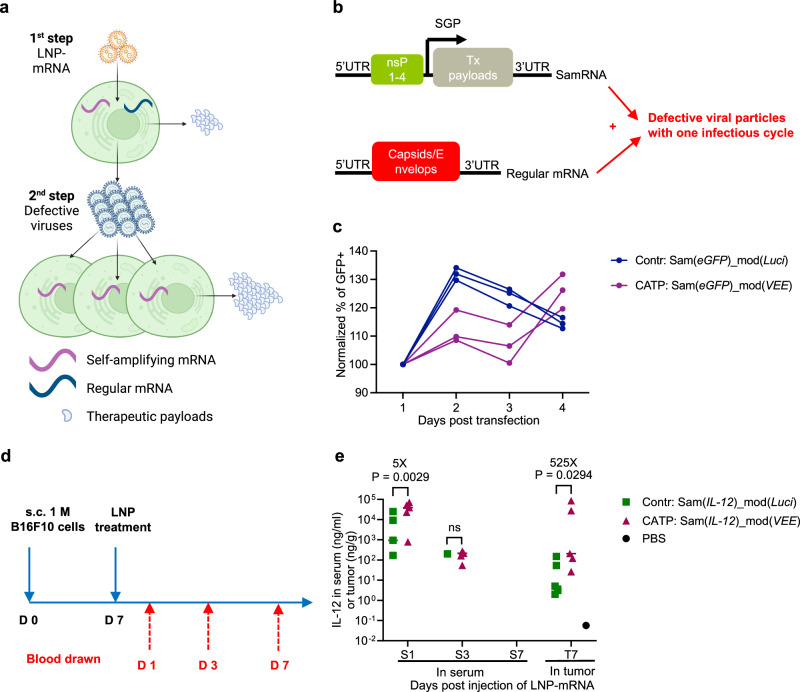
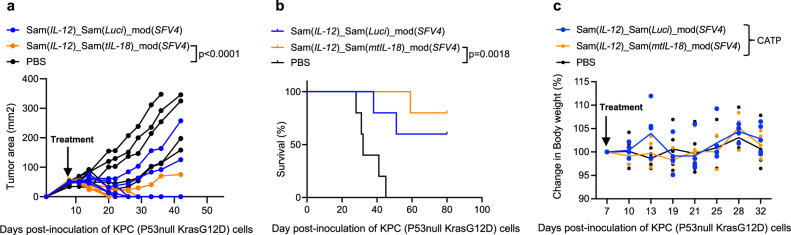
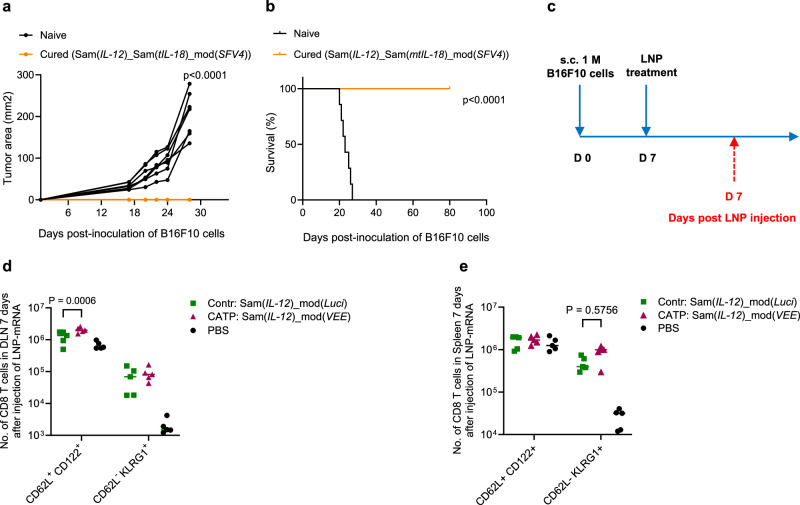
Achieving sufficient therapeutic payload delivery remains a significant challenge in gene therapy, particularly for cancer immunotherapy, where payload thresholds are critical for efficacy. To address this, we developed a Cascade Amplification of Therapeutic Payloads (CATP) system, leveraging lipid nanoparticles (LNPs) to co-deliver self-amplifying mRNA (SamRNA) and modified mRNA encoding alphavirus capsids and envelopes. The CATP system initiates a dual-amplification process: SamRNA amplifies therapeutic payloads within transfected cells, while capsid and envelope proteins package SamRNA into defective viral particles to infect neighboring cells, enabling secondary payload amplification. This single-cycle infection ensures enhanced efficacy while maintaining safety. In vitro and in vivo studies demonstrated the CATP system's superiority over conventional SamRNA delivery. In a B16F10 melanoma model, CATP achieved a 525-fold increase in intratumoral IL-12 levels, resulting in tumor regression and long-term immune memory. The platform also showed broad applicability, effectively treating MC38 colorectal cancer, CT26 colon cancer, and P53null KrasG12D pancreatic ductal adenocarcinoma. Additionally, optimization of therapeutic payloads with mutant IL-18 further enhanced anti-tumor efficacy. The CATP system represents a transformative approach to gene therapy, providing a scalable, safe, and potent platform for cancer immunotherapy. Its dual-amplification strategy offers new opportunities for overcoming payload limitations across diverse malignancies.
© 2025. The Author(s).
Conflict of interest statement
Competing interests: Y.L. and L.Z. are inventors patent of WO2025010420A2 “Compositions and methods for delivering molecules”, which invented the mRNA delivery ionizable lipid P6 for this study; patent of WO2023220693A1 “Synthetic self-amplifying mRNA molecules with secretion antigen and immunomodulator”, which invented one of the self-amplifying mRNA for this study; patent of Methods for cascade amplifications of PCT/US2025/019051 “Therapeutic payloads (CATP) & compositions for cancer immunotherapies and gene therapy” for this study. The other authors declare no competing interests.
Figures


References
-
- Kariko, K., Ni, H., Capodici, J., Lamphier, M. & Weissman, D. mRNA is an endogenous ligand for Toll-like receptor 3. J. Biol. Chem.279, 12542–12550 (2004). - PubMed
-
- Kariko, K., Buckstein, M., Ni, H. & Weissman, D. Suppression of RNA recognition by Toll-like receptors: the impact of nucleoside modification and the evolutionary origin of RNA. Immunity23, 165–175 (2005). - PubMed
MeSH terms
Substances
LinkOut - more resources
Full Text Sources
Medical
Research Materials
Miscellaneous
